Floor plan

Artist galleriesJohn Vanderlyn's contemporaries
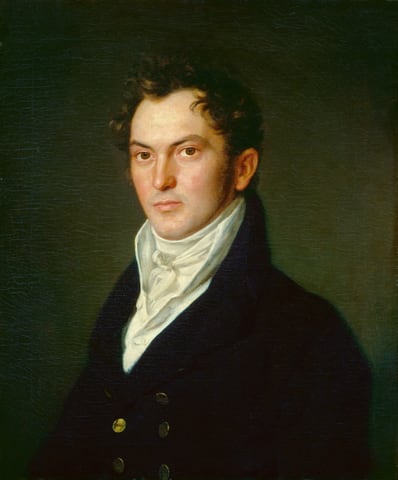
John Vanderlyn's contemporaries
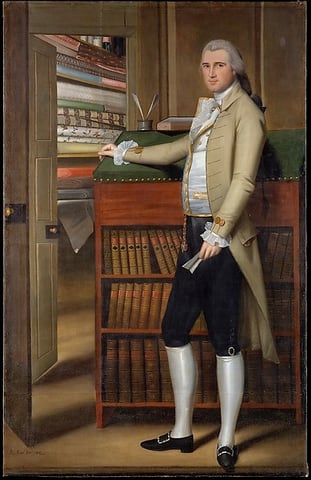
Elijah Boardman, by Ralph Earl, 1789
The image shows a man depicted from the waist up, positioned slightly turned to the side yet facing the viewer directly. He has a composed expression with defined facial features, including a high forehead, strong eyebrows, prominent cheekbones, and a clean-shaven face. His hair is dark and curly, styled away from his forehead. He is dressed in a dark coat featuring a double-breasted design with gold buttons, complemented by a high-collared, white cravat intricately tied at his neck. In the background, there is a subtle, dark, greenish hue.
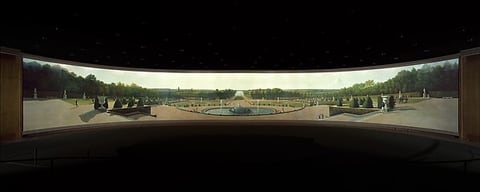
Panoramic View of the Palace and Gardens of Versailles, by John Vanderlyn, 1818–19
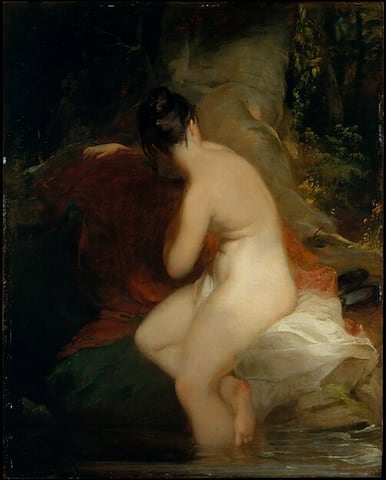
Musidora, by Thomas Sully, 1813–35
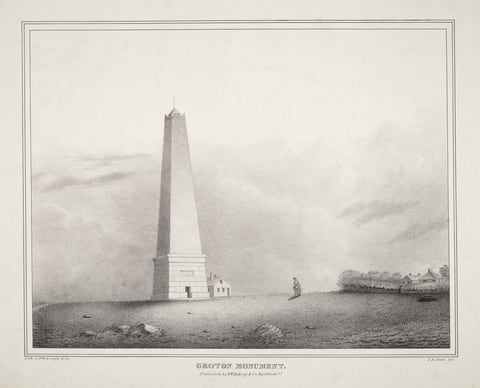
The image shows a scene from a slightly elevated point of view. The horizon is low, highlighting the vast sky above. On the right, there are buildings surrounded by trees. In the center, there is a tall monument with a small structure at its base, slightly to the left. To the right of the monument, a person is standing. The drawing features detailed linework and delicate shading for the sky. The color palette is monochromatic with shades of gray. Rocks and grass in the foreground lead towards the monument and buildings in the distance.
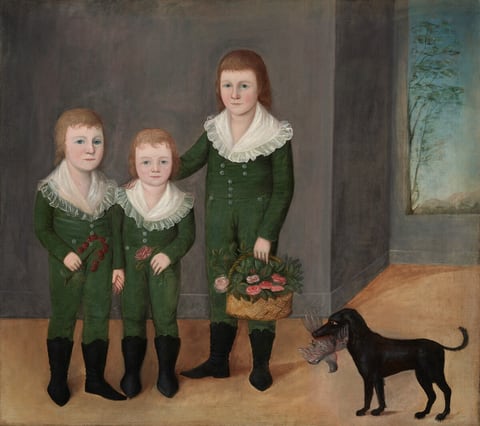
Three pale-skinned, blue-eyed children wearing green suits stand in a row facing us in this horizontal portrait painting. They all have round faces and full, pink cheeks. The tallest child is to the right, and he has shoulder-length cinnamon-brown hair. The other two come up to his shoulder and have blond hair. The tallest puts one arm on the far shoulder of the middle child, and the two smaller children hold hands. Each wears a pine-green, one-piece outfit with pewter-gray buttons, a wide, ivory-white collar lined with ruffles, and black, shin-high boots. The boy on our left holds a branch of dark red cherries. The middle child holds a pink rose, and the tallest a basket filled with pink roses. A black dog holding a gray and mauve-pink bird in its mouth stands in profile facing our left in the lower right corner of the canvas. The room around them has a tan-colored floor and gray walls. The room opens onto an alcove to our right with a rectangular window. A slender tree is along the left edge of the opening and a few pale, pink-tinged gray mountains line the bottom edge. Clear blue sky fills the rest of the window.

The works in this room are listed below.

Works in this room

A few works by John Vanderlyn, then their contemporaries: makers of the same nationality born within 25 years of them, then works from the same century and place.

First room, north wall

  1. Elijah Boardman, by Ralph Earl, 1789
    Elijah BoardmanRalph Earl, 1789Courtesy of The Metropolitan Museum of Art
  2. The image shows a man depicted from the waist up, positioned slightly turned to the side yet facing the viewer directly. He has a composed expression with defined facial features, including a high forehead, strong eyebrows, prominent cheekbones, and a clean-shaven face. His hair is dark and curly, styled away from his forehead. He is dressed in a dark coat featuring a double-breasted design with gold buttons, complemented by a high-collared, white cravat intricately tied at his neck. In the background, there is a subtle, dark, greenish hue.
    Zachariah SchoonmakerJohn Vanderlyn, 1815/1818Courtesy National Gallery of Art, Washington
  3. Panoramic View of the Palace and Gardens of Versailles, by John Vanderlyn, 1818–19
    Panoramic View of the Palace and Gardens of VersaillesJohn Vanderlyn, 1818–19Courtesy of The Metropolitan Museum of Art

First room, south wall

  1. Musidora, by Thomas Sully, 1813–35
    MusidoraThomas Sully, 1813–35Courtesy of The Metropolitan Museum of Art
  2. The image shows a scene from a slightly elevated point of view. The horizon is low, highlighting the vast sky above. On the right, there are buildings surrounded by trees. In the center, there is a tall monument with a small structure at its base, slightly to the left. To the right of the monument, a person is standing. The drawing features detailed linework and delicate shading for the sky. The color palette is monochromatic with shades of gray. Rocks and grass in the foreground lead towards the monument and buildings in the distance.
    Groton MonumentJ.R. Butts, c. 1830-1840Courtesy National Gallery of Art, Washington
  3. Three pale-skinned, blue-eyed children wearing green suits stand in a row facing us in this horizontal portrait painting. They all have round faces and full, pink cheeks. The tallest child is to the right, and he has shoulder-length cinnamon-brown hair. The other two come up to his shoulder and have blond hair. The tallest puts one arm on the far shoulder of the middle child, and the two smaller children hold hands. Each wears a pine-green, one-piece outfit with pewter-gray buttons, a wide, ivory-white collar lined with ruffles, and black, shin-high boots. The boy on our left holds a branch of dark red cherries. The middle child holds a pink rose, and the tallest a basket filled with pink roses. A black dog holding a gray and mauve-pink bird in its mouth stands in profile facing our left in the lower right corner of the canvas. The room around them has a tan-colored floor and gray walls. The room opens onto an alcove to our right with a rectangular window. A slender tree is along the left edge of the opening and a few pale, pink-tinged gray mountains line the bottom edge. Clear blue sky fills the rest of the window.
    The Westwood ChildrenJoshua Johnson, c. 1807Courtesy National Gallery of Art, Washington

Second room, south wall
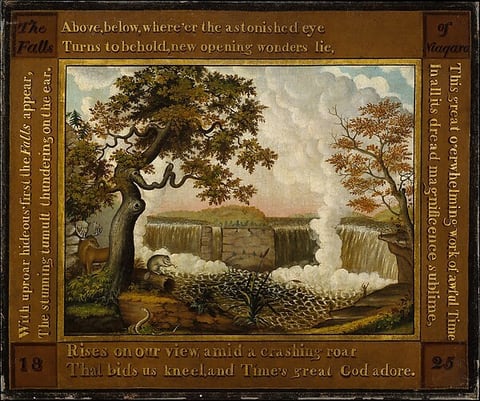
  1. The Falls of Niagara, by Edward Hicks, ca. 1825
    The Falls of NiagaraEdward Hicks, ca. 1825Courtesy of The Metropolitan Museum of Art
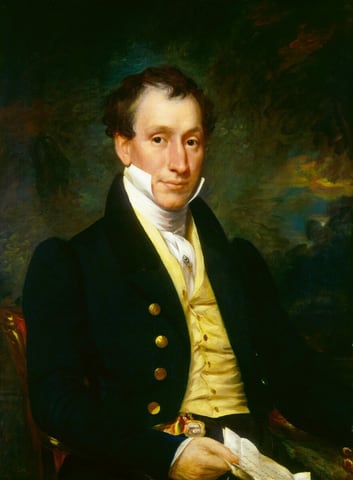
  2. This image depicts a man from the waist up. He is seated, slightly turned to his right, while facing the viewer. The man has a composed expression, prominent cheekbones, and a slightly pointed nose. His dark brown hair is styled in a classic early 19th-century manner, with curls around the sides and forehead. He is dressed in a dark blue coat with gold buttons, a yellow waistcoat, a high-collared white shirt, and a decorative pin. In his right hand, he holds a piece of folded paper with writing on it. The background is an indistinct swirl of darker colors.
    Robert G. L. De PeysterSamuel Lovett Waldo, 1828Courtesy National Gallery of Art, Washington