Floor plan

Artist galleriesGeorge Sand's contemporaries
George Sand's contemporaries
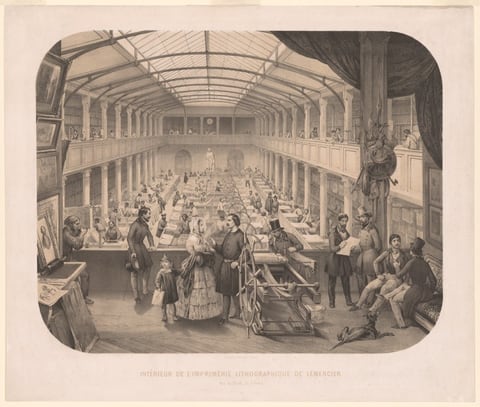
A work made of lithograph from two stones on off-white wove paper.
A work made of watercolor and opaque watercolor on cream wove paper.
A work made of transparent and opaque watercolor on cream wove paper.
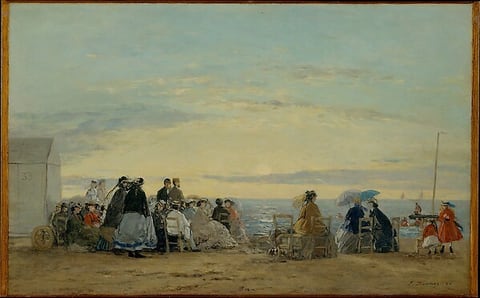
On the Beach, Sunset, by Eugène Boudin, 1865
A work made of oil on canvas.
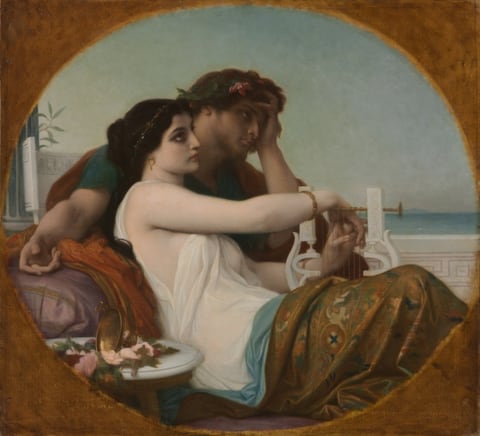
Aglaida and Boniface, by Alexandre Cabanel, c. 1857

The works in this room are listed below.

Works in this room

A few works by George Sand, then their contemporaries: makers of the same nationality born within 25 years of them, then works from the same century and place.

First room, north wall

  1. A work made of lithograph from two stones on off-white wove paper.
    Interior of the Lemercier Lithographic Printing HouseCharles Villemin, n.d.Courtesy of the Art Institute of Chicago
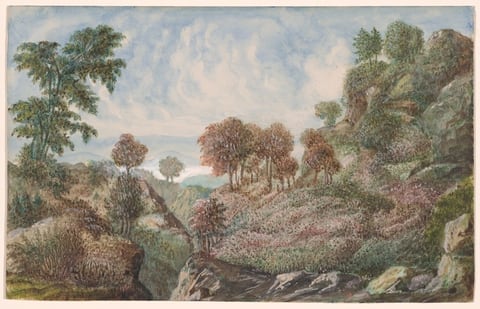
  2. A work made of watercolor and opaque watercolor on cream wove paper.
    Landscape with River GorgeGeorge Sand, 1860/69Courtesy of the Art Institute of Chicago
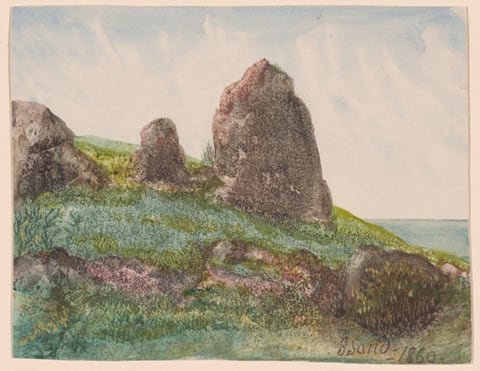
  3. A work made of transparent and opaque watercolor on cream wove paper.
    Landscape with RocksGeorge Sand, c. 1868/76Courtesy of the Art Institute of Chicago
  4. On the Beach, Sunset, by Eugène Boudin, 1865
    On the Beach, SunsetEugène Boudin, 1865Courtesy of The Metropolitan Museum of Art

First room, south wall

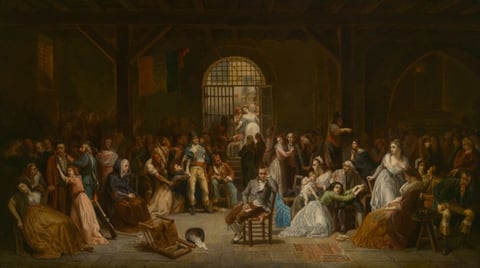
  1. A work made of oil on canvas.
    The Roll Call of the Last Victims of the TerrorCharles Louis-Lucien Muller, c. 1850Courtesy of the Art Institute of Chicago
  2. Aglaida and Boniface, by Alexandre Cabanel, c. 1857
    Aglaida and BonifaceAlexandre Cabanel, c. 1857Courtesy of the Cleveland Museum of Art

Second room, south wall
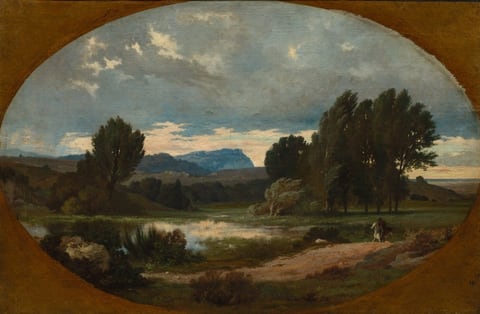
  1. Landscape with Rider on White Horse, by Jean Achille Benouville, 1846
    Landscape with Rider on White HorseJean Achille Benouville, 1846Courtesy of the Cleveland Museum of Art
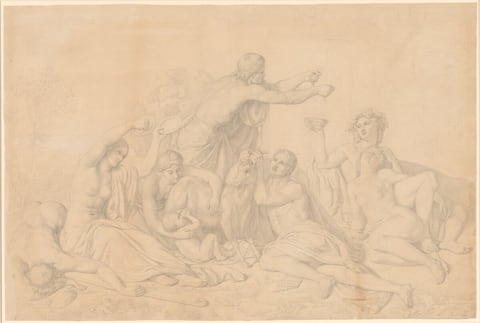
  2. This is a drawing of a group of mythological figures in a ceremonial scene. The composition features multiple figures in various poses, centered around a symbolic gathering. The drawing is detailed, providing a classical representation of human forms, draped fabrics, and an animal. A plateau with trees is subtly depicted in the background. The figures display expressions ranging from serene to contemplative.
    The Nursing of JupiterThéodore ChassériauCourtesy National Gallery of Art, Washington