Floor plan

Artist galleriesArnold Böcklin's contemporaries
Arnold Böcklin's contemporaries
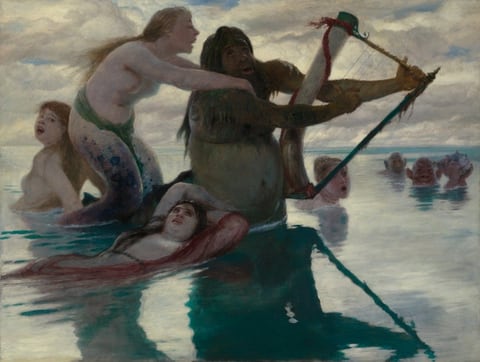
Painting of centaur with harp, in water, surrounded by mermaids and mermen.
A work made of oil on paper, laid on canvas.
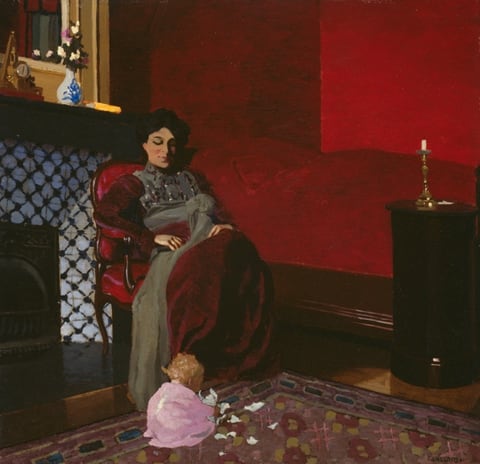
Painting of a stately woman seated on a red velvet chair in a blood-red room, a blue-white fireplace to her left. She glances down at the floor with a serene expression toward a tiny blond child—a baby—who sits on the floor tearing up paper, her pink-clad back facing the viewer.
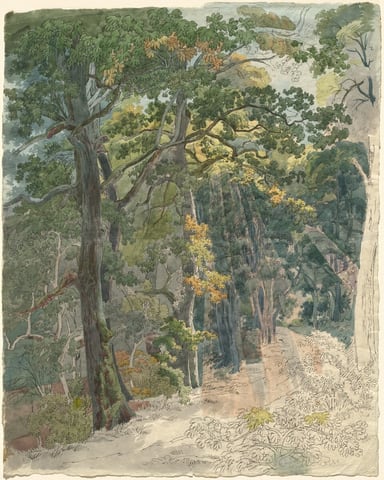
The image shows a dense, forested area with towering trees. The composition leads the eye along a pathway into the distance, without a distinct horizon line. The intricate brushstrokes depict the texture and foliage of the trees, suggesting movement and light filtering through the leaves. The color palette is rich and earthy, with shades of green, brown, yellow, and orange, creating a vibrant yet tranquil atmosphere emphasizing light and shadow.
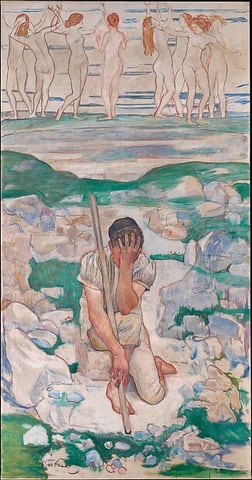
The Dream of the Shepherd (Der Traum des Hirten), by Ferdinand Hodler, 1896
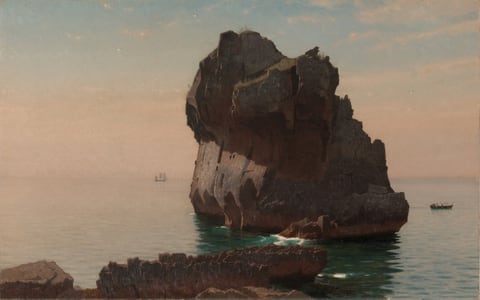
Capri, by William Stanley Haseltine, 1869

The works in this room are listed below.

Works in this room

A few works by Arnold Böcklin, then their contemporaries: makers of the same nationality born within 25 years of them, then works from the same century and place.

With their contemporaries

  1. Painting of centaur with harp, in water, surrounded by mermaids and mermen.
    In the SeaArnold Böcklin, 1883Courtesy of the Art Institute of Chicago
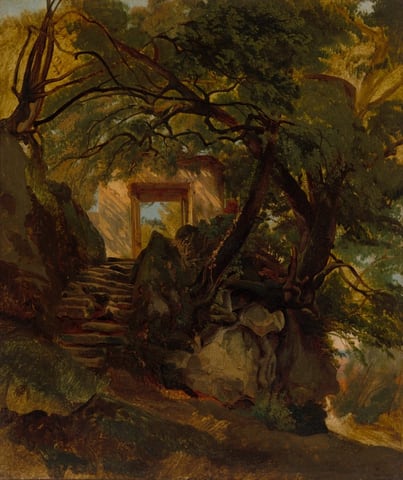
  2. A work made of oil on paper, laid on canvas.
    Staircase in the Park of Villa Chigi di AricciaAlexandre Calame, 1844–1845Courtesy of the Art Institute of Chicago
  3. Painting of a stately woman seated on a red velvet chair in a blood-red room, a blue-white fireplace to her left. She glances down at the floor with a serene expression toward a tiny blond child—a baby—who sits on the floor tearing up paper, her pink-clad back facing the viewer.
    The Red Room, EtretatFélix Vallotton, 1899Courtesy of the Art Institute of Chicago
  4. The image shows a dense, forested area with towering trees. The composition leads the eye along a pathway into the distance, without a distinct horizon line. The intricate brushstrokes depict the texture and foliage of the trees, suggesting movement and light filtering through the leaves. The color palette is rich and earthy, with shades of green, brown, yellow, and orange, creating a vibrant yet tranquil atmosphere emphasizing light and shadow.
    Rays of Sunlight Striking a Woodland PathFriedrich Salathé, c. 1815Courtesy National Gallery of Art, Washington

Their contemporaries

  1. The Dream of the Shepherd (Der Traum des Hirten), by Ferdinand Hodler, 1896
    The Dream of the Shepherd (Der Traum des Hirten)Ferdinand Hodler, 1896Courtesy of The Metropolitan Museum of Art
  2. Capri, by William Stanley Haseltine, 1869
    CapriWilliam Stanley Haseltine, 1869Courtesy of the Cleveland Museum of Art

Their contemporaries, second
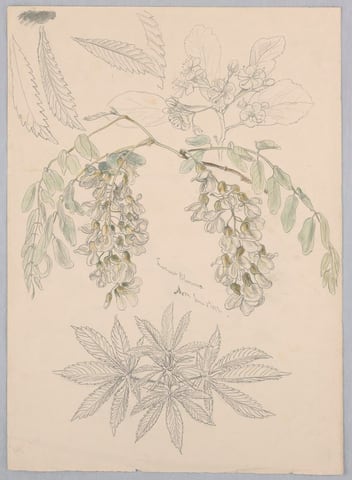
  1. LOCUST BLOSSOMS
    Locust BlossomsSamuel Colman, June 6, 1877Courtesy of Cooper Hewitt, Smithsonian Design Museum
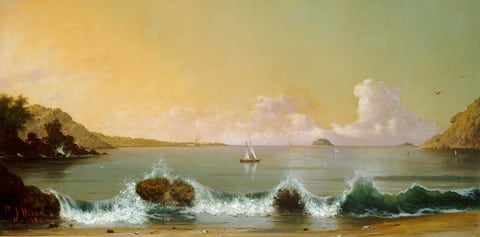
  2. Across a short stretch of sand in front of us, waves of bottle-green water break over two boulders on the shoreline, with sailboats in the water beyond, in this wide, horizontal painting. One boulder is at the left edge of the painting; the other is a short distance away, about a quarter of the way across. The water cascades down between those large rocks. Across the rest of the beach, the waves flare up to break toward us in white, foamy surf. The land curves back into view on both sides of the canvas with muted, sage-green hills and, to our left, dark green trees on more craggy boulders. A more distant finger of land to our left stretches nearly halfway across the horizon, which comes about halfway up the composition. Minuscule in scale there, smoke pours out of a chimney, which is surrounded by pale yellow buildings. A mound emerges from the horizon to our right of center. About ten sailboats float on the water. The closest one to us is near the center of the painting, and the tiny forms of people aboard can just barely be made out. The other boats become smaller as they move back to the horizon, and some are only a touch of white or gray on the canvas. White and pale lavender-purple clouds sweep up from the horizon into the sky, which glows butter yellow along the left edge. The sky cools to mint green in the upper right corner. Several white or brown birds fly across the sky or low over the water. The artist signed and dated the lower left, “M. J. Heade 1864.”
    Rio de Janeiro BayMartin Johnson Heade, 1864Courtesy National Gallery of Art, Washington