Floor plan

Style galleriesParis Salon painting
Paris Salon painting
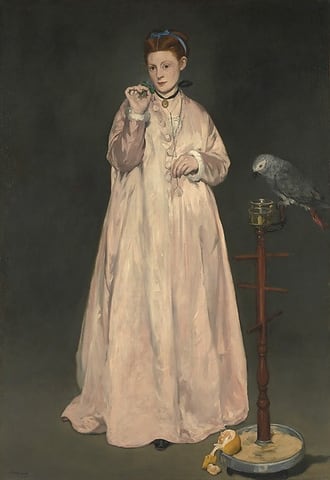
Young Lady in 1866, by Édouard Manet, 1866
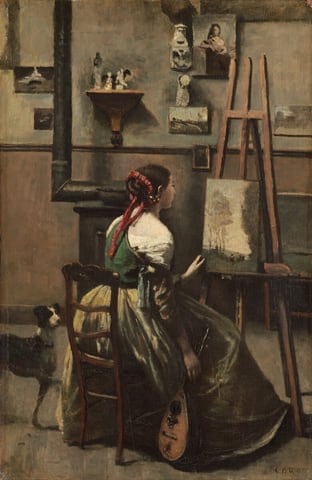
A young, pale-skinned woman sits with her back to us as she looks at a painting on an easel in a studio in this vertical painting. She sits in a ladder-back wood chair so her knees angle away from us, toward the back right corner of the studio. We look onto the side of her right cheek as she leans forward. Her brown hair is combed back and twisted into a bun wrapped with a raspberry-red ribbon that trails down her back. Touches of pearl white, pale pink, and silvery gray suggest flowers by the ear we can see. A cream-white chemise falls off the shoulder closer to us, under a grass-green bodice. She holds a mandolin down by her right side, which is closer to us, to nestle in the folds of her voluminous, olive-green skirt. She reaches forward with her other hand to touch the lower left corner of the painting resting on the easel. That vertically-oriented scene is loosely painted and shows a few people gathered in a landscape. A white and black dog stands with one front leg lifted to the left of the woman's chair, looking at her. The wall opposite us is parchment white over a strip of molding, like a high chair rail, and muted mauve pink below. An L-shaped pipe leads to an iron stove to our left of center. A narrow shelf tucked into the L of the pipe holds three hand-sized sculptures or casts. Small paintings and plaster casts hang around it on the wall above the molding. The artist signed the painting in the lower right: “COROT.”
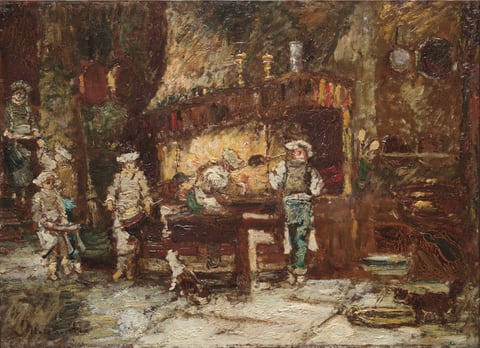
The Kitchen of the Rôtisserie des Deux Paons, by Adolphe Monticelli, c. 1875–1881
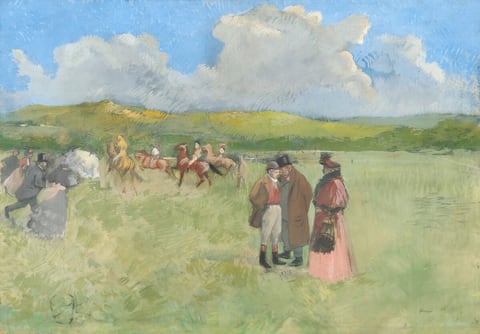
This painting depicts a wide, grassy green field with distant green hills under a blue sky with fluffy white clouds. To the right of center, two men and one woman seem to be engaged in conversation. One man wears a dark suit with a long jacket over it and a top hat, and the other man wears a red shirt with tan breeches, tall black boots, a shorter brown coat, and a round hat. The woman wears a long pink dress with a ruffled black neckline and a large pink hat. Behind them, on the left, are four people riding horses, all headed towards the back left. On the far left, more men and women in dresses and suits seem to watch as the horses and riders race by, one woman holding a large white parasol. All of the people appear to have light skin, and their facial features are indistinct. The brushstrokes in the painting are loose and visible, and the landscape and sky are painted with short, overlapping lines going in different directions, giving the scene a hazy impression.
A work made of oil on canvas.

The works in this room are listed below.

Works in this room

Painting made for the great annual exhibition in Paris, and the realists who argued with it.

First room, north wall

  1. Young Lady in 1866, by Édouard Manet, 1866
    Young Lady in 1866Édouard Manet, 1866Courtesy of The Metropolitan Museum of Art
  2. A young, pale-skinned woman sits with her back to us as she looks at a painting on an easel in a studio in this vertical painting. She sits in a ladder-back wood chair so her knees angle away from us, toward the back right corner of the studio. We look onto the side of her right cheek as she leans forward. Her brown hair is combed back and twisted into a bun wrapped with a raspberry-red ribbon that trails down her back. Touches of pearl white, pale pink, and silvery gray suggest flowers by the ear we can see. A cream-white chemise falls off the shoulder closer to us, under a grass-green bodice. She holds a mandolin down by her right side, which is closer to us, to nestle in the folds of her voluminous, olive-green skirt. She reaches forward with her other hand to touch the lower left corner of the painting resting on the easel. That vertically-oriented scene is loosely painted and shows a few people gathered in a landscape. A white and black dog stands with one front leg lifted to the left of the woman's chair, looking at her. The wall opposite us is parchment white over a strip of molding, like a high chair rail, and muted mauve pink below. An L-shaped pipe leads to an iron stove to our left of center. A narrow shelf tucked into the L of the pipe holds three hand-sized sculptures or casts. Small paintings and plaster casts hang around it on the wall above the molding. The artist signed the painting in the lower right: “COROT.”
    Corot's Studio: Woman Seated Before an Easel, a Mandolin in her HandJean Baptiste Camille Corot, c. 1868Courtesy National Gallery of Art, Washington
  3. The Kitchen of the Rôtisserie des Deux Paons, by Adolphe Monticelli, c. 1875–1881
    The Kitchen of the Rôtisserie des Deux PaonsAdolphe Monticelli, c. 1875–1881Courtesy of the Cleveland Museum of Art

First room, south wall

  1. This painting depicts a wide, grassy green field with distant green hills under a blue sky with fluffy white clouds. To the right of center, two men and one woman seem to be engaged in conversation. One man wears a dark suit with a long jacket over it and a top hat, and the other man wears a red shirt with tan breeches, tall black boots, a shorter brown coat, and a round hat. The woman wears a long pink dress with a ruffled black neckline and a large pink hat. Behind them, on the left, are four people riding horses, all headed towards the back left. On the far left, more men and women in dresses and suits seem to watch as the horses and riders race by, one woman holding a large white parasol. All of the people appear to have light skin, and their facial features are indistinct. The brushstrokes in the painting are loose and visible, and the landscape and sky are painted with short, overlapping lines going in different directions, giving the scene a hazy impression.
    The Race TrackJean Louis Forain, c. 1891Courtesy National Gallery of Art, Washington
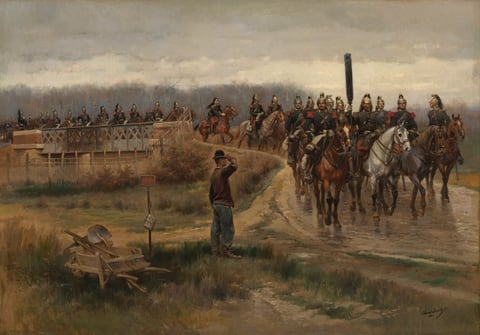
  2. A work made of oil on canvas.
    Mon Ancien RegimentJean Baptiste Édouard Detaille, 1881Courtesy of the Art Institute of Chicago
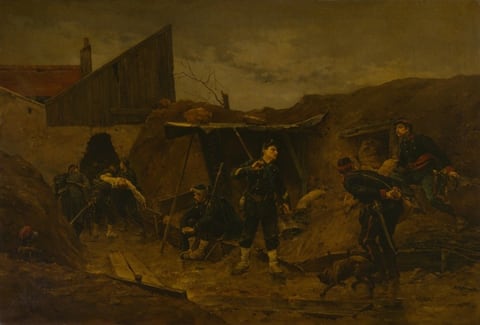
  3. A work made of oil on canvas.
    Dans la TranchéeEtienne Prosper Berne-Bellecour, c. 1875Courtesy of the Art Institute of Chicago

Second room, south wall
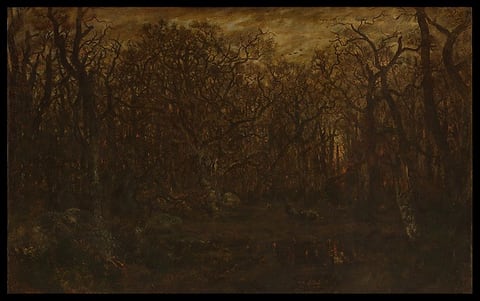
  1. The Forest in Winter at Sunset, by Théodore Rousseau, ca. 1846–67
    The Forest in Winter at SunsetThéodore Rousseau, ca. 1846–67Courtesy of The Metropolitan Museum of Art
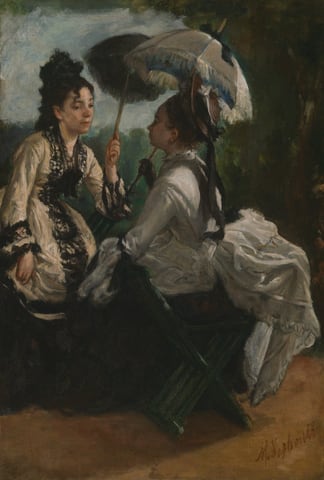
  2. A work made of oil on canvas.
    The ConversationMarcellin Gilbert Desboutin, 1875–79Courtesy of the Art Institute of Chicago
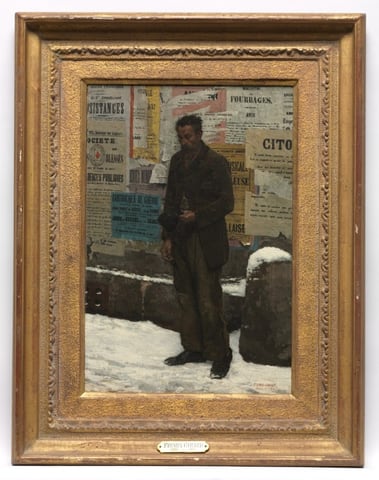
  3. The Veteran, by Marie-François Firmin-Girard, 1870
    The VeteranMarie-François Firmin-Girard, 1870Courtesy of the Cleveland Museum of Art

Second room, north wall
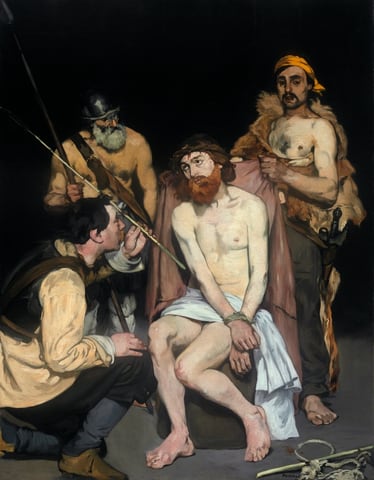
  1. Large, dark painting of Jesus sitting with three standing soldiers.
    Jesus Mocked by the SoldiersÉdouard Manet, 1865Courtesy of the Art Institute of Chicago
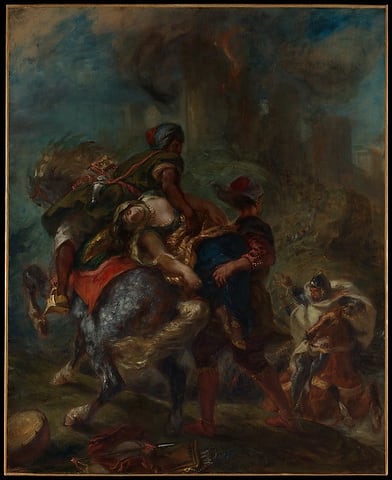
  2. The Abduction of Rebecca, by Eugène Delacroix, 1846
    The Abduction of RebeccaEugène Delacroix, 1846Courtesy of The Metropolitan Museum of Art

Third room, north wall
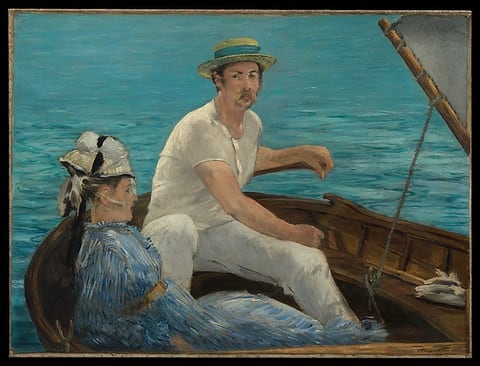
  1. Boating, by Édouard Manet, 1874
    BoatingÉdouard Manet, 1874Courtesy of The Metropolitan Museum of Art
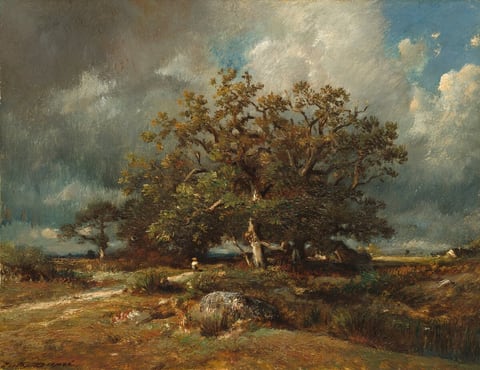
  2. The painting depicts a landscape with a field, trees, and a dramatic cloudy sky. Grass, rocks, and a group of large trees are visible in the center of the composition. Below the trees, there is a small shape that could be a person looking up. Farther back, there are some small triangular structures that might be houses. The brushstrokes are expressive and not much detail is visible in the smaller shapes. The grass and foliage are painted in earthy tones of brown, orange, and green, while the sky is blue with areas of thick gray and white clouds.
    The Old OakJules Dupré, c. 1870Courtesy National Gallery of Art, Washington
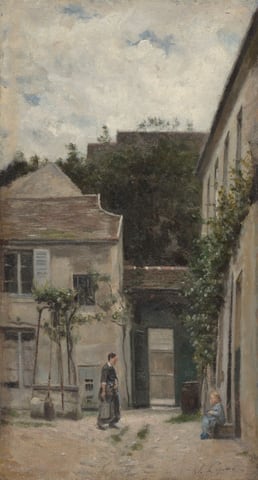
  3. A work made of oil on canvas.
    The CourtyardStanislas Lépine, c. 1880Courtesy of the Art Institute of Chicago

Third room, south wall
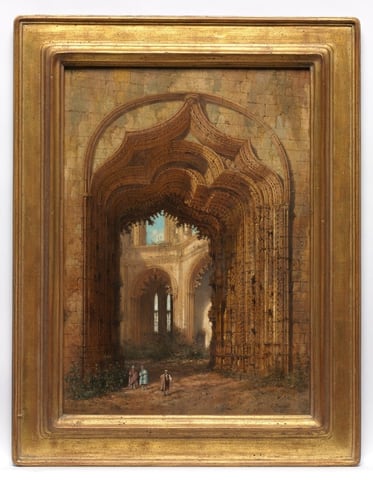
  1. Ruined Church, by Adrien Dauzats, c. 1840
    Ruined ChurchAdrien Dauzats, c. 1840Courtesy of the Cleveland Museum of Art
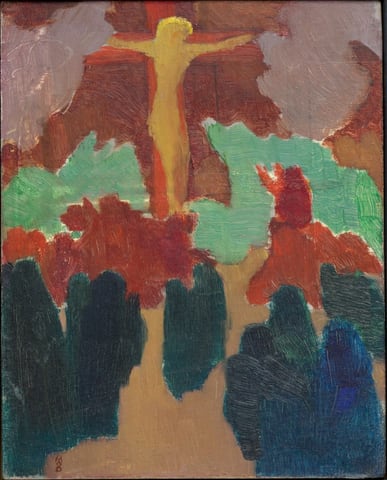
  2. The Orange Christ, by Maurice Denis, 1889
    The Orange ChristMaurice Denis, 1889Courtesy of the Cleveland Museum of Art