Floor plan

Style galleriesParis Salon painting
Paris Salon painting
A work made of oil on canvas.
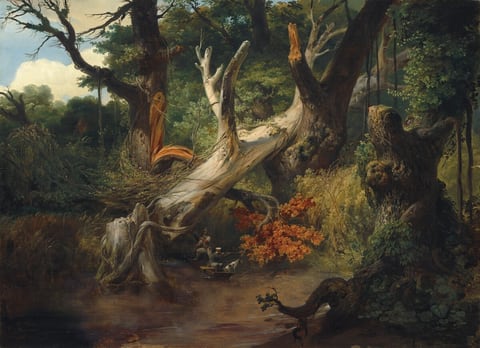
A leafless, ash-white tree trunk has fallen from a broken stump into the wide V of a neighboring tree at the edge of a body of water near a verdant forest in this horizontal landscape painting. The fallen trunk creates a diagonal from near the lower left corner to the upper right. As it fell, it sheared off a substantial branch from a neighboring tree with a dark trunk. The bark where the damaged branch has pulled away is honey-orange, the same color as the leaves at the canopy, which has been pinned under the fallen trunk. Trees, vines, and other vegetation fill the space around and beyond this pair. In the lower right corner of the painting, vines grow over a broken stump, which deep in shadow. Between the stump and fallen tree, the peanut-brown surface of the water is smooth. Tiny in scale beneath the fallen tree and easily overlooked, there are two men and a dog in a boat. One man stands at the back of the boat and pushes it along with a long pole. He wears a tall, brown, cloth hat, a white shirt rolled up to the elbows under a blue vest, and loose-fitting pants. A second man wears a flat-topped, white hat with a black brim, a long, forest-green jacket, and tight-fitting slate-blue pants. He braces a rifle against one shoulder and shoots into the forest. The dog is white with brown spots, and it stands with its front paws on the edge of the boat, presumably ready to spring after the target. A patch of blue sky with puffy white clouds is seen above the trees in the upper left corner. The artist signed and dated the work in the lower right corner: “H. Vernet Rome 1833.”
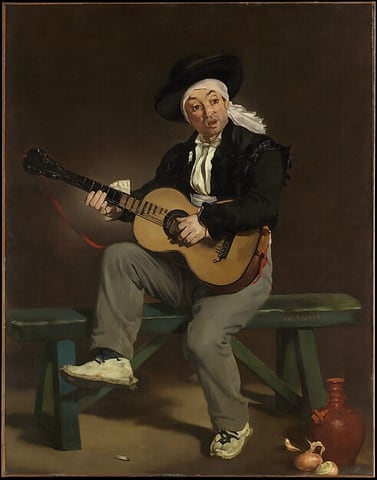
The Spanish Singer, by Édouard Manet, 1860
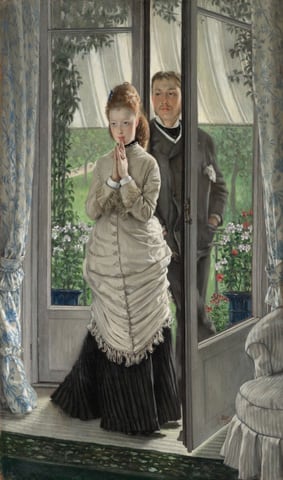
The Lovers, by James Tissot, 1872
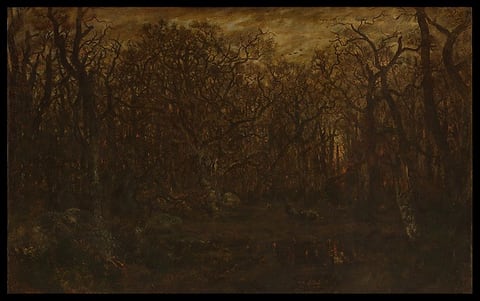
The Forest in Winter at Sunset, by Théodore Rousseau, ca. 1846–67

The works in this room are listed below.

Works in this room

Painting made for the great annual exhibition in Paris, and the realists who argued with it.

Section 1, north wall

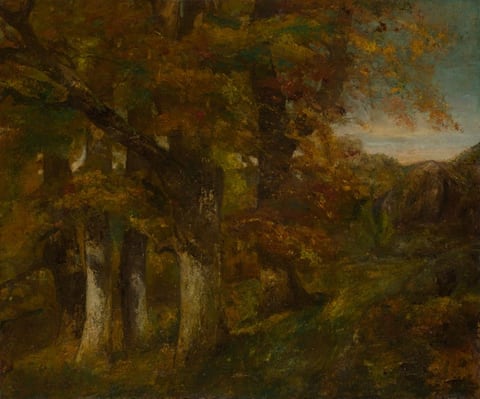
  1. A work made of oil on canvas.
    Wooded LandscapeGustave Courbet, 1860–65Courtesy of the Art Institute of Chicago
  2. A leafless, ash-white tree trunk has fallen from a broken stump into the wide V of a neighboring tree at the edge of a body of water near a verdant forest in this horizontal landscape painting. The fallen trunk creates a diagonal from near the lower left corner to the upper right. As it fell, it sheared off a substantial branch from a neighboring tree with a dark trunk. The bark where the damaged branch has pulled away is honey-orange, the same color as the leaves at the canopy, which has been pinned under the fallen trunk. Trees, vines, and other vegetation fill the space around and beyond this pair. In the lower right corner of the painting, vines grow over a broken stump, which deep in shadow. Between the stump and fallen tree, the peanut-brown surface of the water is smooth. Tiny in scale beneath the fallen tree and easily overlooked, there are two men and a dog in a boat. One man stands at the back of the boat and pushes it along with a long pole. He wears a tall, brown, cloth hat, a white shirt rolled up to the elbows under a blue vest, and loose-fitting pants. A second man wears a flat-topped, white hat with a black brim, a long, forest-green jacket, and tight-fitting slate-blue pants. He braces a rifle against one shoulder and shoots into the forest. The dog is white with brown spots, and it stands with its front paws on the edge of the boat, presumably ready to spring after the target. A patch of blue sky with puffy white clouds is seen above the trees in the upper left corner. The artist signed and dated the work in the lower right corner: “H. Vernet Rome 1833.”
    Hunting in the Pontine MarshesHorace Vernet, 1833Courtesy National Gallery of Art, Washington
  3. The Spanish Singer, by Édouard Manet, 1860
    The Spanish SingerÉdouard Manet, 1860Courtesy of The Metropolitan Museum of Art

Section 1, south wall

  1. The Lovers, by James Tissot, 1872
    The LoversJames Tissot, 1872Courtesy of the Cleveland Museum of Art
  2. The Forest in Winter at Sunset, by Théodore Rousseau, ca. 1846–67
    The Forest in Winter at SunsetThéodore Rousseau, ca. 1846–67Courtesy of The Metropolitan Museum of Art

Section 2, south wall
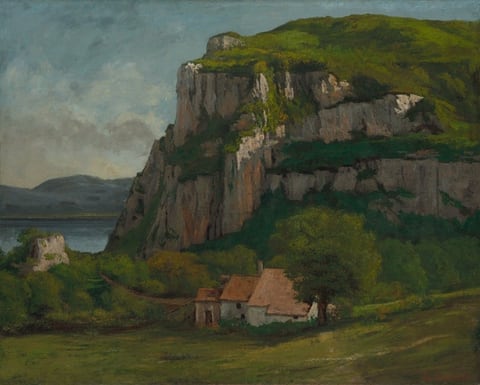
  1. A work made of oil on canvas.
    The Rock of HautepierreGustave Courbet, c. 1869Courtesy of the Art Institute of Chicago
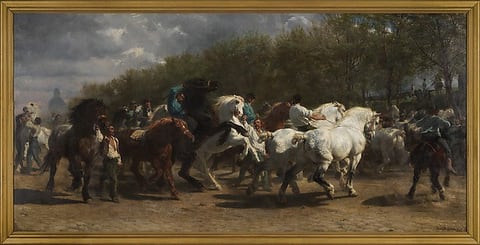
  2. The Horse Fair, by Rosa Bonheur, 1852–55
    The Horse FairRosa Bonheur, 1852–55Courtesy of The Metropolitan Museum of Art

Section 2, north wall
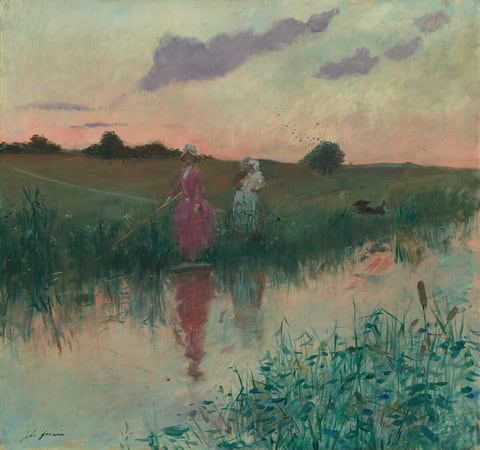
  1. In this painting, there are two women standing near a body of water, surrounded by tall green grass and white flowers. One woman wears a bright pink dress, while the other wears a brown dress with a white apron. The woman in pink holds a long, thin rod outwards, its other end connected to a thin string and a small red lure floating on the water. The other woman stands behind her and holds a baby wearing white clothes and a white bonnet. Behind both women, on the right, is a brown shape like a small dog running towards them. The reflection of the women is visible against the still, blue water. The sky is light blue at the top, transitioning to a warm pink by the horizon, crossed by purple clouds and a flock of small birds. In the bottom right corner, across the water from the women, is a patch of more tall blue-and-green grass. The brushstrokes of the painting are light and feathery.
    The Artist's Wife FishingJean Louis Forain, 1896Courtesy National Gallery of Art, Washington
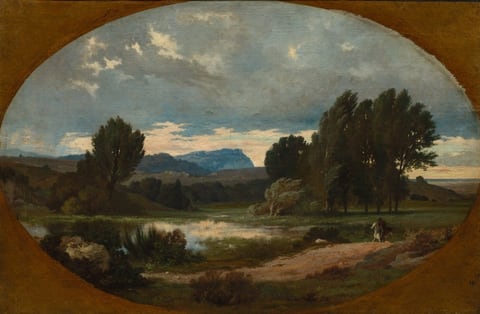
  2. Landscape with Rider on White Horse, by Jean Achille Benouville, 1846
    Landscape with Rider on White HorseJean Achille Benouville, 1846Courtesy of the Cleveland Museum of Art
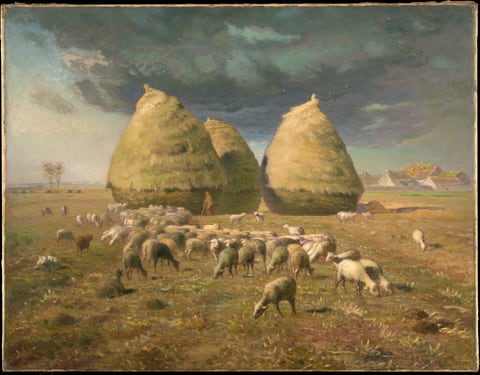
  3. Haystacks: Autumn, by Jean-François Millet, ca. 1874
    Haystacks: AutumnJean-François Millet, ca. 1874Courtesy of The Metropolitan Museum of Art

Section 3, north wall
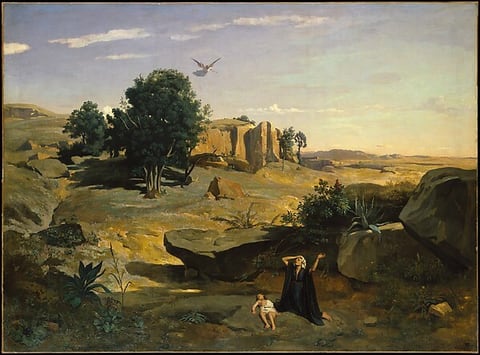
  1. Hagar in the Wilderness, by Jean Baptiste Camille Corot, 1835
    Hagar in the WildernessJean Baptiste Camille Corot, 1835Courtesy of The Metropolitan Museum of Art
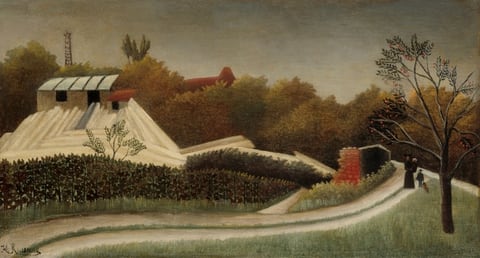
  2. A work made of oil on canvas.
    Sawmill, Outskirts of ParisHenri Rousseau, c. 1893/95Courtesy of the Art Institute of Chicago
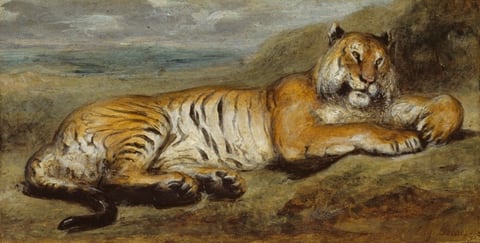
  3. A boldly painted orange tiger lies on brown, rocky ground, his body nearly filling the canvas, blue water and gray sky in the background.
    Tiger RestingPierre Andrieu, c. 1845Courtesy of the Art Institute of Chicago

Section 3, south wall
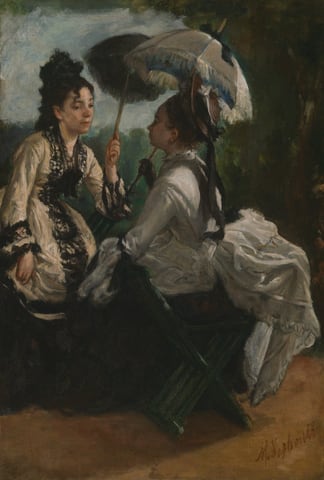
  1. A work made of oil on canvas.
    The ConversationMarcellin Gilbert Desboutin, 1875–79Courtesy of the Art Institute of Chicago
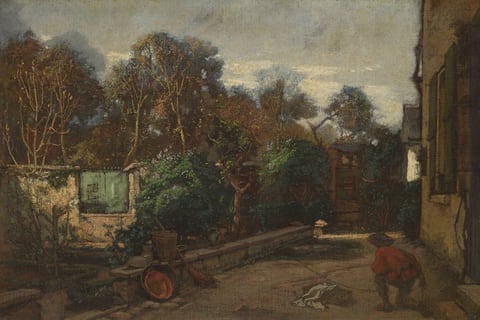
  2. A work made of oil on canvas.
    The Bird CatcherThomas Couture, c. 1857Courtesy of the Art Institute of Chicago
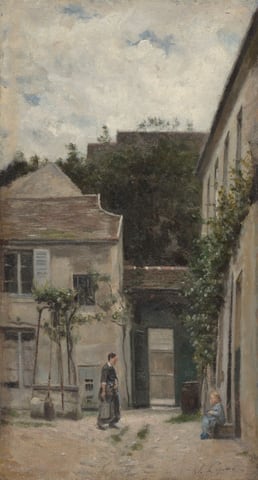
  3. A work made of oil on canvas.
    The CourtyardStanislas Lépine, c. 1880Courtesy of the Art Institute of Chicago