Floor plan

Style galleriesNeoclassicism

Neoclassicism

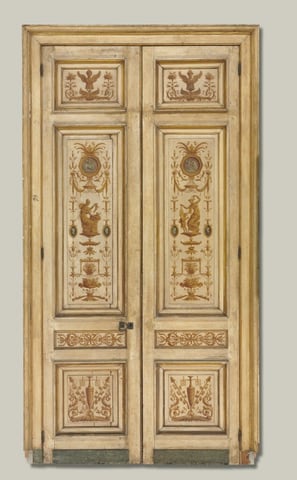
Overdoor Painting, by Pierre Rousseau, 1790s
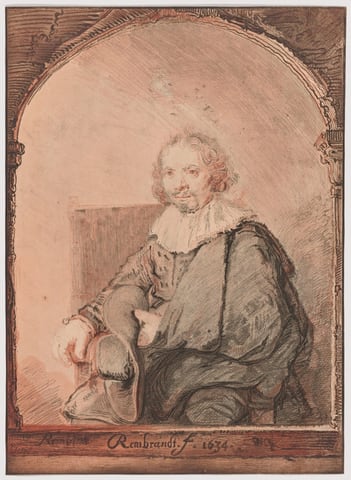
A work made of soft ground etching, hard ground etching, aquatint, and roulette, printed from two plates in red-brown and black, on ivory laid paper.
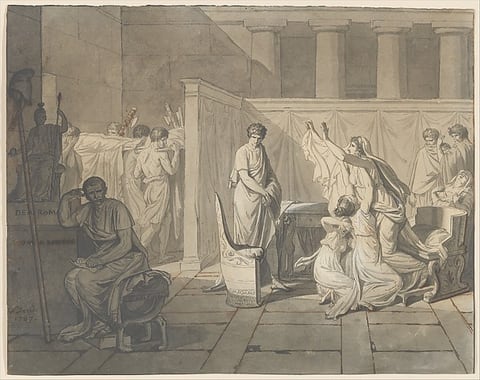
The Lictors Bringing Brutus the Bodies of his Sons, by Jacques-Louis David, 1787
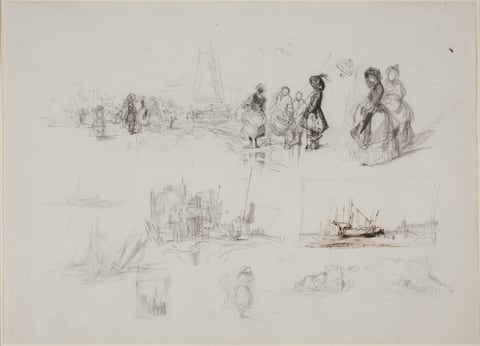
This image is a pencil sketch on paper with a monochrome palette of graphite gray. The viewer sees various scenes without a defined horizon line. The upper section shows figures in period clothing, possibly mid-19th century women's fashion. The middle area has abstract architectural forms. In the lower right corner, a sailing ship or boat is sketched with more detail than the rest. The drawing style consists of quick, expressive strokes. The image conveys multiple narrative or compositional ideas on a single sheet.
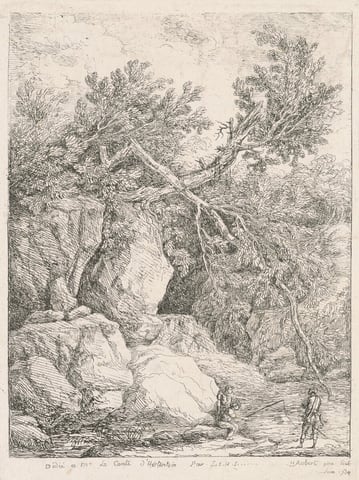
The image shows an illustration of a rocky terrain with towering stone formations and dense foliage. The sky is textured and the scene is created using an etching technique with intricate linework. There are two figures in the scene, one appearing to climb or position near a rock, while the other observes. The color palette is monochromatic, using black on a white background to depict depth and dimension in the artwork.
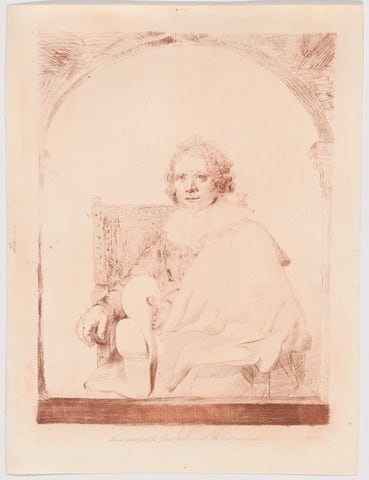
A work made of soft ground etching, with roulette, printed in red on white wove paper.
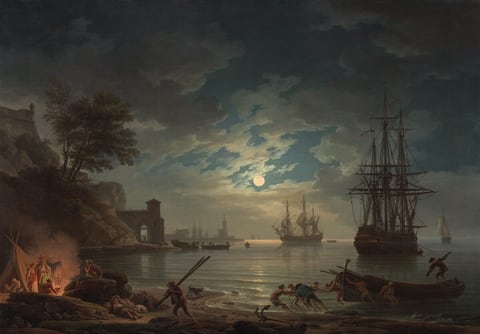
Moonlight falls across several masted ships near a rocky shoreline in this horizontal painting. The sky fills the top three-quarters of the picture. A veil of slate-gray clouds is lit to pearl white around the crisp, full moon at the center of the composition. Patches of denim-blue sky are seen through breaks in the blanket of clouds. Moonlight reflects down the center of rippling, silvery-gray water that laps against a beach close to us, along the bottom edge of the painting. A tent is set up in the lower left corner of the composition. There, two women and one man stand looking at a glowing fire next to the tent. One woman holds a basket on her head, the other tucks a flat basket under one arm. The man stands between the two women, and a fourth man crouches near the fire, his back to us. In the opening of the tent, another woman kneels over a large bowl as she looks at the fire. A fifth person, a man, gazes at the fire as he sits smoking a long-stemmed pipe on a boulder. At the foot of the boulders, a man lies back against some bundles, one arm thrown up over his head. A dog curls up next to his hip. Not far from the sleeping man and in the center of the foreground, a man carries several long wooden objects, possibly oars, over one shoulder while a dog beyond him barks at the lapping surf. The beach curves like a C away from us, along the left. At the point of the curve in the middle distance, a structure like a city wall and gate jut out to the water’s edge. More buildings atop steep cliffs rise vertically beyond the gate. The shoreline curves into the distance again, and more buildings, including a lighthouse, and masted ships there are smoke-gray silhouettes. Near the lower right corner of the painting, four men pull on ropes tied around the prow of a small wooden boat while three others push it toward the land. Another man stands in the far end. A short distance beyond that boat is a tall wooden ship with three masts and rigging outlined against the night sky. Windows along the decks of that boat’s wide stern, angled toward us, glow with golden light. Beyond it and a bit to our left, another ship, smaller in scale, sails away from us. Several more ships move back to the horizon until we only see strokes of white and gray to indicate their unfurled sails.

The works in this room are listed below.

Works in this room

Europe turns back to Greece and Rome: clear line, calm figures and civic virtue.

First room, north wall

  1. Overdoor Painting, by Pierre Rousseau, 1790s
    Overdoor PaintingPierre Rousseau, 1790sCourtesy of the Cleveland Museum of Art
  2. A work made of soft ground etching, hard ground etching, aquatint, and roulette, printed from two plates in red-brown and black, on ivory laid paper.
    Portrait of a Man in an Armchair, from Collection d'imitations de Dessins d'après les Principaux Maîtres Hollandais et FlamandsChristian Josi, 1826Courtesy of the Art Institute of Chicago
  3. The Lictors Bringing Brutus the Bodies of his Sons, by Jacques-Louis David, 1787
    The Lictors Bringing Brutus the Bodies of his SonsJacques-Louis David, 1787Courtesy of The Metropolitan Museum of Art
  4. This image is a pencil sketch on paper with a monochrome palette of graphite gray. The viewer sees various scenes without a defined horizon line. The upper section shows figures in period clothing, possibly mid-19th century women's fashion. The middle area has abstract architectural forms. In the lower right corner, a sailing ship or boat is sketched with more detail than the rest. The drawing style consists of quick, expressive strokes. The image conveys multiple narrative or compositional ideas on a single sheet.
    Seaside StudiesEugène Isabey, 1830sCourtesy National Gallery of Art, Washington

First room, south wall

  1. The image shows an illustration of a rocky terrain with towering stone formations and dense foliage. The sky is textured and the scene is created using an etching technique with intricate linework. There are two figures in the scene, one appearing to climb or position near a rock, while the other observes. The color palette is monochromatic, using black on a white background to depict depth and dimension in the artwork.
    Landscape with a Fallen Tree (Paysage à l'arbre cassé)Hubert Robert, 1764Courtesy National Gallery of Art, Washington
  2. A work made of soft ground etching, with roulette, printed in red on white wove paper.
    Portrait of a Man in an Armchair, from Collection d'imitations de Dessins d'après les Principaux Maîtres Hollandais et FlamandsChristian Josi, 1826Courtesy of the Art Institute of Chicago
  3. Moonlight falls across several masted ships near a rocky shoreline in this horizontal painting. The sky fills the top three-quarters of the picture. A veil of slate-gray clouds is lit to pearl white around the crisp, full moon at the center of the composition. Patches of denim-blue sky are seen through breaks in the blanket of clouds. Moonlight reflects down the center of rippling, silvery-gray water that laps against a beach close to us, along the bottom edge of the painting. A tent is set up in the lower left corner of the composition. There, two women and one man stand looking at a glowing fire next to the tent. One woman holds a basket on her head, the other tucks a flat basket under one arm. The man stands between the two women, and a fourth man crouches near the fire, his back to us. In the opening of the tent, another woman kneels over a large bowl as she looks at the fire. A fifth person, a man, gazes at the fire as he sits smoking a long-stemmed pipe on a boulder. At the foot of the boulders, a man lies back against some bundles, one arm thrown up over his head. A dog curls up next to his hip. Not far from the sleeping man and in the center of the foreground, a man carries several long wooden objects, possibly oars, over one shoulder while a dog beyond him barks at the lapping surf. The beach curves like a C away from us, along the left. At the point of the curve in the middle distance, a structure like a city wall and gate jut out to the water’s edge. More buildings atop steep cliffs rise vertically beyond the gate. The shoreline curves into the distance again, and more buildings, including a lighthouse, and masted ships there are smoke-gray silhouettes. Near the lower right corner of the painting, four men pull on ropes tied around the prow of a small wooden boat while three others push it toward the land. Another man stands in the far end. A short distance beyond that boat is a tall wooden ship with three masts and rigging outlined against the night sky. Windows along the decks of that boat’s wide stern, angled toward us, glow with golden light. Beyond it and a bit to our left, another ship, smaller in scale, sails away from us. Several more ships move back to the horizon until we only see strokes of white and gray to indicate their unfurled sails.
    MoonlightClaude-Joseph Vernet, 1772Courtesy National Gallery of Art, Washington

Second room, south wall
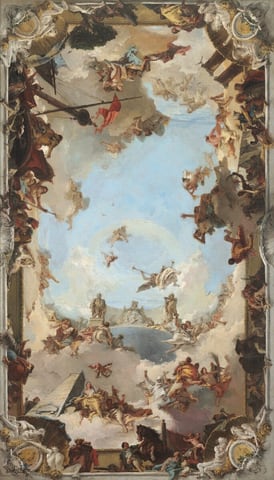
  1. We look up through an opening surrounded by a stone ledge, with clusters of people and clouds swirling into a blue sky up and away from us in this vertical, rectangular painting. From a distance, the scene looks like a complete illusion but up close, the people, clouds, and architecture are sketchily painted. The ledge running around the opening has a gold, oval medallion at each corner. Appearing to be carved from white stone, two bearded men with long hair recline against each medallion, flanking them to each side in front of large shells that curve up over the people and frames them. A few architectural structures extend up into the sky, including a pointed obelisk in the lower left corner, a pair of columns at the upper right, and what seems to be the mast of a ship at the top left. Most of the people have pale skin but some have more tan complexions, and a few, including those wearing feather headdresses near the upper left corner, have brown skin. The people wear windswept robes of pale, butter yellow, robin’s egg blue, rose pink, and ivory. The eye may drawn to a few vignettes, such as the man holding a rearing, chestnut-brown horse on the illusionistic ledge near the lower right, a nun wearing a white robe and holding a cross above him in the clouds, and, farthest away, a crowned person sitting on a throne.
    Wealth and Benefits of the Spanish Monarchy under Charles IIIGiovanni Battista Tiepolo, 1762Courtesy National Gallery of Art, Washington
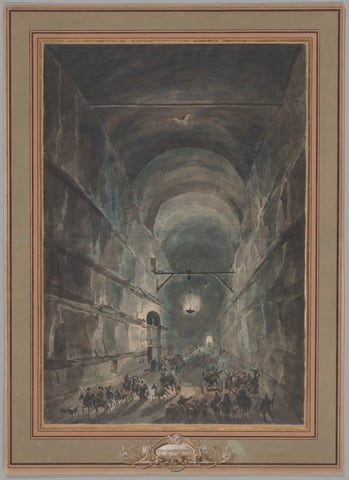
  2. A work made of handcolored etching in black on cream laid paper.
    The Grotto of Posillipo (La Grotta di Posillipo)Louis Jean Desprez, 1785/90Courtesy of the Art Institute of Chicago
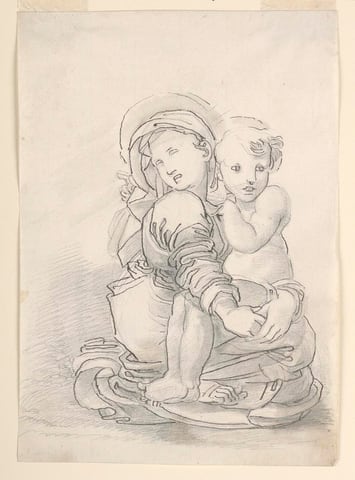
  3. THE VIRGIN WITH THE CHILD
    The Virgin with the ChildFortunato Duranti, 1820–1850Courtesy of Cooper Hewitt, Smithsonian Design Museum
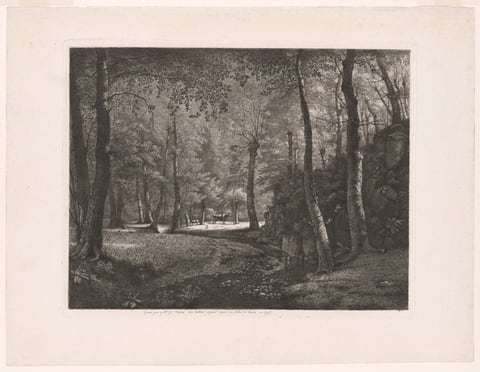
  4. A work made of etching with roulette in black on ivory wove paper.
    The Forest of RochecardonJean-Michel Grobon, 1800Courtesy of the Art Institute of Chicago

Second room, north wall
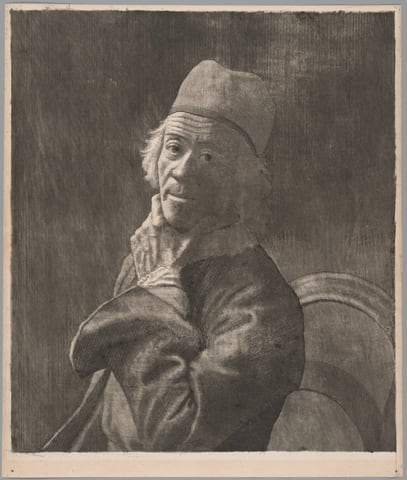
  1. A work made of etching, roulette, and mezzotint in black on cream laid paper.
    The Large Self-PortraitJean Etienne Liotard, 1778/81Courtesy of the Art Institute of Chicago
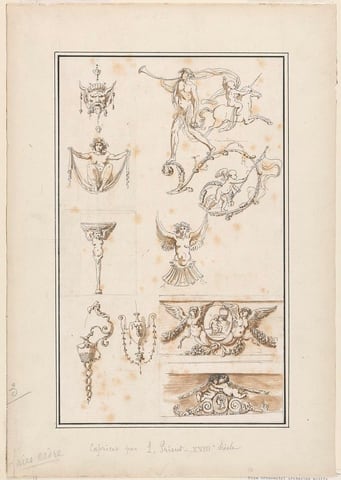
  2. DESIGNS FOR ORNAMENTAL ARABESQUE MOTIFS
    Designs for Ornamental Arabesque MotifsEtienne de Lavallée-Poussin, 1770Courtesy of Cooper Hewitt, Smithsonian Design Museum
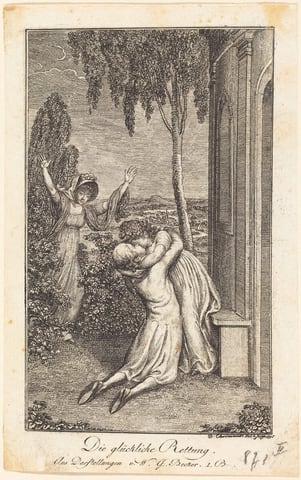
  3. The image shows three figures. Two of them are embracing in the foreground, kneeling on the ground and facing each other in a kiss. The person on the left has curly hair and appears to be wearing a coat-like garment, while the person on the right has long hair tied back and is dressed in a long robe. The third figure emerges from the bushes in the background, with shoulder-length hair, wearing a dress with a sash and a light shawl or scarf over their head. The setting includes tall trees, shrubs, and a structure with columns and arches on the right side, suggesting a garden or courtyard. Rolling hills and cloudy skies are in the distant background.
    The Fortunate RescueDaniel Nikolaus Chodowiecki, 1791Courtesy National Gallery of Art, Washington

Third room, north wall
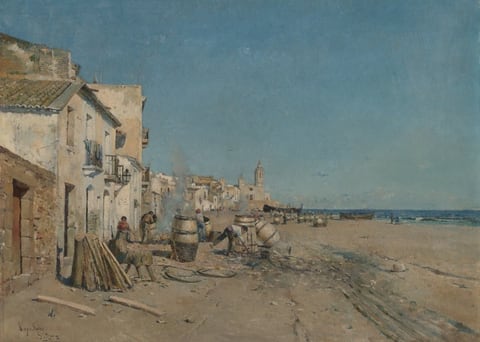
  1. A work made of oil on masonite.
    SitgesJuan Roig y Soler, 19th centuryCourtesy of the Art Institute of Chicago
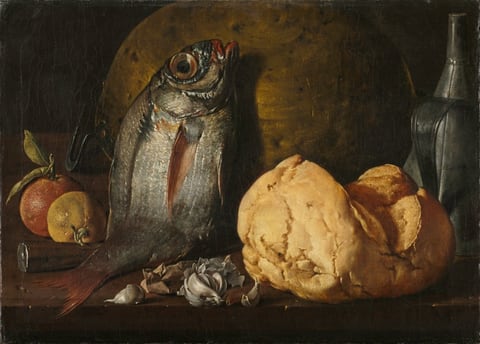
  2. Still Life with Fish, Bread, and Kettle, by Luis Meléndez, c. 1772
    Still Life with Fish, Bread, and KettleLuis Meléndez, c. 1772Courtesy of the Cleveland Museum of Art