Floor plan

Style galleriesThe Italian Renaissance
The Italian Renaissance
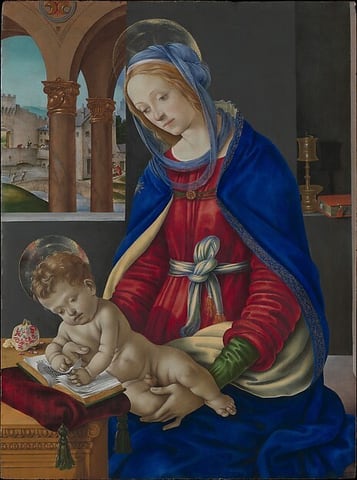
Madonna and Child, by Filippino Lippi, ca. 1483–84
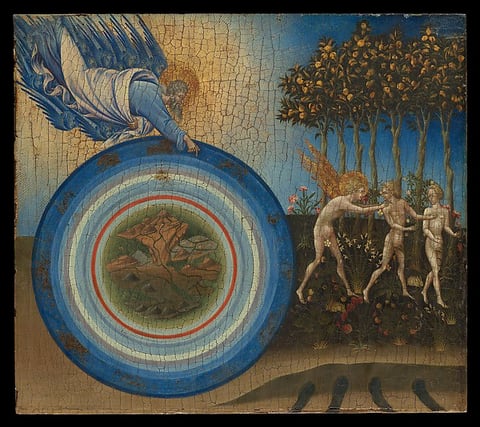
The Creation of the World and the Expulsion from Paradise, by Giovanni di Paolo, 1445
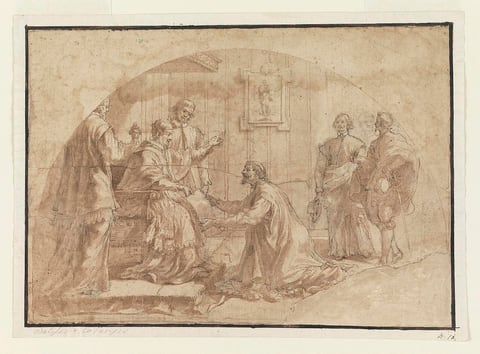
POPE RECEIVING VISITOR
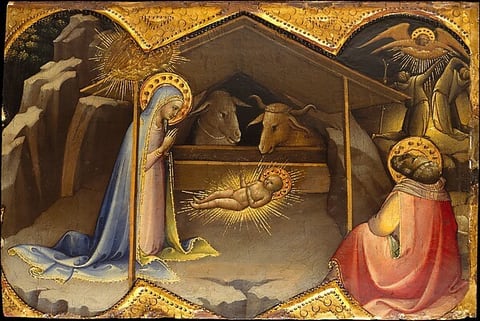
The Nativity, by Lorenzo Monaco, ca. 1406–10
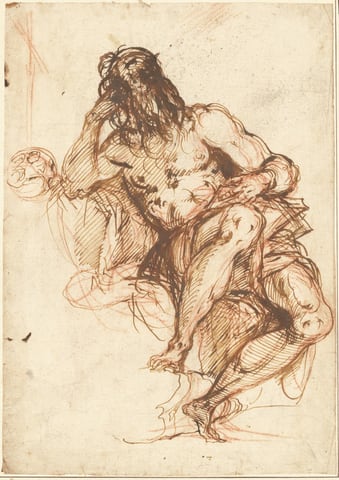
The image shows a sketch of a seated bearded figure holding an orb. The figure appears muscular, with a beard merging into long hair. The face is not detailed, and draped fabric covers part of the body. There is no jewelry, and the background is plain.
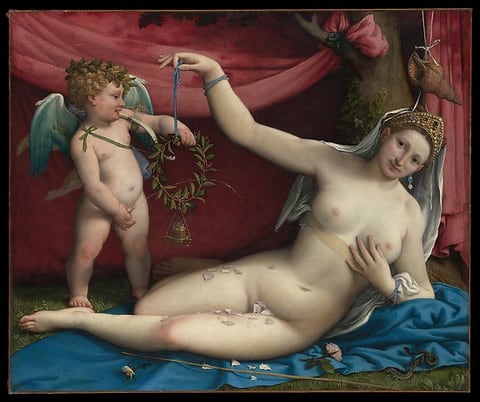
Venus and Cupid, by Lorenzo Lotto, 1520s
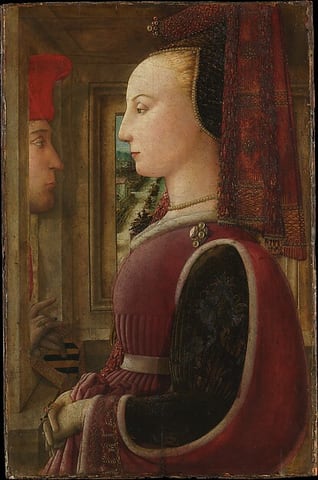
Portrait of a Woman with a Man at a Casement, by Fra Filippo Lippi, ca. 1440
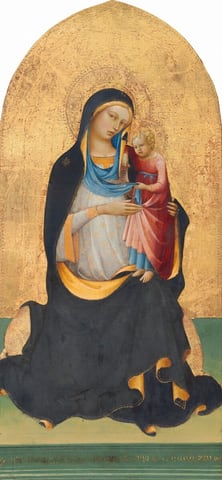
A woman sits and supports a baby standing on her lap, both against a gold background in this arched, vertical painting. The woman and baby’s light skin is shaded with faint green, and they have pale pink cheeks. The woman’s body faces us. She tips her head toward the baby who stands on her knee, to our right. The woman looks at us with light brown eyes under curving brows. She has a long, straight nose, and her small pink lips are closed. Her blond hair is mostly covered by a midnight-blue robe that drapes over her shoulders, across her lap, and pools on the floor. The robe is lined with goldenrod yellow, edged with bright gold, and has gold starburst-like designs on the shoulder we can see and top of the head. The dress she wears underneath has more gold stars creating a pattern across the pearl-white fabric. A sky-blue scarf wraps over her head and loops across her shoulders. The baby holds one end of the scarf, and his other elbow rests on the woman’s shoulder. She props him up with both hands. He has a cap of blond curls and chubby cheeks with delicate features. His geranium-red garment falls over a pale blue skirt that reaches his bare feet. In the hand near the woman’s shoulder, he holds a scroll with the letters “EGO S.” The floor beneath them is mint green and has gold writing across the front, reading, “AVE.G ANN O.D M.CCCC.XIII.” The woman and baby’s disc-like gold halos blend into the gold background, which is visibly cracked in some areas. The panel comes to a pointed arch at the top.

The works in this room are listed below.

Works in this room

Florence, Venice and Rome from 1400 to 1600: perspective, anatomy and the classical past.

First room, north wall

  1. Madonna and Child, by Filippino Lippi, ca. 1483–84
    Madonna and ChildFilippino Lippi, ca. 1483–84Courtesy of The Metropolitan Museum of Art
  2. The Creation of the World and the Expulsion from Paradise, by Giovanni di Paolo, 1445
    The Creation of the World and the Expulsion from ParadiseGiovanni di Paolo, 1445Courtesy of The Metropolitan Museum of Art
  3. POPE RECEIVING VISITOR
    Pope Receiving VisitorBelisario Corenzio, 1590–1646Courtesy of Cooper Hewitt, Smithsonian Design Museum
  4. The Nativity, by Lorenzo Monaco, ca. 1406–10
    The NativityLorenzo Monaco, ca. 1406–10Courtesy of The Metropolitan Museum of Art

First room, south wall

  1. The image shows a sketch of a seated bearded figure holding an orb. The figure appears muscular, with a beard merging into long hair. The face is not detailed, and draped fabric covers part of the body. There is no jewelry, and the background is plain.
    Saint JeromeAlessandro Vittoria, 1565/1570Courtesy National Gallery of Art, Washington
  2. Venus and Cupid, by Lorenzo Lotto, 1520s
    Venus and CupidLorenzo Lotto, 1520sCourtesy of The Metropolitan Museum of Art
  3. Portrait of a Woman with a Man at a Casement, by Fra Filippo Lippi, ca. 1440
    Portrait of a Woman with a Man at a CasementFra Filippo Lippi, ca. 1440Courtesy of The Metropolitan Museum of Art
  4. A woman sits and supports a baby standing on her lap, both against a gold background in this arched, vertical painting. The woman and baby’s light skin is shaded with faint green, and they have pale pink cheeks. The woman’s body faces us. She tips her head toward the baby who stands on her knee, to our right. The woman looks at us with light brown eyes under curving brows. She has a long, straight nose, and her small pink lips are closed. Her blond hair is mostly covered by a midnight-blue robe that drapes over her shoulders, across her lap, and pools on the floor. The robe is lined with goldenrod yellow, edged with bright gold, and has gold starburst-like designs on the shoulder we can see and top of the head. The dress she wears underneath has more gold stars creating a pattern across the pearl-white fabric. A sky-blue scarf wraps over her head and loops across her shoulders. The baby holds one end of the scarf, and his other elbow rests on the woman’s shoulder. She props him up with both hands. He has a cap of blond curls and chubby cheeks with delicate features. His geranium-red garment falls over a pale blue skirt that reaches his bare feet. In the hand near the woman’s shoulder, he holds a scroll with the letters “EGO S.” The floor beneath them is mint green and has gold writing across the front, reading, “AVE.G ANN O.D M.CCCC.XIII.” The woman and baby’s disc-like gold halos blend into the gold background, which is visibly cracked in some areas. The panel comes to a pointed arch at the top.
    Madonna and ChildLorenzo Monaco, 1413Courtesy National Gallery of Art, Washington

Second room, south wall
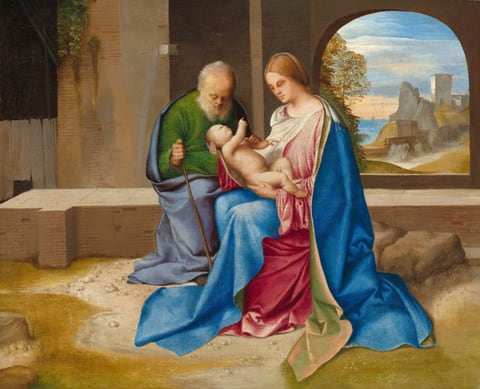
  1. An old man and a young woman holding an infant are seated together in the center of this almost square painting. All three people have pale, peachy skin. To our left, the man sits on a low, tan brick wall with his head bowed to look at the baby on the woman’s lap. A periwinkle-blue cloak is wrapped around the kelly-green robe that covers his shoulders, back, and legs. One hand grips a short staff planted on the ground. His receding white hair and beard are thin and scraggly with tufts sticking out over his ears. The woman sits next to and slightly in front of him, to our right, on a low rock, her body angled toward the man. A long, cobalt-blue cloak is draped around her shoulders and covers her knees over her rose-pink gown. Her honey-brown hair is parted in the middle and gathered at the back of her head. Her brown eyes look down at the infant, who is blond with brown eyes. A long white shawl is tucked into the neckline of her dress, drapes over her shoulders, and wraps under the baby as she cradles his body with one hand under his backside and the other behind his head. The baby lies on his back with his head turned toward the woman, and he points to her with one outstretched arm. The dirt ground is scattered with pebbles that make a loose ring around the trio, with moss-green growth to either side. A brown brick wall fills the upper half of the composition behind the people and extends off the top edge. A rounded arch pierces the back wall to our right of the woman. On the other side of the opening, trees with copper-brown leaves grow up along the left and the landscape beyond opens onto rocky hills with a white, square tower. In the deep distance, the silhouette of a town is painted in robin’s egg-blue against a pale peach horizon line. Thin, white clouds skim across the blue sky above.
    The Holy FamilyGiorgione, probably c. 1500Courtesy National Gallery of Art, Washington
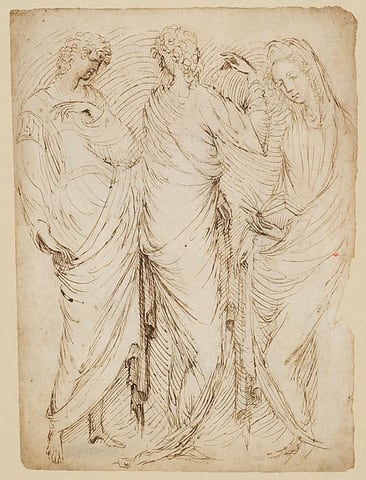
  2. Three Standing Figures (recto); Seated Woman and a Male Hermit in Half-length (verso), by Stefano da Verona (Stefano di Giovanni d'Arbosio di Francia), 1435–38
    Three Standing Figures (recto); Seated Woman and a Male Hermit in Half-length (verso)Stefano da Verona (Stefano di Giovanni d'Arbosio di Francia), 1435–38Courtesy of The Metropolitan Museum of Art
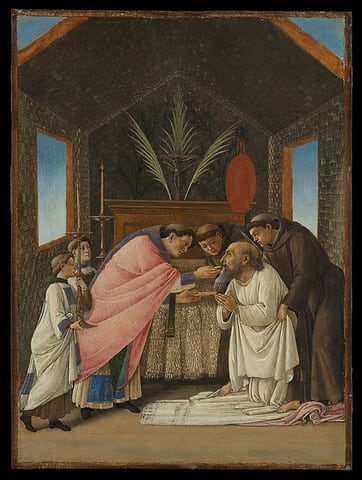
  3. The Last Communion of Saint Jerome, by Botticelli (Alessandro di Mariano Filipepi), early 1490s
    The Last Communion of Saint JeromeBotticelli (Alessandro di Mariano Filipepi), early 1490sCourtesy of The Metropolitan Museum of Art
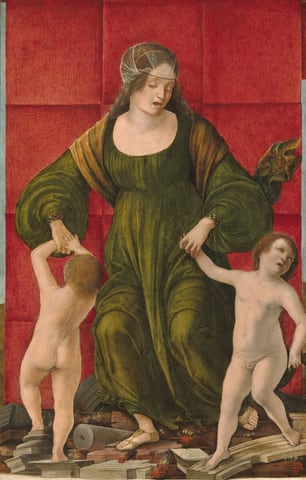
  4. A woman holds the hands of two nude children in front of a crimson-red cloth in this vertical painting. All three have pale skin and brown hair. The woman wears a forest-green dress with voluminous sleeves and a gauzy white headdress that wraps around her hair and is fastened with a band across her forehead. She stands crouching with one foot extended slightly forward in a sandal, surrounded by broken chunks of masonry and bits of burning logs. Her body faces us but she turns her head to the right. Her mouth is wide open, and her eyes cut back to our left. The woman clutches the children’s hands in both of her own. The child to our left turns away from us and reaches one hand up to touch the back of the woman’s hand. The child on the right twists away from the woman, eyes squinted up and to the right and mouth open. Behind them, fold lines create a grid across the red cloth. Slivers of grass and blue sky line each side of the composition.
    The Wife of Hasdrubal and Her ChildrenErcole de' Roberti, c. 1490/1493Courtesy National Gallery of Art, Washington

Second room, north wall
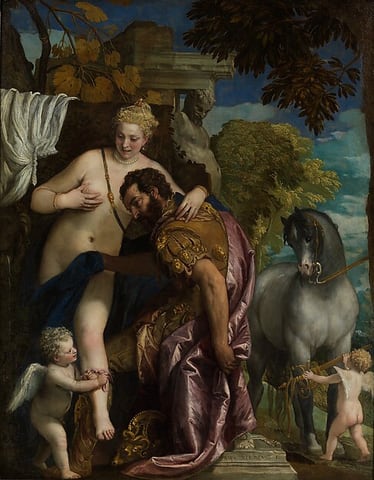
  1. Mars and Venus United by Love, by Paolo Veronese (Paolo Caliari), 1570s
    Mars and Venus United by LovePaolo Veronese (Paolo Caliari), 1570sCourtesy of The Metropolitan Museum of Art
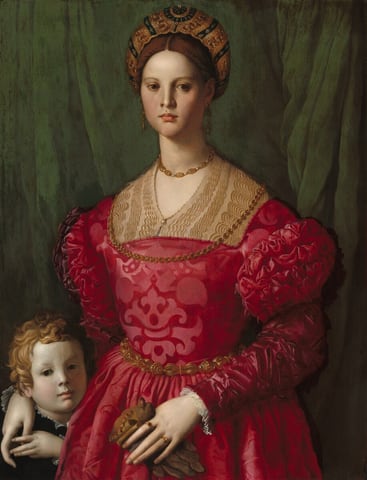
  2. A woman wearing a crimson-red brocade dress and gold jewelry fills most of this vertical portrait, but her right hand, on our left, rests on the shoulder of a young boy tucked into the lower left corner of the panel. The woman and boy both have pale, white skin, and both face and look out at us against an emerald-green curtain that falls behind them. The woman has brown eyes, a straight nose, full pink lips, smooth cheeks, and a long neck. Her brown hair is pulled back under a turban densely embroidered with gold. The woman’s dress has puffed shoulders and decorative slashes on the sleeves. One gold chain rests on her throat and the other falls over her chest. She wears long gold earrings, a gold belt, and two gold rings. She holds a brown leather glove in her left hand. The boy’s face is even with the woman’s waist, and he raises his left hand to hold hers, which is draped over his shoulder. He has curly blond hair and dark eyes, and he wears black with a ruffled white shirt just visible at his collar.
    A Young Woman and Her Little BoyAgnolo Bronzino, c. 1540Courtesy National Gallery of Art, Washington

Third room, north wall
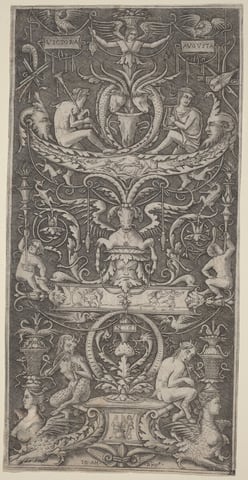
  1. This is a drawing of an ornamental design featuring mythological creatures and motifs. The artwork depicts a symmetrical arrangement with two central figures holding musical instruments, surrounded by acanthus leaves, griffins, and sphinxes. In the upper portion, there is a winged figure with a crown-like headdress carrying symbols or trophies. The design is detailed with decorative elements including floral patterns and architectural motifs. Throughout the drawing, there are various mythological creatures integrated into the composition.
    Ornamental Panel Inscribed "Victoria Augusta"Giovanni Antonio da Brescia, c. 1516Courtesy National Gallery of Art, Washington
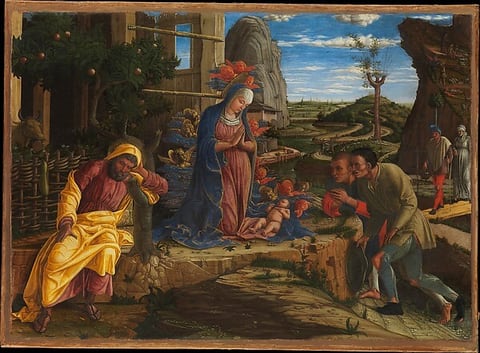
  2. The Adoration of the Shepherds, by Andrea Mantegna, shortly after 1450
    The Adoration of the ShepherdsAndrea Mantegna, shortly after 1450Courtesy of The Metropolitan Museum of Art