Floor plan

Style galleriesThe Italian Renaissance
The Italian Renaissance
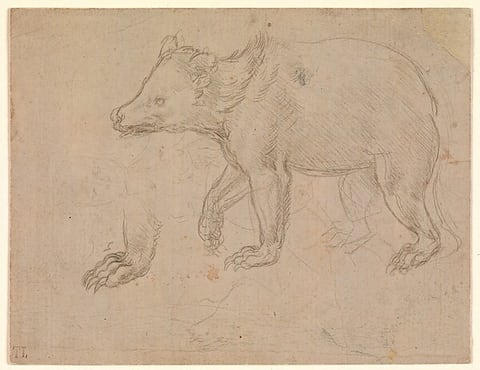
A Bear Walking, by Leonardo da Vinci, ca. 1482–85
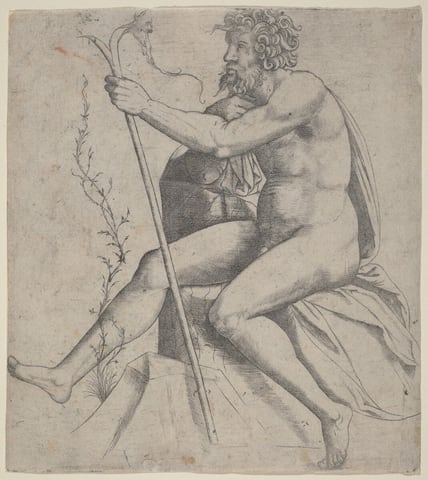
The image shows a man seated with a slight forward tilt. He is muscular, with one leg bent and the other extended. His head is turned to the left in profile, revealing his facial features, which include a large nose, full beard, and curly hair. He appears naked except for a fabric drape over his shoulders. In his left hand, he holds a staff, and there is a plant with twisting vines near him. The background is a shaded rocky surface with no other details.
Christ Crowned with Thorns, by Antonello da Messina (Antonello di Giovanni d'Antonio)
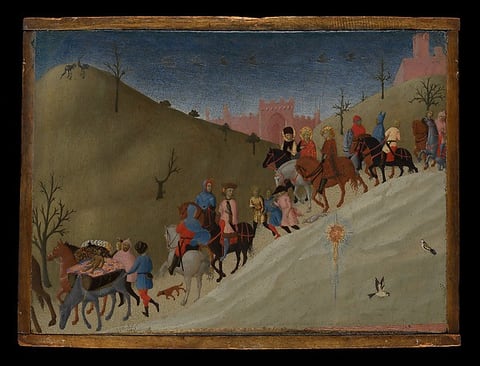
The Journey of the Magi, by Sassetta, ca. 1433–35
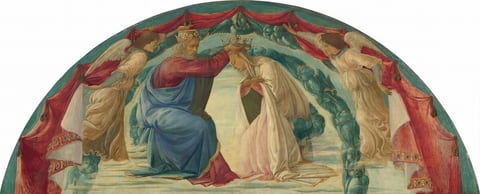
In a wide, arched panel, a bearded man wearing a crown places another crown on the head of a woman. To our right, the woman bows her head with her eyes nearly closed and crosses her wrists over her chest. A white cloak covers her head, drapes over her shoulders, and pools in deep folds around her feet. The cloak is lined with pine green, and she wears a shell-pink dress. To our left, the man has shoulder-length, curly gray hair and a beard. His robe is dark rose pink, and the cloak is azure blue lined with pine green. Two winged angels have brown hair, short, white wings, and wear voluminous white robes. They stand to either side of the man and woman and hold up a swag of raspberry-red cloth hung with gold tassels. All the people have pale, peachy skin. Winged baby heads encircled with gold rays create an arch behind the man and woman, who sit on clouds. The background is pale blue sky.
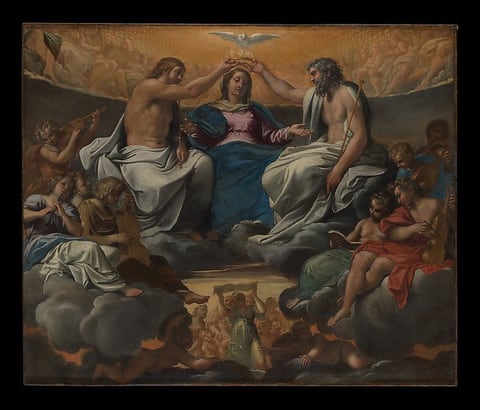
The Coronation of the Virgin, by Annibale Carracci, after 1595

The works in this room are listed below.

Works in this room

Florence, Venice and Rome from 1400 to 1600: perspective, anatomy and the classical past.

First room, north wall

  1. A Bear Walking, by Leonardo da Vinci, ca. 1482–85
    A Bear WalkingLeonardo da Vinci, ca. 1482–85Courtesy of The Metropolitan Museum of Art
  2. The image shows a man seated with a slight forward tilt. He is muscular, with one leg bent and the other extended. His head is turned to the left in profile, revealing his facial features, which include a large nose, full beard, and curly hair. He appears naked except for a fabric drape over his shoulders. In his left hand, he holds a staff, and there is a plant with twisting vines near him. The background is a shaded rocky surface with no other details.
    Man Seated Holding a Forked StaffGiovanni Antonio da Brescia, c. 1514/1515Courtesy National Gallery of Art, Washington
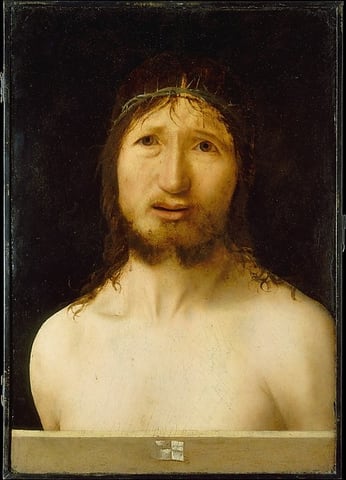
  3. Christ Crowned with Thorns, by Antonello da Messina (Antonello di Giovanni d'Antonio)
    Christ Crowned with ThornsAntonello da Messina (Antonello di Giovanni d'Antonio)Courtesy of The Metropolitan Museum of Art
  4. The Journey of the Magi, by Sassetta, ca. 1433–35
    The Journey of the MagiSassetta, ca. 1433–35Courtesy of The Metropolitan Museum of Art

First room, south wall

  1. In a wide, arched panel, a bearded man wearing a crown places another crown on the head of a woman. To our right, the woman bows her head with her eyes nearly closed and crosses her wrists over her chest. A white cloak covers her head, drapes over her shoulders, and pools in deep folds around her feet. The cloak is lined with pine green, and she wears a shell-pink dress. To our left, the man has shoulder-length, curly gray hair and a beard. His robe is dark rose pink, and the cloak is azure blue lined with pine green. Two winged angels have brown hair, short, white wings, and wear voluminous white robes. They stand to either side of the man and woman and hold up a swag of raspberry-red cloth hung with gold tassels. All the people have pale, peachy skin. Winged baby heads encircled with gold rays create an arch behind the man and woman, who sit on clouds. The background is pale blue sky.
    The Coronation of the VirginFilippino Lippi, c. 1475Courtesy National Gallery of Art, Washington
  2. The Coronation of the Virgin, by Annibale Carracci, after 1595
    The Coronation of the VirginAnnibale Carracci, after 1595Courtesy of The Metropolitan Museum of Art

Second room, south wall
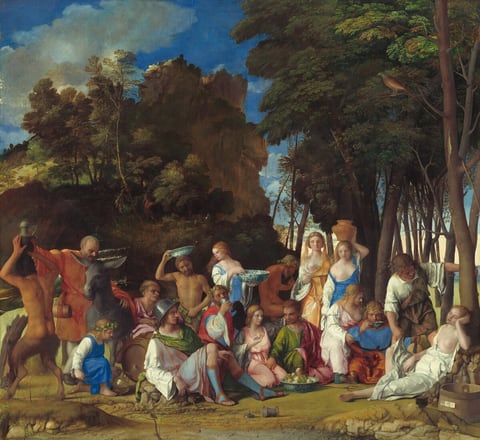
  1. Six women, eight men, two satyrs, and one child gather in pairs and trios in a loose row that spans the width of this nearly square painting. They are set within a landscape with craggy rocks, cliffs, and trees. Most of the people face us, and the men, women, and child have pale skin. The two satyrs have men’s torsos and furry goat’s legs, and they have darker, olive complexions. Most of the men wear voluminous, knee-length togas wrapped in short robes in shades of white, topaz blue, grass green, coral orange, or rose pink. Most of the women wear long, dress-like garments in tones of shell pink, apricot orange, or lapis blue over white sleeves. For all but one woman, their garments have fallen off one shoulder to reveal a round, firm breast. Several objects are strewn on the rocky, dirt ground in front of the group, including a wide, wooden bucket with a piece of paper affixed to its front to our right, a glass goblet, a pitchfork, a large blue and white ceramic dish filled with grapes and small yellow fruits, and an overturned cup near the center. Cliff-like, craggy rocks rise steeply behind the group to our left, filling much of the sky opposite a tall grove of leafy, dark green trees to our right. A few puffy white clouds float across the vivid blue sky. The slip of paper on the barrel has been inscribed, “joannes bellinus venetus p MDXIIII.”
    The Feast of the GodsGiovanni Bellini, 1514/1529Courtesy National Gallery of Art, Washington
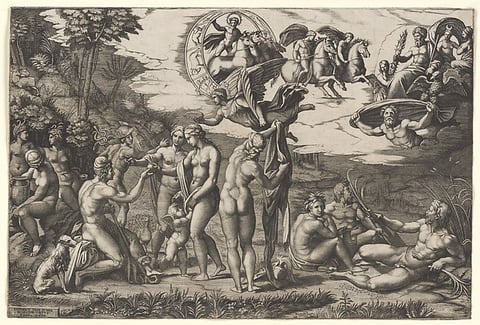
  2. The Judgment of Paris: he is sitting at left with Venus, Juno and Pallas Athena, a winged victory above. In the upper section the Sun in his chariot preceeded by Castor and Pollux on horseback, at lower right two river gods and a naiad above whom Jupiter, an eagle, Ganymede, Diana and another goddess, by Marcantonio Raimondi, ca. 1510–20
    The Judgment of Paris: he is sitting at left with Venus, Juno and Pallas Athena, a winged victory above. In the upper section the Sun in his chariot preceeded by Castor and Pollux on horseback, at lower right two river gods and a naiad above whom Jupiter, an eagle, Ganymede, Diana and another goddessMarcantonio Raimondi, ca. 1510–20Courtesy of The Metropolitan Museum of Art
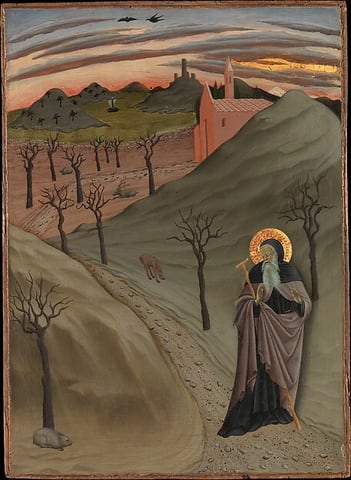
  3. Saint Anthony the Abbot in the Wilderness, by Sano di Pietro (Ansano di Pietro di Mencio), ca. 1440
    Saint Anthony the Abbot in the WildernessSano di Pietro (Ansano di Pietro di Mencio), ca. 1440Courtesy of The Metropolitan Museum of Art

Second room, north wall
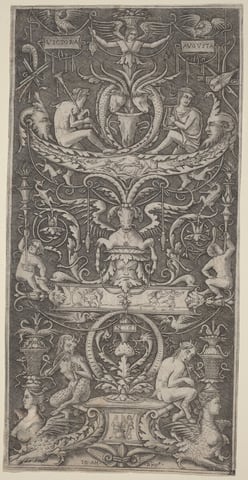
  1. This is a drawing of an ornamental design featuring mythological creatures and motifs. The artwork depicts a symmetrical arrangement with two central figures holding musical instruments, surrounded by acanthus leaves, griffins, and sphinxes. In the upper portion, there is a winged figure with a crown-like headdress carrying symbols or trophies. The design is detailed with decorative elements including floral patterns and architectural motifs. Throughout the drawing, there are various mythological creatures integrated into the composition.
    Ornamental Panel Inscribed "Victoria Augusta"Giovanni Antonio da Brescia, c. 1516Courtesy National Gallery of Art, Washington
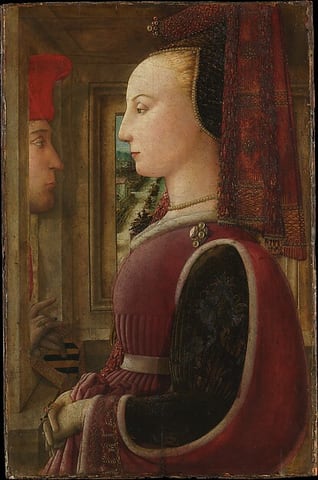
  2. Portrait of a Woman with a Man at a Casement, by Fra Filippo Lippi, ca. 1440
    Portrait of a Woman with a Man at a CasementFra Filippo Lippi, ca. 1440Courtesy of The Metropolitan Museum of Art
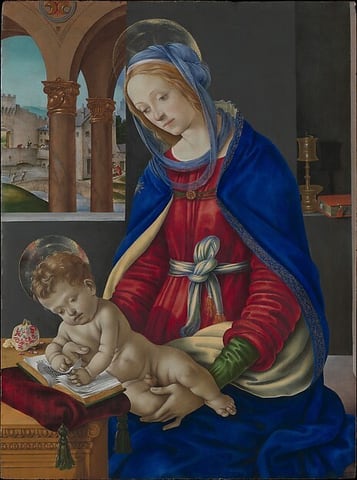
  3. Madonna and Child, by Filippino Lippi, ca. 1483–84
    Madonna and ChildFilippino Lippi, ca. 1483–84Courtesy of The Metropolitan Museum of Art
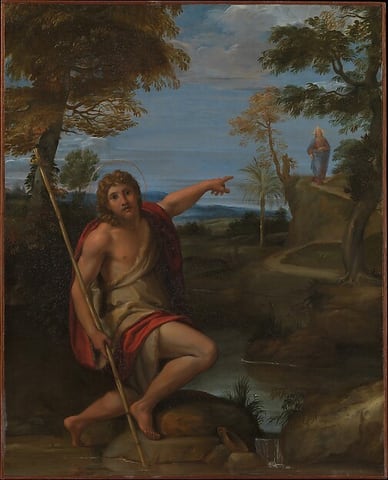
  4. Saint John the Baptist Bearing Witness, by Annibale Carracci, ca. 1600
    Saint John the Baptist Bearing WitnessAnnibale Carracci, ca. 1600Courtesy of The Metropolitan Museum of Art

Third room, north wall
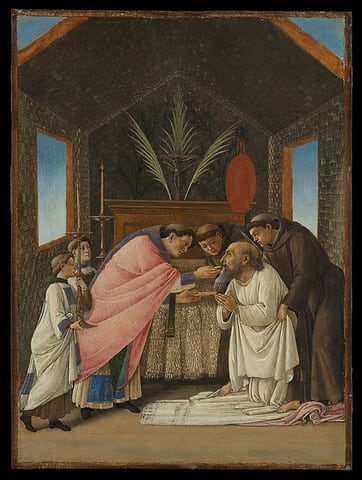
  1. The Last Communion of Saint Jerome, by Botticelli (Alessandro di Mariano Filipepi), early 1490s
    The Last Communion of Saint JeromeBotticelli (Alessandro di Mariano Filipepi), early 1490sCourtesy of The Metropolitan Museum of Art
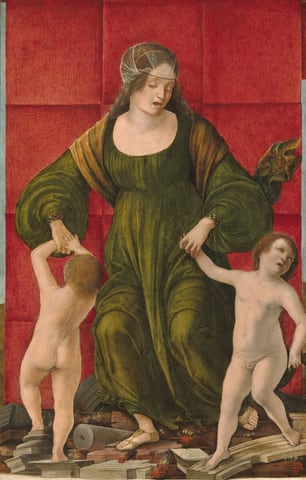
  2. A woman holds the hands of two nude children in front of a crimson-red cloth in this vertical painting. All three have pale skin and brown hair. The woman wears a forest-green dress with voluminous sleeves and a gauzy white headdress that wraps around her hair and is fastened with a band across her forehead. She stands crouching with one foot extended slightly forward in a sandal, surrounded by broken chunks of masonry and bits of burning logs. Her body faces us but she turns her head to the right. Her mouth is wide open, and her eyes cut back to our left. The woman clutches the children’s hands in both of her own. The child to our left turns away from us and reaches one hand up to touch the back of the woman’s hand. The child on the right twists away from the woman, eyes squinted up and to the right and mouth open. Behind them, fold lines create a grid across the red cloth. Slivers of grass and blue sky line each side of the composition.
    The Wife of Hasdrubal and Her ChildrenErcole de' Roberti, c. 1490/1493Courtesy National Gallery of Art, Washington
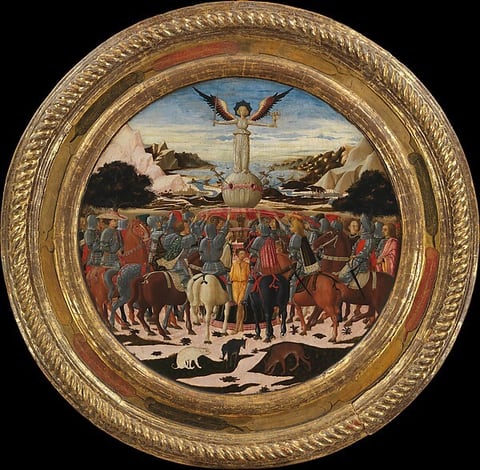
  3. The Triumph of Fame; (reverse) Impresa of the Medici Family and Arms of the Medici and Tornabuoni Families, by Giovanni di ser Giovanni Guidi (called Scheggia), ca. 1449
    The Triumph of Fame; (reverse) Impresa of the Medici Family and Arms of the Medici and Tornabuoni FamiliesGiovanni di ser Giovanni Guidi (called Scheggia), ca. 1449Courtesy of The Metropolitan Museum of Art