Floor plan

Style galleriesThe Etching Revival

The Etching Revival

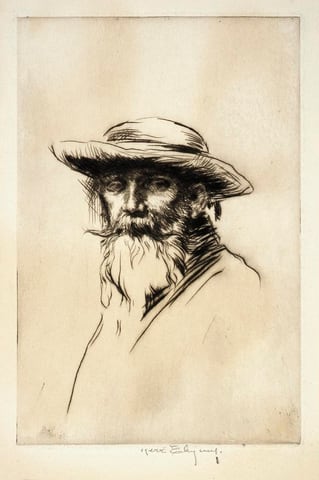
Head of an Old Man, by Kerr Eby, ca. 1918
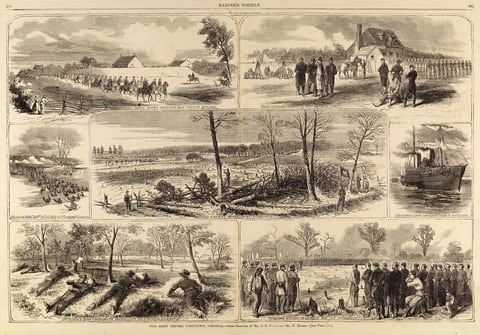
Our Army before Yorktown, Virginia, from Harper's Weekly, May 3, 1862, by Winslow Homer, 1862
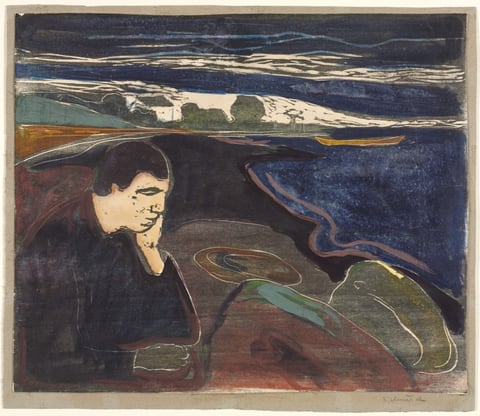
Evening, Melancholy I, by Edvard Munch, 1896
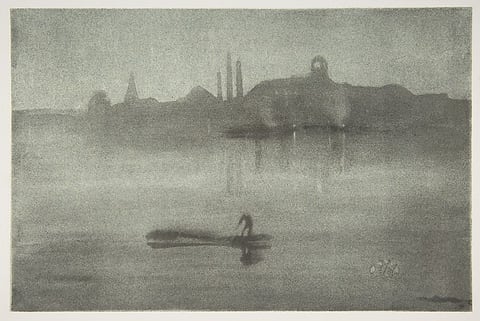
Nocturne (Nocturne: The Thames at Battersea), by James McNeill Whistler, 1878

The works in this room are listed below.

Works in this room

Artists who took up the etching needle again, from Whistler to the Paris printmakers.

Section 1, north wall

  1. Head of an Old Man, by Kerr Eby, ca. 1918
    Head of an Old ManKerr Eby, ca. 1918Courtesy of the Smithsonian American Art Museum
  2. Our Army before Yorktown, Virginia, from Harper's Weekly, May 3, 1862, by Winslow Homer, 1862
    Our Army before Yorktown, Virginia, from Harper's Weekly, May 3, 1862Winslow Homer, 1862Courtesy of the Smithsonian American Art Museum

Section 1, south wall

  1. Evening, Melancholy I, by Edvard Munch, 1896
    Evening, Melancholy IEdvard Munch, 1896Courtesy of the Cleveland Museum of Art
  2. Nocturne (Nocturne: The Thames at Battersea), by James McNeill Whistler, 1878
    Nocturne (Nocturne: The Thames at Battersea)James McNeill Whistler, 1878Courtesy of The Metropolitan Museum of Art

Section 2, south wall
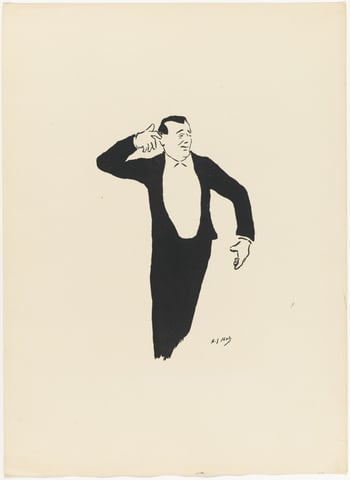
  1. A work made of lithograph on ivory wove paper.
    Paulus, from Le Café-ConcertHenri-Gabriel Ibels, 1893Courtesy of the Art Institute of Chicago
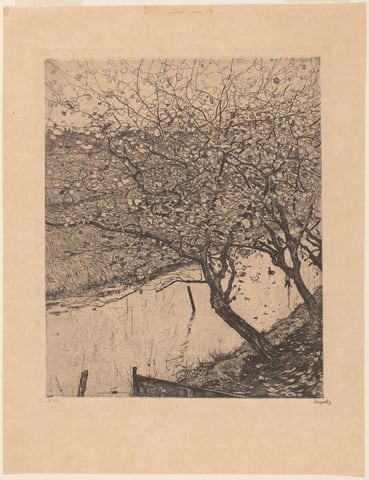
  2. The image shows a small body of water with grass-covered banks on either side. The viewpoint is slightly elevated, looking down at the scene. The horizon is in the upper third of the composition, separating the sky from the land. The artwork features intricate linework and stippling to create texture and detail, particularly in the tree branches. The color palette is monochrome, with shades of sepia and brown. A tree dominates the right side of the scene, leaning over the water. In the distance, more trees and fields are visible with minimal detail in the far background.
    Apple Trees along the Side of a DitchPieter Dupont, 1894Courtesy National Gallery of Art, Washington
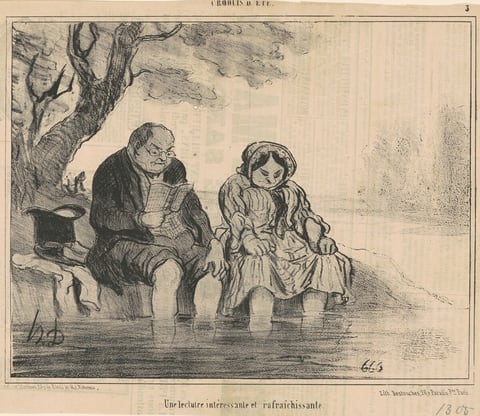
  3. The image shows two individuals seated outdoors near a body of water with their feet submerged. Both individuals are seen from head to toe. The person on the left is seated with a slightly hunched posture, reading a document or a book. They have a balding head, wear glasses, a dark suit with the coat draped over their knees, and a top hat placed on the ground. The individual on the right is sitting upright with a scarf over their hair. They wear a long dress with a shawl, and their hands rest on their lap. The background features a bare tree and a rough, sketched environment. The sky and landscape are depicted in shades of light and dark.
    Une lecture intéressante et rafraichissanteHonoré Daumier, 1854Courtesy National Gallery of Art, Washington

Section 2, north wall
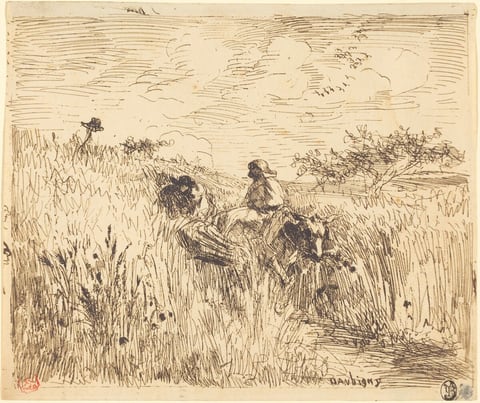
  1. This image shows an elevated view of a grassy landscape with sparse trees and vegetation at the horizon. The linear brushstrokes create texture and movement in the grass and sky. The color palette is monochromatic with sepia tones. In the foreground, a figure is on a horse amidst tall grasses, while in the distance, another figure stands on the left and a cluster of trees is on the right. The sky has wisps of clouds.
    Path through a Wheat Field (Sentier dans les bles)Charles-François Daubigny, 1862Courtesy National Gallery of Art, Washington
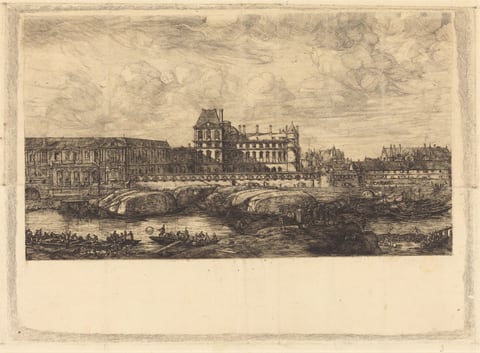
  2. The image features a riverside scene with a large building in the center and smaller structures in the background. The sky is filled with clouds, and there are boats on the water. The artwork is done in an etching style, with detailed lines showing architectural elements, boats, and water ripples. The color scheme is monochromatic in shades of brown and black.
    L'ancien Louvre d'après une peinture de Zeeman, 1651 (The Old Louvre, from a Painting by Zeeman, l651)Charles Meryon, 1866Courtesy National Gallery of Art, Washington
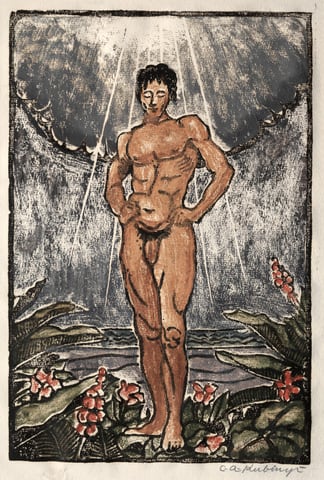
  3. The Creation, by Kálmán Kubinyi, before 1927
    The CreationKálmán Kubinyi, before 1927Courtesy of the Cleveland Museum of Art

Section 3, north wall
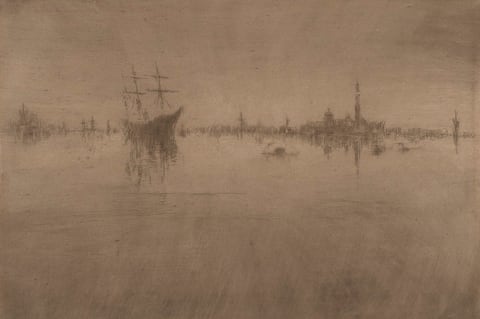
  1. A work made of etching and drypoint in brown on cream laid paper.
    Nocturne, from Venice, a Series of Twelve Etchings (the "First Venice Set")James McNeill Whistler, 1879–80Courtesy of the Art Institute of Chicago
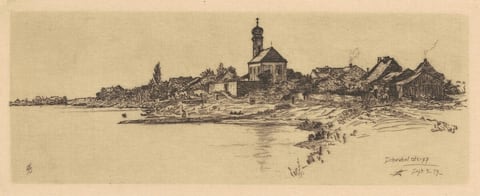
  2. The image shows a village scene viewed from a low vantage point near a water's edge. A row of small, closely packed buildings and a church with an onion-shaped dome are prominently featured. There are gentle slopes leading towards the structures. The image uses fine, detailed line work to depict texture and depth in the buildings and natural landscape. The lines are delicate and varied, creating a sense of detail and softness. The color palette is monochromatic, with dark ink on a pale background, resulting in a classic and timeless feel.
    SchwabelweissOtto Henry Bacher, 1879Courtesy National Gallery of Art, Washington
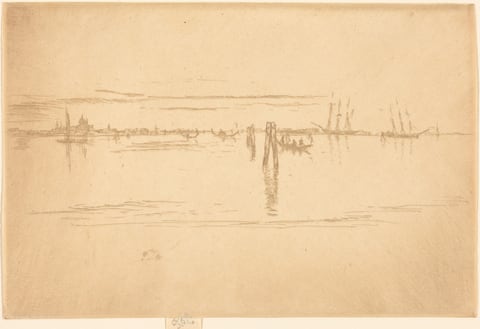
  3. The image shows a landscape with a waterscape. The horizon separates the water and the sky. In the distance, there are buildings, structures, and ships with tall masts. Close to us, there are reflections of the ships and structures in the water with fine brushstrokes. The style is impressionistic with thin lines conveying details. The color palette is monochromatic with sepia tones.
    Long LagoonJames McNeill Whistler, 1880Courtesy National Gallery of Art, Washington

Section 3, south wall
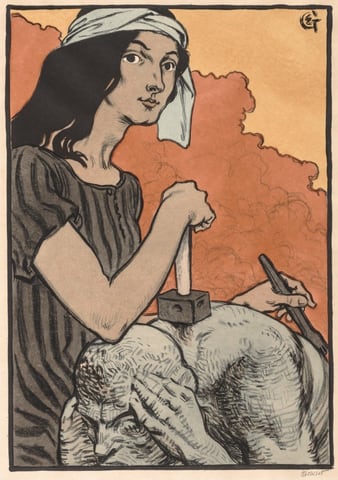
  1. Sculptress, by Eugène Grasset, 1897
    SculptressEugène Grasset, 1897Courtesy of the Cleveland Museum of Art
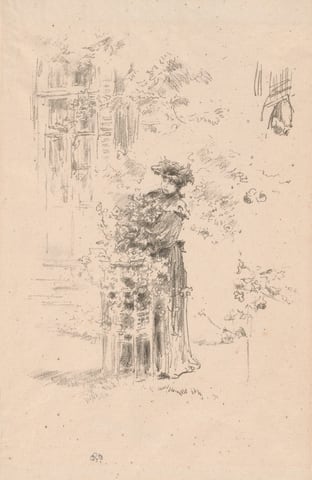
  2. A work made of transfer lithograph in black, with stumping and scraping, on cream laid paper, laid down on a heavy backing sheet.
    La Belle JardinièreJames McNeill Whistler, 1894Courtesy of the Art Institute of Chicago
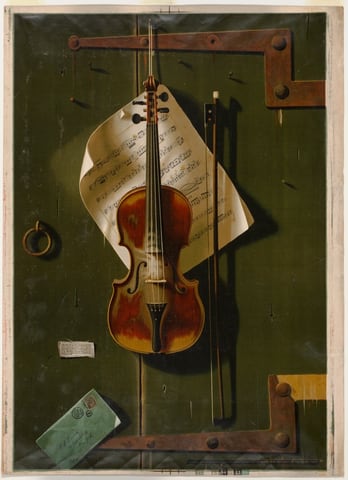
  3. A work made of color lithograph on paper.
    The Old ViolinWilliam Michael Harnett, 1887Courtesy of the Art Institute of Chicago