Floor plan

Style galleriesAmerican folk and design
American folk and design
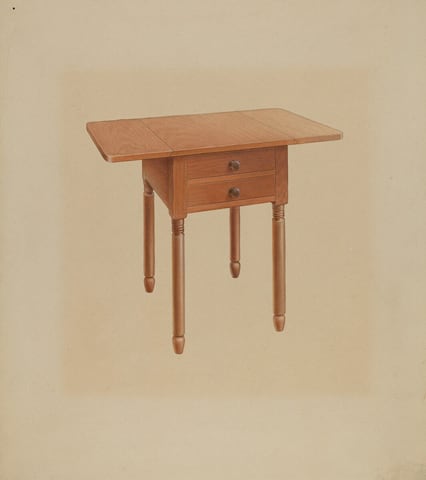
The image shows a wooden drop-leaf table with four turned legs and two drawers. The table's surface includes two side panels that can be raised or lowered. The color palette is warm brown tones. The table is centered in the image, with both leaves partially visible.
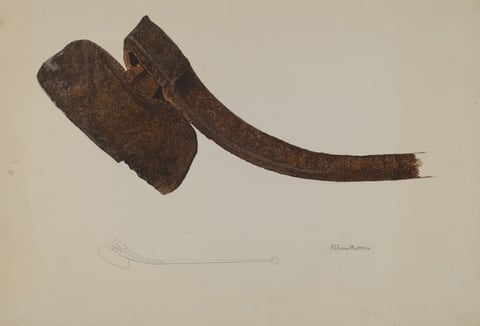
The image shows a large, rusted ax with a curved brown handle placed diagonally across the canvas. The color palette consists of muted browns and beiges, highlighting the aged appearance of the ax. Beneath the ax, there is a faint outline sketch of a similar object, and the artist's signature is located to the right of the sketch. The ax is in the upper half of the image, while the sketch and signature are in the center-bottom section.
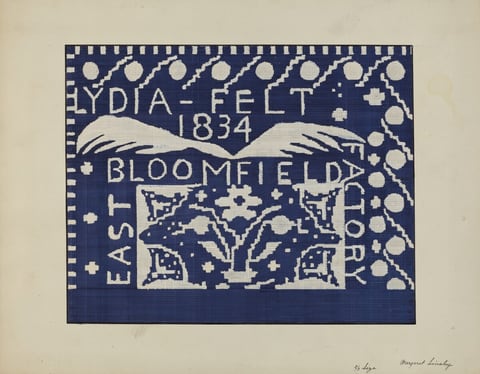
This is a drawing of a textile design. The image consists of a pattern with the text "LYDIA FELT 1834 BLOOMFIELD" displayed along with decorative motifs of abstract leaves and floral shapes in a contrasting color against a dark background. The composition also includes the word "EAST" placed vertically and "YORK" placed horizontally. The combination of geometric shapes and organic elements forms a unified aesthetic typical of traditional textile patterns.
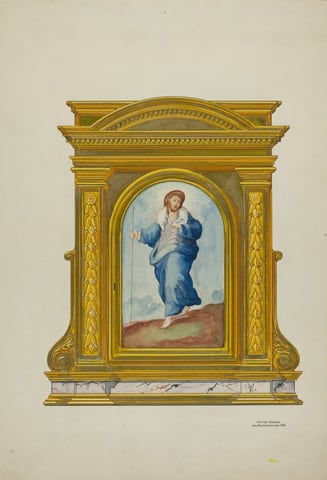
The image shows a painted artwork within an ornate frame. The artwork features a figure standing with one hand raised. The figure has long hair and a beard, and wears flowing blue and white garments. The background shows an earthy surface and a sky. The frame is gold and elaborately designed. The scene is set against a blank, light-colored background.
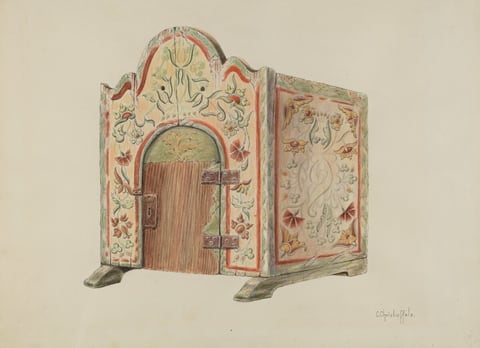
The image shows a small intricately decorated wooden structure with an arched top and a central door flanked by two metal hinges. The structure is painted with a floral and vine motif in colors such as red, green, and yellow on a light background. The wooden door has a textured appearance. The object is positioned centrally with the door facing forward, placed on a slightly elevated base with two footings extending forward. The overall look is ornate and symmetrical, showcasing detailed design work.
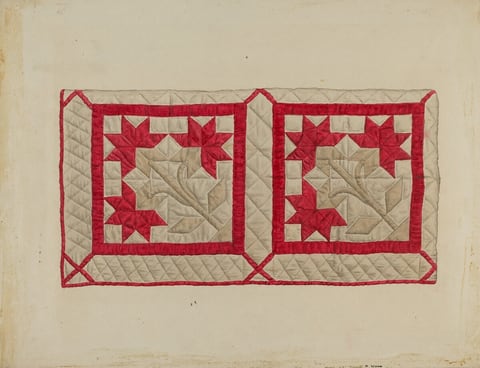
The image shows two large quilt blocks with a matching design, side by side. Each block consists of red and beige fabric with quilted stitching creating a textured appearance. The color palette includes primarily red, beige, and dark stitching outlining the patterns. The quilt blocks are placed centrally on a light-colored surface.

The works in this room are listed below.

Works in this room

The everyday art of early America, recorded in watercolour by the Index of American Design.

Section 1, north wall

  1. The image shows a wooden drop-leaf table with four turned legs and two drawers. The table's surface includes two side panels that can be raised or lowered. The color palette is warm brown tones. The table is centered in the image, with both leaves partially visible.
    Shaker TableAlfred H. Smith, c. 1938Courtesy National Gallery of Art, Washington
  2. The image shows a large, rusted ax with a curved brown handle placed diagonally across the canvas. The color palette consists of muted browns and beiges, highlighting the aged appearance of the ax. Beneath the ax, there is a faint outline sketch of a similar object, and the artist's signature is located to the right of the sketch. The ax is in the upper half of the image, while the sketch and signature are in the center-bottom section.
    Dumb IronAlfonso Moreno, c. 1938Courtesy National Gallery of Art, Washington
  3. This is a drawing of a textile design. The image consists of a pattern with the text "LYDIA FELT 1834 BLOOMFIELD" displayed along with decorative motifs of abstract leaves and floral shapes in a contrasting color against a dark background. The composition also includes the word "EAST" placed vertically and "YORK" placed horizontally. The combination of geometric shapes and organic elements forms a unified aesthetic typical of traditional textile patterns.
    CoverletMargaret Linsley, c. 1940Courtesy National Gallery of Art, Washington

Section 1, south wall

  1. The image shows a painted artwork within an ornate frame. The artwork features a figure standing with one hand raised. The figure has long hair and a beard, and wears flowing blue and white garments. The background shows an earthy surface and a sky. The frame is gold and elaborately designed. The scene is set against a blank, light-colored background.
    Original Tabernacle, for Communion VesselsDayton Brown, 1936Courtesy National Gallery of Art, Washington
  2. The image shows a small intricately decorated wooden structure with an arched top and a central door flanked by two metal hinges. The structure is painted with a floral and vine motif in colors such as red, green, and yellow on a light background. The wooden door has a textured appearance. The object is positioned centrally with the door facing forward, placed on a slightly elevated base with two footings extending forward. The overall look is ornate and symmetrical, showcasing detailed design work.
    Tabernacle (Ecclesiastical Furniture)Cornelius Christoffels, c. 1938Courtesy National Gallery of Art, Washington
  3. The image shows two large quilt blocks with a matching design, side by side. Each block consists of red and beige fabric with quilted stitching creating a textured appearance. The color palette includes primarily red, beige, and dark stitching outlining the patterns. The quilt blocks are placed centrally on a light-colored surface.
    Patchwork QuiltPaul Ward, c. 1936Courtesy National Gallery of Art, Washington

Section 2, south wall
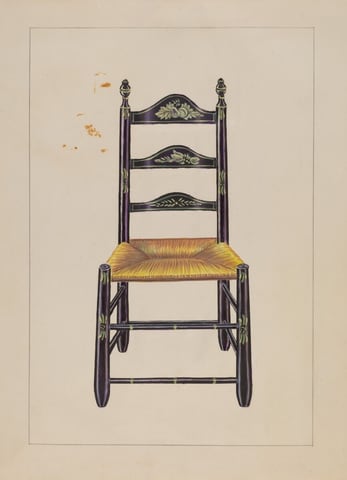
  1. The image shows a wooden chair with a rush seat. It features ornate details on the backrest. The color palette includes dark wood tones, pale greenish detailing, and a warm yellowish hue for the seat. The chair is centrally positioned in the image, viewed from the front, with no other objects around it.
    Ladderback ChairGerald Bernhardt, c. 1936Courtesy National Gallery of Art, Washington
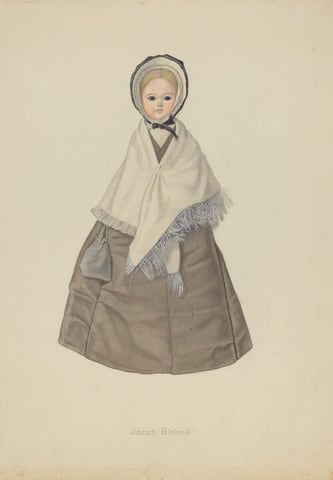
  2. The image depicts a young person standing upright with distinct facial features including rounded cheeks, a small mouth, and large eyes. They are wearing a brown dress with a cream-colored shawl, a bonnet with dark trim, and a pouch hanging from their left side. The background is plain and cream-colored.
    Quaker DollJacob Gielens, 1935/1942Courtesy National Gallery of Art, Washington
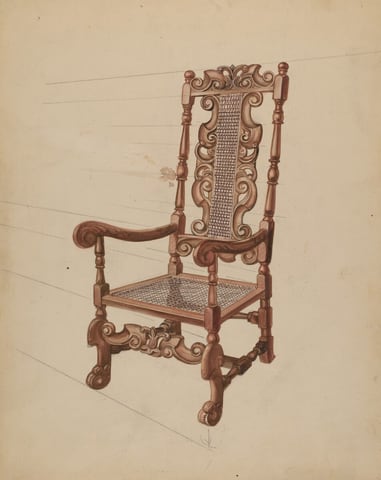
  3. The image shows an ornate chair with a high back, decorative carvings along its arms, legs, and backrest, a woven or cane seat and back, and intricate patterns. The chair is detailed with earthy brown tones and subtle shading accentuating the wood texture and design motifs. It is placed in the center of the image, facing slightly to the left, with linear guides indicating perspective and depth on a plain background.
    ArmchairAgnes Karlin, c. 1936Courtesy National Gallery of Art, Washington

Section 2, north wall
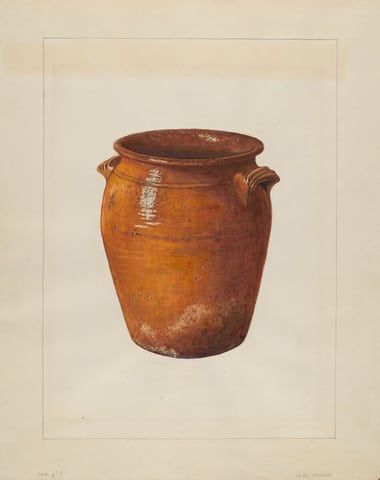
  1. The image features a large terracotta pot with two small handles on its sides. The pot is primarily in shades of earthy orange and brown with some lighter patches that suggest a slightly weathered texture. It is positioned centrally against a plain, light background.
    Preserving JarWilford H. Shurtliff, c. 1938Courtesy National Gallery of Art, Washington
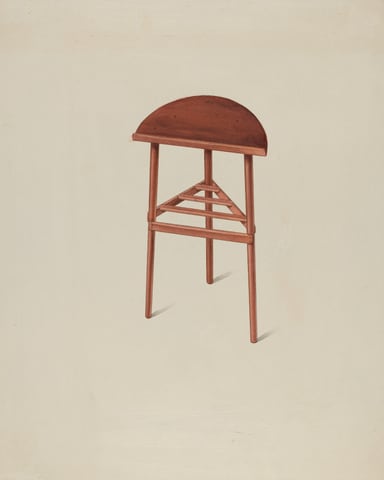
  2. The image shows a wooden stool with a semi-circular seat on a light beige background. The stool has four slim legs and a primarily brown color.
    Shaker Music RackAlfred H. Smith, c. 1936Courtesy National Gallery of Art, Washington
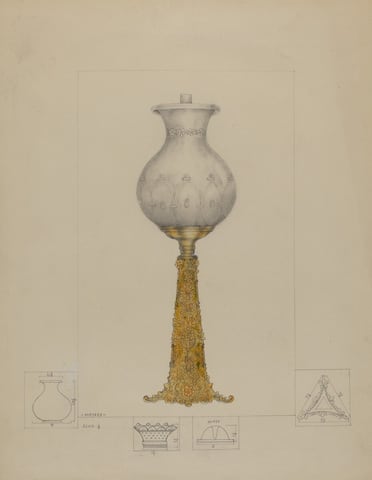
  3. This is a drawing of a decorative vase design. The central focus of the image is a detailed drawing of a vase with a bulbous body and a flared top, placed on an intricately designed tall stand. The stand features elaborate ornate patterns, giving it an almost floral appearance with its swirling details and golden hue. The vase itself has subtle decorative elements engraved or painted around its surface. Surrounding the primary image are additional sketches showcasing different parts and views of the vase, such as its profile, the pattern, and cross-sectional diagrams. These supplementary sketches provide further insight into the structural and decorative design aspects of the vase. The careful attention to scale and detail suggests this is a design blueprint for a piece of decorative art.
    Metal Base LampHenry Meyers, c. 1936Courtesy National Gallery of Art, Washington

Section 3, north wall
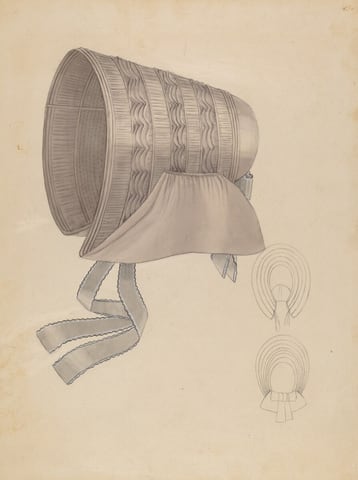
  1. This is an image of a bonnet and its details. The drawing showcases a bonnet with intricate design and texture. The bonnet is viewed from the side, revealing its woven structure with patterns representing fabric pleats or folds. It has a long ribbon hanging from the back, depicted with flowing lines. There are also two smaller sketches showing the bonnet from the back, emphasizing its shape and construction. The background is plain.
    BonnetBessie Forman, c. 1936Courtesy National Gallery of Art, Washington
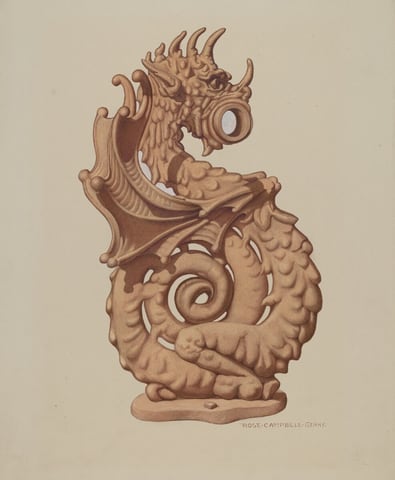
  2. The sculpture depicts a mythical creature resembling a dragon. It has a long spiraled body and an intricate head with spiky protrusions. The sculpture is a warm brown color. The dragon has bat-like wings, an open mouth, detailed texture with scales, and is standing on a small base.
    FenceRose Campbell-Gerke, c. 1941Courtesy National Gallery of Art, Washington

Section 3, south wall

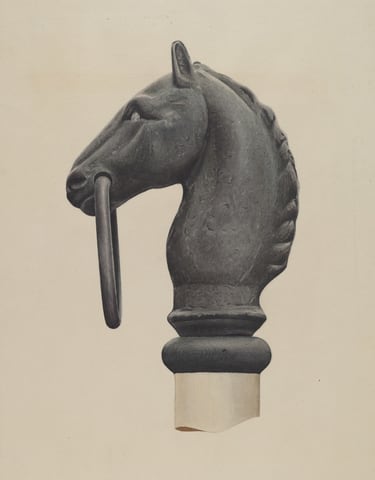
  1. The sculpture is a depiction of a horse's head crafted from a dark material that appears to be metal. The horse's ears are perked up, and its mane is depicted with smooth, curving lines trailing down the back of the neck. The sculpture includes a ring that extends from the horse's mouth. Positioned on a simple cylindrical pedestal, the sculpture's material and design suggest a robust and timeless feel. The details of the horse's expression and mane are rendered with a smooth finish.
    Hitching PostAlbert Ryder, c. 1938Courtesy National Gallery of Art, Washington
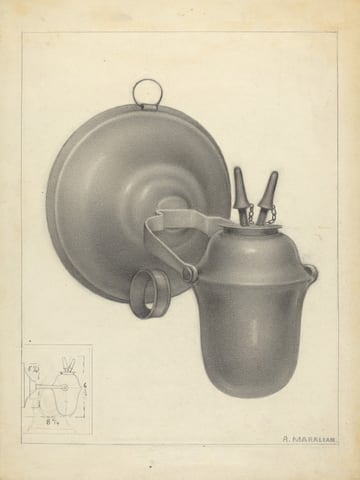
  2. The image depicts a detailed drawing of a wall-mounted vessel. It consists of a large, spherical body attached to a flat disc, with two smaller protrusions resembling handles or clips. The color palette is monochromatic with shades of gray, giving it a metallic or ceramic appearance. The objects are centrally positioned, with a small inset illustration in the bottom left corner showing annotations. The artist's signature, "A. Marshall," is located near the lower right corner of the image.
    LampArsen Maralian, c. 1936Courtesy National Gallery of Art, Washington