Floor plan

Style galleriesAmerican folk and design
American folk and design
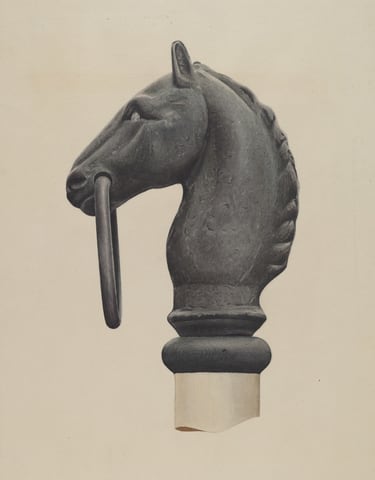
The sculpture is a depiction of a horse's head crafted from a dark material that appears to be metal. The horse's ears are perked up, and its mane is depicted with smooth, curving lines trailing down the back of the neck. The sculpture includes a ring that extends from the horse's mouth. Positioned on a simple cylindrical pedestal, the sculpture's material and design suggest a robust and timeless feel. The details of the horse's expression and mane are rendered with a smooth finish.
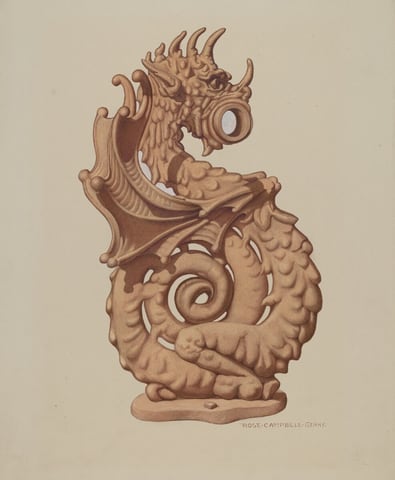
The sculpture depicts a mythical creature resembling a dragon. It has a long spiraled body and an intricate head with spiky protrusions. The sculpture is a warm brown color. The dragon has bat-like wings, an open mouth, detailed texture with scales, and is standing on a small base.
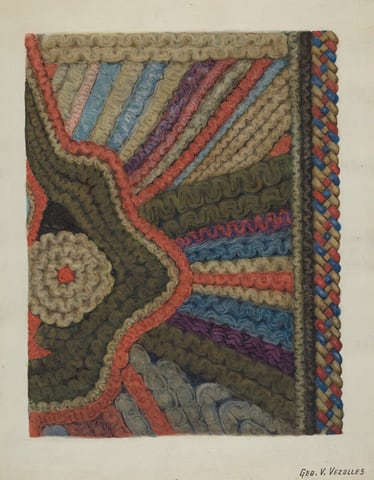
The image displays wavy lines and shapes with a mix of colors, creating an abstract composition. Curved lines are intertwined, resembling braided patterns or woven fabric textures. On the left, there is a large, organic shape bordered by red, green, and beige. The right side showcases a rhythmic pattern resembling a braided rug, with strands of red, blue, and brown. The overall composition resembles a textured textile piece.
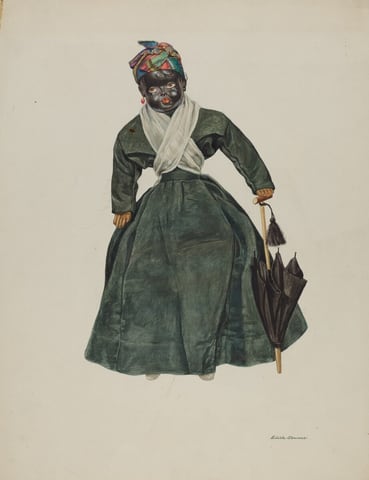
The image depicts a person standing upright. They are wearing a dark green dress with long sleeves and a floor-length skirt. Over the dress, there is a white fabric wrapped around their shoulders. The person is holding a closed umbrella in their right hand. Their face is dark with distinguishable eyes and a nose, but specific facial features are not detailed. The person's hair is covered by a colorful headscarf with shades of blue, pink, and yellow. They are wearing large earrings, possibly pink or red. The background is plain and light with no additional objects present.
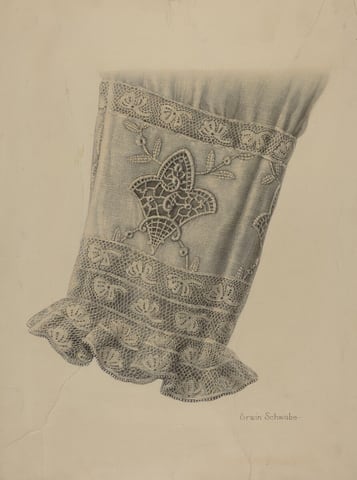
The image shows a lace-trimmed sleeve with a floral lace design in the center, primarily in shades of gray and off-white. The sleeve is positioned vertically in the center of the image, with the top slightly obscured by shadow and the ruffled lace edge at the bottom. The lace details are intricate and precise, enhancing the texture and complexity of the design.
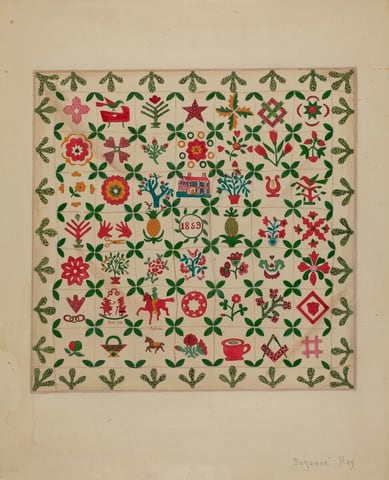
This is a painting of a decorative quilt pattern. The image shows a grid of square sections with various colorful motifs including stars, flowers, a horse, a house, and a cup. The design features vibrant colors, symmetrical patterns, and a central section with the date "1859". The quilt border has leaf-like patterns creating a frame around the central grid. The style is folk art.

The works in this room are listed below.

Works in this room

The everyday art of early America, recorded in watercolour by the Index of American Design.

Section 1, north wall

  1. The sculpture is a depiction of a horse's head crafted from a dark material that appears to be metal. The horse's ears are perked up, and its mane is depicted with smooth, curving lines trailing down the back of the neck. The sculpture includes a ring that extends from the horse's mouth. Positioned on a simple cylindrical pedestal, the sculpture's material and design suggest a robust and timeless feel. The details of the horse's expression and mane are rendered with a smooth finish.
    Hitching PostAlbert Ryder, c. 1938Courtesy National Gallery of Art, Washington
  2. The sculpture depicts a mythical creature resembling a dragon. It has a long spiraled body and an intricate head with spiky protrusions. The sculpture is a warm brown color. The dragon has bat-like wings, an open mouth, detailed texture with scales, and is standing on a small base.
    FenceRose Campbell-Gerke, c. 1941Courtesy National Gallery of Art, Washington
  3. The image displays wavy lines and shapes with a mix of colors, creating an abstract composition. Curved lines are intertwined, resembling braided patterns or woven fabric textures. On the left, there is a large, organic shape bordered by red, green, and beige. The right side showcases a rhythmic pattern resembling a braided rug, with strands of red, blue, and brown. The overall composition resembles a textured textile piece.
    Shaker Woolen RugGeorge V. Vezolles, 1935/1942Courtesy National Gallery of Art, Washington

Section 1, south wall

  1. The image depicts a person standing upright. They are wearing a dark green dress with long sleeves and a floor-length skirt. Over the dress, there is a white fabric wrapped around their shoulders. The person is holding a closed umbrella in their right hand. Their face is dark with distinguishable eyes and a nose, but specific facial features are not detailed. The person's hair is covered by a colorful headscarf with shades of blue, pink, and yellow. They are wearing large earrings, possibly pink or red. The background is plain and light with no additional objects present.
    Doll--"Hannah Hitch"Edith Towner, c. 1940Courtesy National Gallery of Art, Washington
  2. The image shows a lace-trimmed sleeve with a floral lace design in the center, primarily in shades of gray and off-white. The sleeve is positioned vertically in the center of the image, with the top slightly obscured by shadow and the ruffled lace edge at the bottom. The lace details are intricate and precise, enhancing the texture and complexity of the design.
    Cuff LaceErwin Schwabe, c. 1937Courtesy National Gallery of Art, Washington
  3. This is a painting of a decorative quilt pattern. The image shows a grid of square sections with various colorful motifs including stars, flowers, a horse, a house, and a cup. The design features vibrant colors, symmetrical patterns, and a central section with the date "1859". The quilt border has leaf-like patterns creating a frame around the central grid. The style is folk art.
    Applique QuiltSuzanne Roy, 1938Courtesy National Gallery of Art, Washington

Section 2, south wall
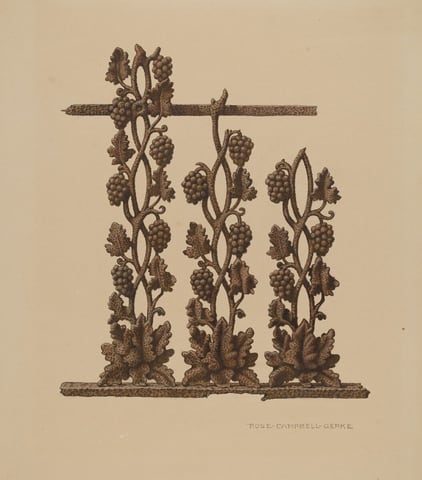
  1. The image depicts an iron sculpture with grapevine motifs. The color scheme is primarily brown, with a textured appearance. The grapevine design is arranged vertically and includes grape clusters and leaves. The sculpture is mounted on a base and includes an iron bar at the top. The artist's signature "ROSE CAMPBELL GERKE" is visible in the lower right corner of the image.
    FenceRose Campbell-Gerke, c. 1940Courtesy National Gallery of Art, Washington
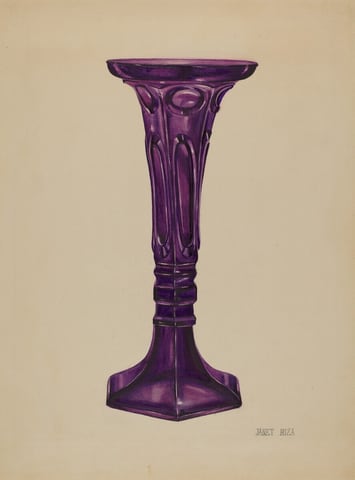
  2. The image shows a tall, intricately designed purple candlestick against a light beige background. The overall color palette is dominated by shades of purple. The candlestick is centrally positioned and stands upright with detailed patterns visible.
    VaseJanet Riza, c. 1937Courtesy National Gallery of Art, Washington
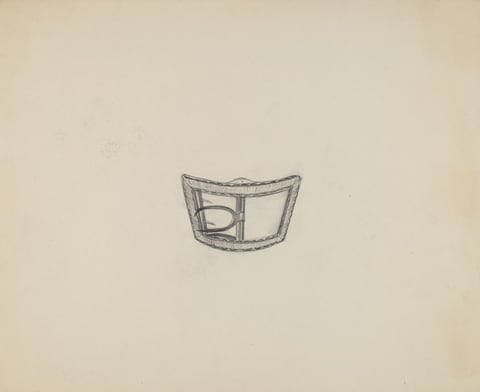
  3. The image displays a detailed pencil sketch of a curved architectural structure in the center of a light beige canvas. The sketch is in grayscale, with a simple color palette. The object occupies a small portion of the canvas, surrounded by negative space.
    Knee BuckleEdna Crenshaw Rex, c. 1937Courtesy National Gallery of Art, Washington

Section 2, north wall
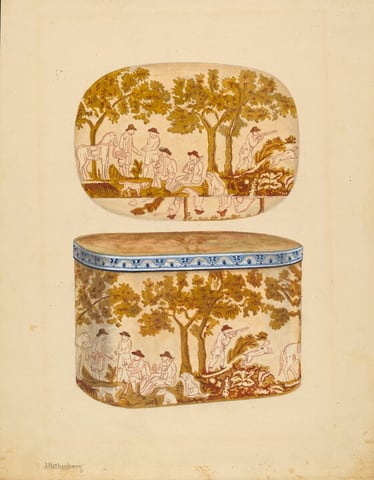
  1. This is a painting of a decorative box with pastoral scenes. The box has an oval lid and rectangular base adorned with intricate pastoral scenes in earthy tones. The scenes depict landscapes with trees, hills, and figures engaged in various activities against a warm backdrop. The lid has a similar scene, creating a cohesive decorative theme. The style resembles 19th-century European art focusing on pastoral genre scenes and decorative arts. The artwork delicately balances detail and composition, evoking calm and nostalgia.
    BandboxJohn Tarantino, c. 1937Courtesy National Gallery of Art, Washington
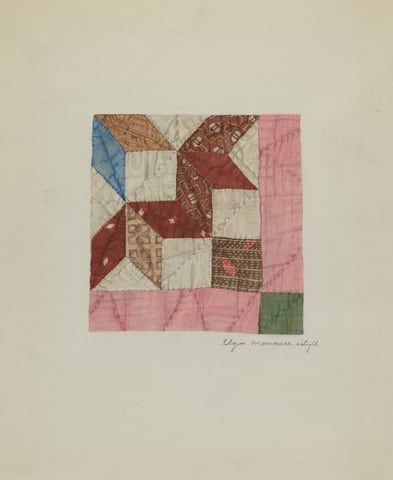
  2. This is a painting of a quilt design pattern. The image depicts a square quilt block featuring a variety of geometric shapes and patterns pieced together. The quilt features a mix of colors, including blues, reds, browns, and a pink border, with intricate patterns in the fabric segments. The textures and colors create an intricate optical composition resembling different geometric forms and depth. The piece is delicately framed within a larger white space, which emphasizes the detail of the quilt pattern. This is in the style of a traditional textile or quilting pattern illustrator.
    Cotton Bed QuiltElgin Moncure Styll, c. 1941Courtesy National Gallery of Art, Washington
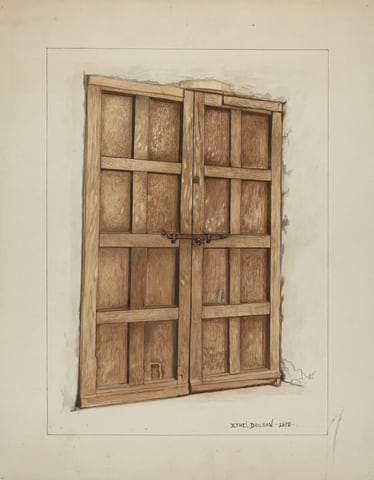
  3. This is a drawing of a wooden window shutter in a light-colored wall. The detailed study shows the craftsmanship of the shutter, with a focus on texture, form, wood grain, and panels. The aged and weathered texture suggests exposure to the elements. The shutter is secured with a metal latch in the center. The wall is subtly shaded to imply depth and setting, with slight distress marks adding to the aged ambiance of the scene.
    Sacristy Door at Mission San Juan BautistaEthel Dougan, 1938Courtesy National Gallery of Art, Washington

Section 3, north wall
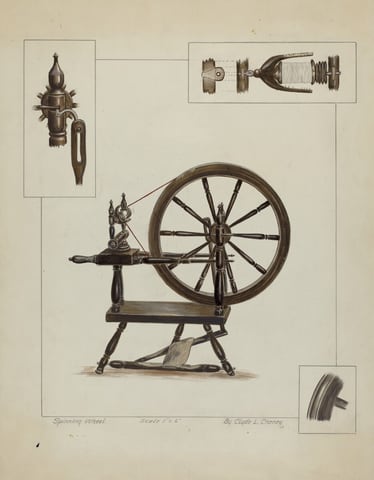
  1. The image shows a spinning wheel with intricate details, surrounded by smaller insets highlighting specific components. The color palette consists of muted browns, greens, and beiges. The spinning wheel is positioned in the center, with its circular wheel on the right and the spinning mechanism on the left. Detailed insets are placed around the spinning wheel, each showing different mechanical elements.
    Spinning WheelClyde L. Cheney, 1935/1942Courtesy National Gallery of Art, Washington
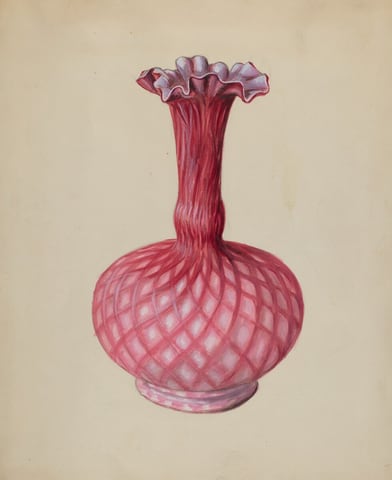
  2. The image displays a single ornate vase with a bulbous base and a ruffled top, taking up most of the frame. The vase is predominantly pink with red accents, the ruffled top is highlighted with white on the inner edges, and there's a crisscross pattern visible on the body. Against a plain beige background, the vase is centrally positioned.
    Ornamental Ruby VaseRobert Stewart, c. 1936Courtesy National Gallery of Art, Washington

Section 3, south wall
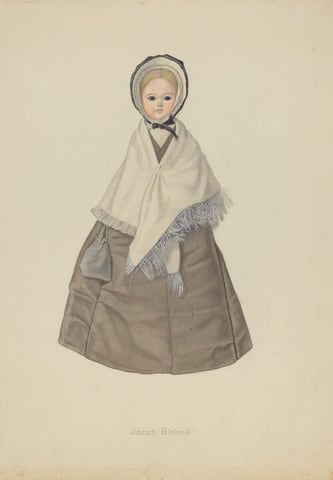
  1. The image depicts a young person standing upright with distinct facial features including rounded cheeks, a small mouth, and large eyes. They are wearing a brown dress with a cream-colored shawl, a bonnet with dark trim, and a pouch hanging from their left side. The background is plain and cream-colored.
    Quaker DollJacob Gielens, 1935/1942Courtesy National Gallery of Art, Washington
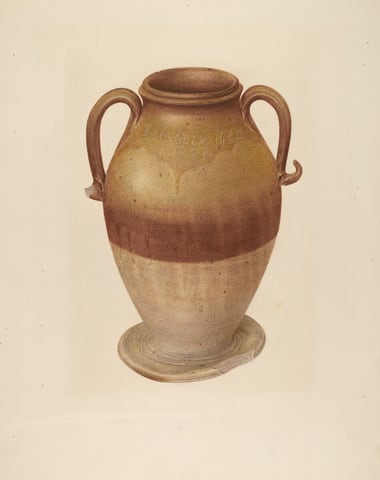
  2. The image shows a large ceramic vase with two curved handles positioned near the top on either side. The vase has an earthy color palette with shades of brown, beige, and a subtle hint of reddish-brown forming a band around its middle. The vase is centrally placed on a flat surface, and both handles extend outward at the top.
    VaseIsadore Goldberg, c. 1939Courtesy National Gallery of Art, Washington