Floor plan

Time and placeThe 20th century

The 20th century

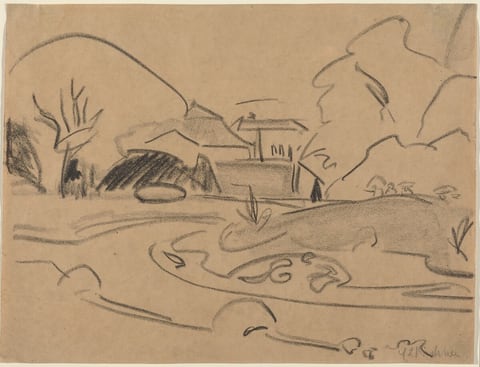
The image shows a landscape drawing with buildings, trees, and a winding path or water feature. The drawing is done in black charcoal on brownish background paper, creating a monochromatic color palette.
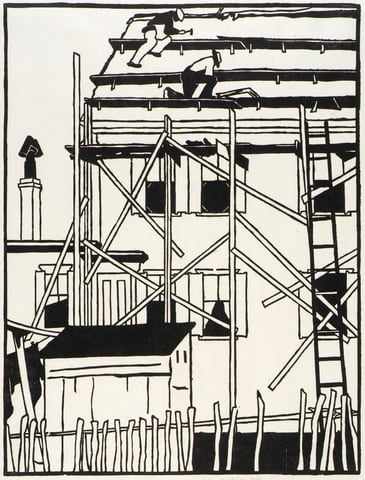
Untitled, by Mildred McMillen, 1915
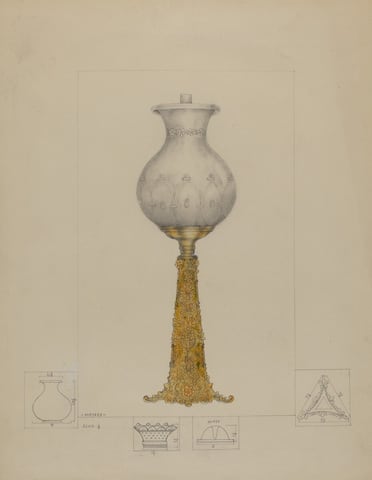
This is a drawing of a decorative vase design. The central focus of the image is a detailed drawing of a vase with a bulbous body and a flared top, placed on an intricately designed tall stand. The stand features elaborate ornate patterns, giving it an almost floral appearance with its swirling details and golden hue. The vase itself has subtle decorative elements engraved or painted around its surface. Surrounding the primary image are additional sketches showcasing different parts and views of the vase, such as its profile, the pattern, and cross-sectional diagrams. These supplementary sketches provide further insight into the structural and decorative design aspects of the vase. The careful attention to scale and detail suggests this is a design blueprint for a piece of decorative art.
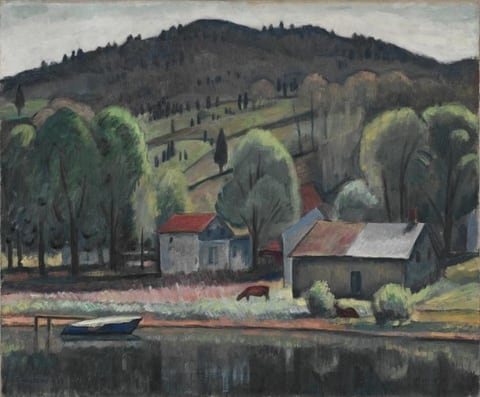
Eddyville, by Samuel Halpert, 1917
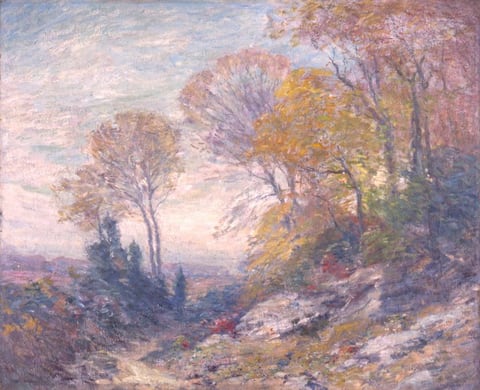
October Morning, by Frank A. Bicknell, ca. 1910

The works in this room are listed below.

Works in this room

Works made in the 20th century, anywhere in the world.

Section 1, north wall

  1. The image shows a landscape drawing with buildings, trees, and a winding path or water feature. The drawing is done in black charcoal on brownish background paper, creating a monochromatic color palette.
    Footpaths and Pavilion in the Dresden Grosser GartenErnst Ludwig Kirchner, c. 1909Courtesy National Gallery of Art, Washington
  2. Untitled, by Mildred McMillen, 1915
    UntitledMildred McMillen, 1915Courtesy of the Smithsonian American Art Museum
  3. This is a drawing of a decorative vase design. The central focus of the image is a detailed drawing of a vase with a bulbous body and a flared top, placed on an intricately designed tall stand. The stand features elaborate ornate patterns, giving it an almost floral appearance with its swirling details and golden hue. The vase itself has subtle decorative elements engraved or painted around its surface. Surrounding the primary image are additional sketches showcasing different parts and views of the vase, such as its profile, the pattern, and cross-sectional diagrams. These supplementary sketches provide further insight into the structural and decorative design aspects of the vase. The careful attention to scale and detail suggests this is a design blueprint for a piece of decorative art.
    Metal Base LampHenry Meyers, c. 1936Courtesy National Gallery of Art, Washington

Section 1, south wall

  1. Eddyville, by Samuel Halpert, 1917
    EddyvilleSamuel Halpert, 1917Courtesy of the Cleveland Museum of Art
  2. October Morning, by Frank A. Bicknell, ca. 1910
    October MorningFrank A. Bicknell, ca. 1910Courtesy of the Smithsonian American Art Museum

Section 2, south wall
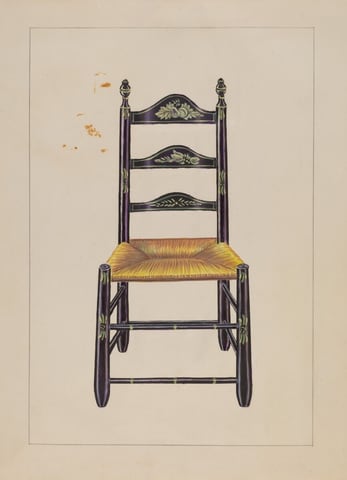
  1. The image shows a wooden chair with a rush seat. It features ornate details on the backrest. The color palette includes dark wood tones, pale greenish detailing, and a warm yellowish hue for the seat. The chair is centrally positioned in the image, viewed from the front, with no other objects around it.
    Ladderback ChairGerald Bernhardt, c. 1936Courtesy National Gallery of Art, Washington
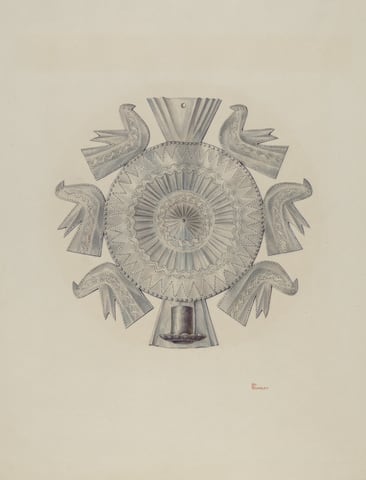
  2. The image shows an abstract composition with circular and linear shapes. In the center is a large, intricately patterned circle with concentric rings, zigzag, and radiating lines. Around it are six identical abstract forms resembling birds or wings, radiating outward. The shapes create a symmetrical pattern reminiscent of a rotating wheel or a sunburst.
    Cut Tin CandleholderHal Blakeley, 1940Courtesy National Gallery of Art, Washington
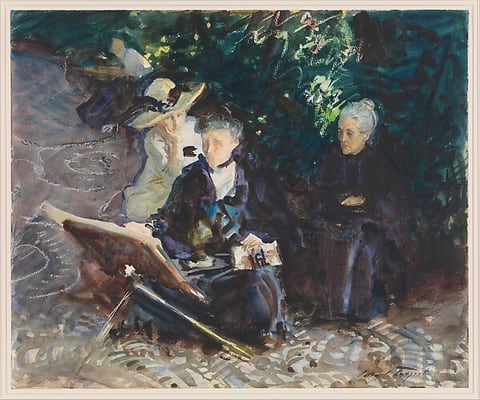
  3. In the Generalife, by John Singer Sargent, 1912
    In the GeneralifeJohn Singer Sargent, 1912Courtesy of The Metropolitan Museum of Art

Section 2, north wall
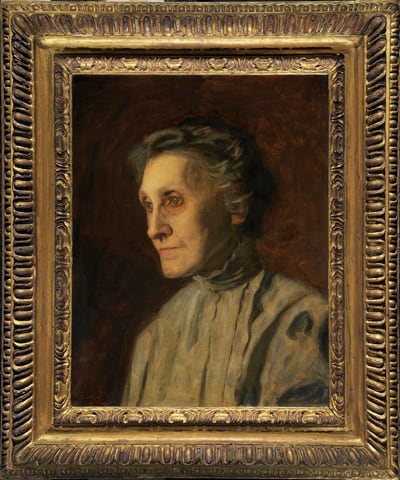
  1. Thomas Eakins
    Portrait of Mrs. Helen Mac Knight (Portrait of a Mother)Thomas Eakins, (c. 1903)Courtesy of the Hirshhorn Museum and Sculpture Garden, Smithsonian Institution
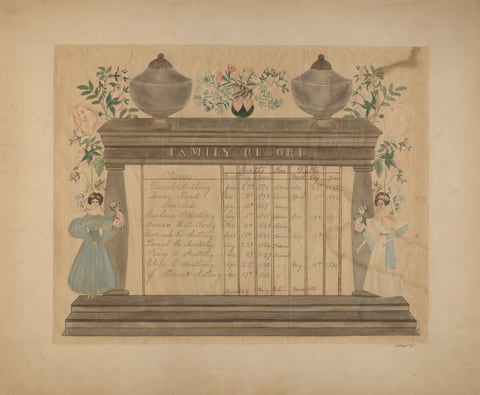
  2. This is a drawing of a decorative family record. The central feature is a structure resembling a classical monument or altar labeled "FAMILY RECORD" at the top. The structure has columns and a pediment with names and dates. Flanking the list are two figures holding flowers, dressed in long gowns of blue and white. Above the structure are two large urns and a floral arrangement with pink flowers and green foliage. The background is a soft, neutral color. Green leaves and small flowers further embellish the scene.
    Family Record of Susan B. AnthonyJohn Wilkes, c. 1937Courtesy National Gallery of Art, Washington

Section 3, north wall
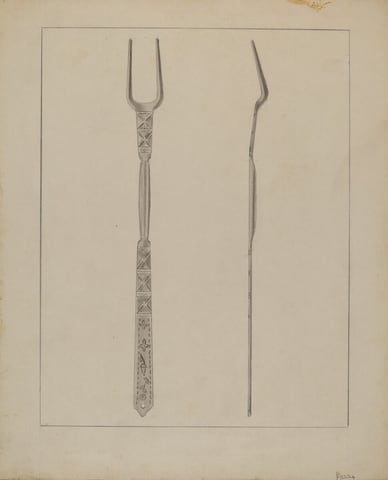
  1. This is a drawing of a tool with intricate patterns. The tool appears elongated with a pronged end, and features symmetrical geometric designs etched along the handle. The drawing also includes a side profile showing its slender form.
    ForkAnthony Zuccarello, c. 1936Courtesy National Gallery of Art, Washington
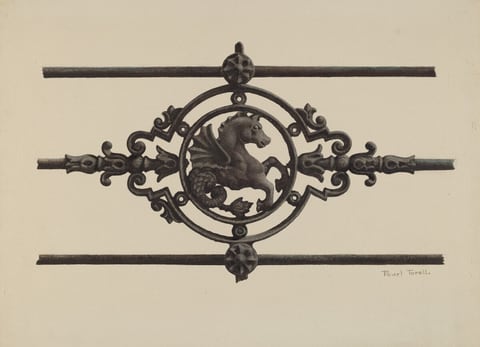
  2. The image shows an ornate metalwork design with a winged creature. The design features intricate wrought iron decoration with a mythical figure, resembling a Pegasus, enclosed within a circular frame. The central circle is surrounded by symmetrical, stylized scrollwork motifs and horizontal bars, suggesting an architectural or ornamental fixture intended for use in structures like gates or window grills. The detailed craftsmanship and balanced design highlight the creature's form and the harmonious symmetry of the patterns.
    Fence - Sea Horse DesignPearl Torell, c. 1939Courtesy National Gallery of Art, Washington
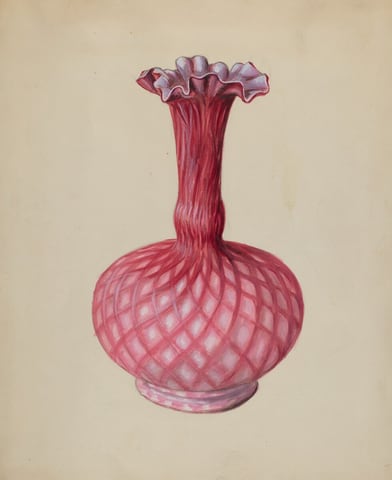
  3. The image displays a single ornate vase with a bulbous base and a ruffled top, taking up most of the frame. The vase is predominantly pink with red accents, the ruffled top is highlighted with white on the inner edges, and there's a crisscross pattern visible on the body. Against a plain beige background, the vase is centrally positioned.
    Ornamental Ruby VaseRobert Stewart, c. 1936Courtesy National Gallery of Art, Washington

Section 3, south wall
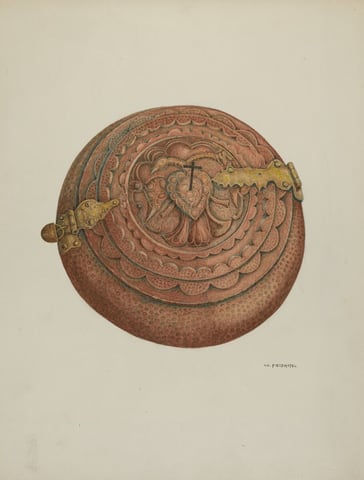
  1. The image features a round, ornately decorated object resembling a shield with metallic-looking decorative hinges on its surface. The color palette is primarily earthy tones such as brown, red, and hints of gold. The object is centered in the image, viewed from the front, with engravings decorating its surface. The background is plain and light in color.
    Baptismal FontWilliam Kieckhofel, c. 1941Courtesy National Gallery of Art, Washington
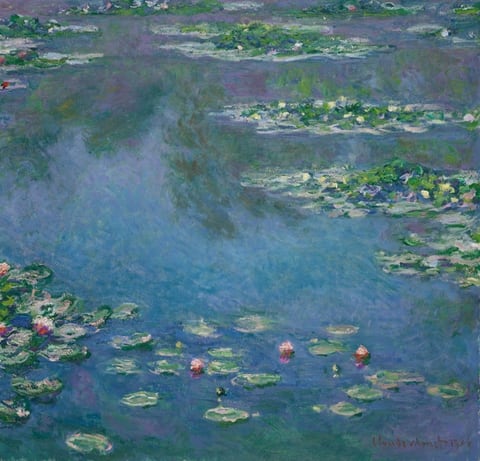
  2. Painting of a pond seen up close spotted with thickly painted pink and white water lilies and a shadow across the top third of the picture.
    Water LiliesClaude Monet, 1906Courtesy of the Art Institute of Chicago
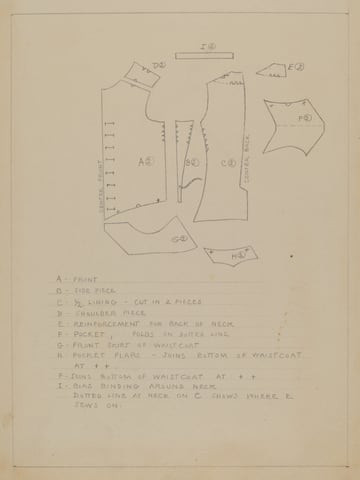
  3. This is a drawing depicting instructional annotations on a pattern for tailoring or assembling clothing. The pattern includes various pieces labeled with letters and numbers corresponding to specific parts of a garment, like "FRONT," "SIDE BACK," and "COLLAR." The layout is precise and technical, resembling a guide for constructing a garment with detailed cutting and assembly instructions.
    Waistcoat PatternRosalia Lane, c. 1936Courtesy National Gallery of Art, Washington