Floor plan

Time and placeThe 20th century

The 20th century

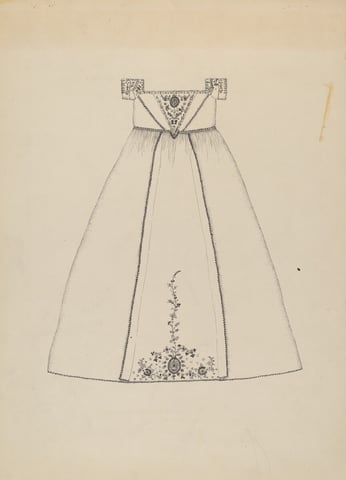
This is a drawing of a dress design. The illustration features a dress with a square neckline, adorned with embroidery around the bust area. The dress has a high waistline with a gathered skirt. The lower part of the dress also features floral embroidery patterns. The design emphasizes fine lines and delicate patterns.
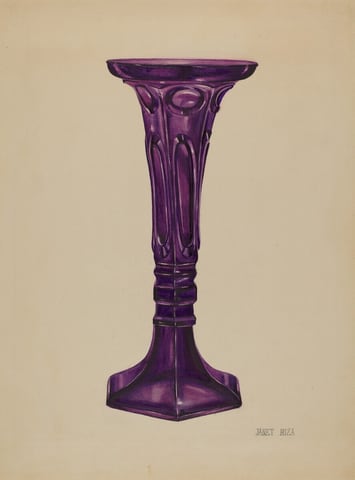
The image shows a tall, intricately designed purple candlestick against a light beige background. The overall color palette is dominated by shades of purple. The candlestick is centrally positioned and stands upright with detailed patterns visible.
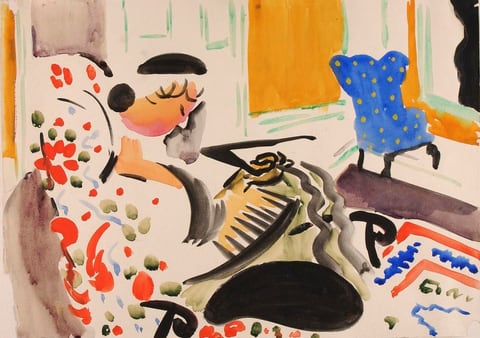
Calligraphic Interior, by H. Lyman Saÿen, ca. 1915
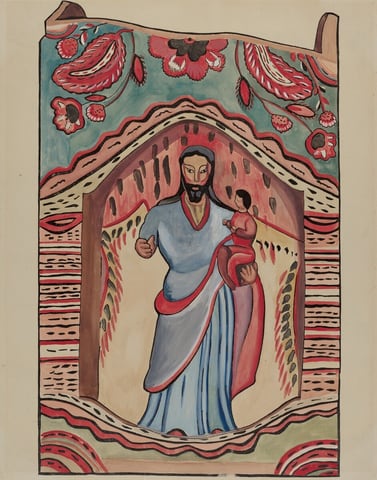
This is a painting of stylized figures within an ornate frame. The artwork features two central figures that are reminiscent of a traditional religious iconography but rendered in a simplified and almost cartoonish form. The larger figure is draped in blue with red accents, while a smaller figure is held in one hand, enrobed in red. The background is decorated with a variety of patterns including an arch-like structure with wavy designs and lines, all outlining the central figures. The outer sections feature floral patterns with bold, contrasting colors of red, black, and teal. The use of thick outlines and vivid colors suggests a playful and decorative approach to the portrayal of the figures, drawing inspiration possibly from folk art traditions.
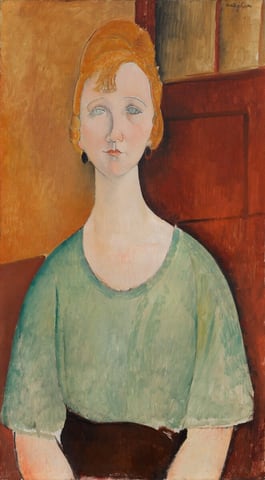
Shown from the lap up, a pale-skinned woman with an oval face and long neck sits facing us in this vertical painting. The portrait is created with areas of mottled colors outlined with black lines. Her body faces us, and she looks out with pale blue eyes, the irises almost white. Her thin eyebrows slope down the sides and her small, dark peach lips are closed. Golden-orange hair is piled atop her head and a few bangs fall onto her high forehead. Black oval earrings hang from her lobes. Her shoulders also slope unnaturally down. Her mint-green shirt has a scooped neckline and elbow-length sleeves, and it appears to be tucked into a brown skirt or pants. The background is honey orange in the top left quadrant, amber brown in the lower left, and a russet brown door with windows across the top fills the right half. The artist signed the top right corner, “modigliani.”
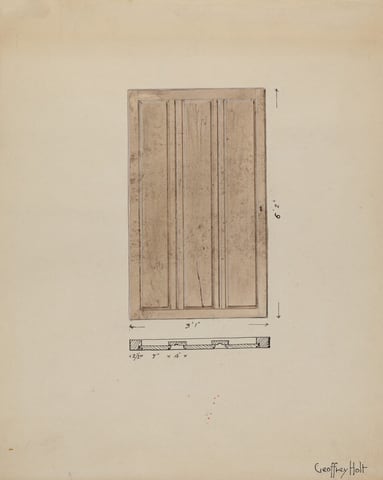
This is a drawing of a wooden door panel. It features a detailed rendering of a rectangular wooden door panel with vertical lines. Below the door panel, there is an elevation view showing the construction detail of the door in cross-section, with measurements indicating dimensions and proportions. The color palette is in shades of brown and beige. A signature in the lower right corner attributes the drawing to an artist named Geoffrey Holt.
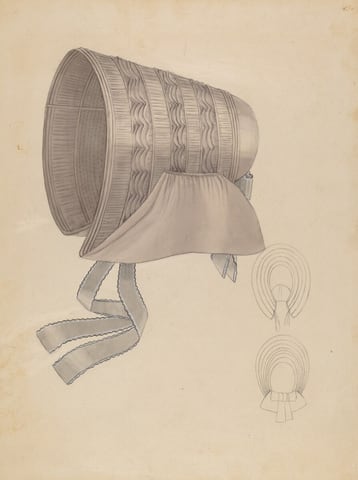
This is an image of a bonnet and its details. The drawing showcases a bonnet with intricate design and texture. The bonnet is viewed from the side, revealing its woven structure with patterns representing fabric pleats or folds. It has a long ribbon hanging from the back, depicted with flowing lines. There are also two smaller sketches showing the bonnet from the back, emphasizing its shape and construction. The background is plain.
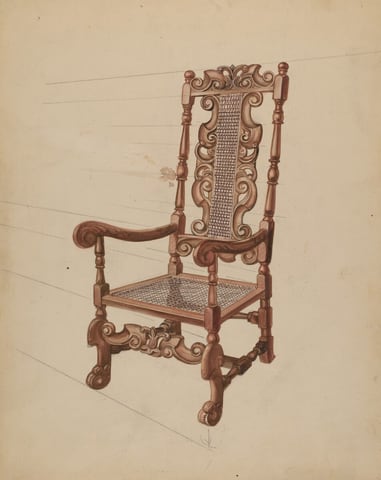
The image shows an ornate chair with a high back, decorative carvings along its arms, legs, and backrest, a woven or cane seat and back, and intricate patterns. The chair is detailed with earthy brown tones and subtle shading accentuating the wood texture and design motifs. It is placed in the center of the image, facing slightly to the left, with linear guides indicating perspective and depth on a plain background.

The works in this room are listed below.

Works in this room

Works made in the 20th century, anywhere in the world.

Section 1, north wall

  1. This is a drawing of a dress design. The illustration features a dress with a square neckline, adorned with embroidery around the bust area. The dress has a high waistline with a gathered skirt. The lower part of the dress also features floral embroidery patterns. The design emphasizes fine lines and delicate patterns.
    Baptismal DressEvelyn Bailey, c. 1936Courtesy National Gallery of Art, Washington
  2. The image shows a tall, intricately designed purple candlestick against a light beige background. The overall color palette is dominated by shades of purple. The candlestick is centrally positioned and stands upright with detailed patterns visible.
    VaseJanet Riza, c. 1937Courtesy National Gallery of Art, Washington
  3. Calligraphic Interior, by H. Lyman Saÿen, ca. 1915
    Calligraphic InteriorH. Lyman Saÿen, ca. 1915Courtesy of the Smithsonian American Art Museum
  4. This is a painting of stylized figures within an ornate frame. The artwork features two central figures that are reminiscent of a traditional religious iconography but rendered in a simplified and almost cartoonish form. The larger figure is draped in blue with red accents, while a smaller figure is held in one hand, enrobed in red. The background is decorated with a variety of patterns including an arch-like structure with wavy designs and lines, all outlining the central figures. The outer sections feature floral patterns with bold, contrasting colors of red, black, and teal. The use of thick outlines and vivid colors suggests a playful and decorative approach to the portrayal of the figures, drawing inspiration possibly from folk art traditions.
    St. JosephE. Boyd, 1936Courtesy National Gallery of Art, Washington

Section 1, south wall

  1. Shown from the lap up, a pale-skinned woman with an oval face and long neck sits facing us in this vertical painting. The portrait is created with areas of mottled colors outlined with black lines. Her body faces us, and she looks out with pale blue eyes, the irises almost white. Her thin eyebrows slope down the sides and her small, dark peach lips are closed. Golden-orange hair is piled atop her head and a few bangs fall onto her high forehead. Black oval earrings hang from her lobes. Her shoulders also slope unnaturally down. Her mint-green shirt has a scooped neckline and elbow-length sleeves, and it appears to be tucked into a brown skirt or pants. The background is honey orange in the top left quadrant, amber brown in the lower left, and a russet brown door with windows across the top fills the right half. The artist signed the top right corner, “modigliani.”
    Girl in a Green BlouseAmedeo Modigliani, 1917Courtesy National Gallery of Art, Washington
  2. This is a drawing of a wooden door panel. It features a detailed rendering of a rectangular wooden door panel with vertical lines. Below the door panel, there is an elevation view showing the construction detail of the door in cross-section, with measurements indicating dimensions and proportions. The color palette is in shades of brown and beige. A signature in the lower right corner attributes the drawing to an artist named Geoffrey Holt.
    One of Original Inside Doors to SacristyGeoffrey Holt, c. 1936Courtesy National Gallery of Art, Washington
  3. This is an image of a bonnet and its details. The drawing showcases a bonnet with intricate design and texture. The bonnet is viewed from the side, revealing its woven structure with patterns representing fabric pleats or folds. It has a long ribbon hanging from the back, depicted with flowing lines. There are also two smaller sketches showing the bonnet from the back, emphasizing its shape and construction. The background is plain.
    BonnetBessie Forman, c. 1936Courtesy National Gallery of Art, Washington
  4. The image shows an ornate chair with a high back, decorative carvings along its arms, legs, and backrest, a woven or cane seat and back, and intricate patterns. The chair is detailed with earthy brown tones and subtle shading accentuating the wood texture and design motifs. It is placed in the center of the image, facing slightly to the left, with linear guides indicating perspective and depth on a plain background.
    ArmchairAgnes Karlin, c. 1936Courtesy National Gallery of Art, Washington

Section 2, south wall
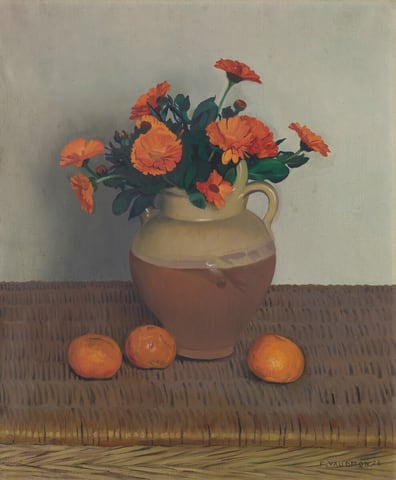
  1. This painting shows a large jug filled with orange flowers on a woven brown surface, with three small oranges placed in front of it. The bottom half of the jug is a brownish-red color, while the top part and handles are a light tan. The jug is centered, with flowers extending slightly to the sides. The flowers in the vase are surrounded by dark green leaves and buds. The wall behind the vase is a light gray color, and the vase casts a light shadow on it.
    Marigolds and TangerinesFélix Vallotton, 1924Courtesy National Gallery of Art, Washington
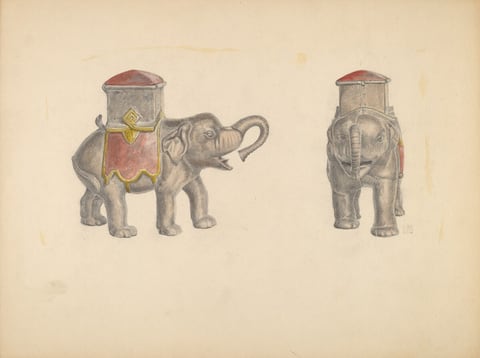
  2. This is a drawing of two ornate elephants. The image depicts two stylized elephants, each adorned with decorative elements. Both elephants are shown carrying a structure on their backs, resembling a small tower or box with a red domed top. The left elephant is turned to the side, its trunk raised. The right elephant faces forward. Each structure on their backs is detailed with intricate designs, including a diamond shape on the side. The overall composition suggests a ceremonial or regal theme. The subtle use of colors like red and gold enhances the ornate appearance. The coloring and shading indicate an attention to detail typical of deliberately crafted illustrations.
    Iron Bank ElephantZ.S. Lupus, c. 1938Courtesy National Gallery of Art, Washington
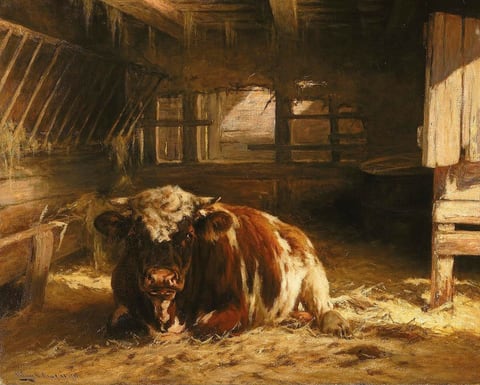
  3. My Day at Home, by William H. Howe, 1906
    My Day at HomeWilliam H. Howe, 1906Courtesy of the Smithsonian American Art Museum
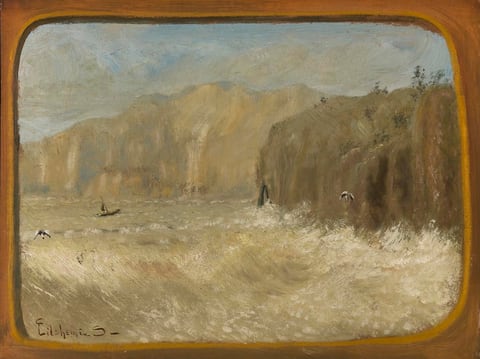
  4. Two Gulls and Cliffs, by Louis M. Eilshemius, ca. 1913-1921
    Two Gulls and CliffsLouis M. Eilshemius, ca. 1913-1921Courtesy of the Smithsonian American Art Museum

Section 2, north wall
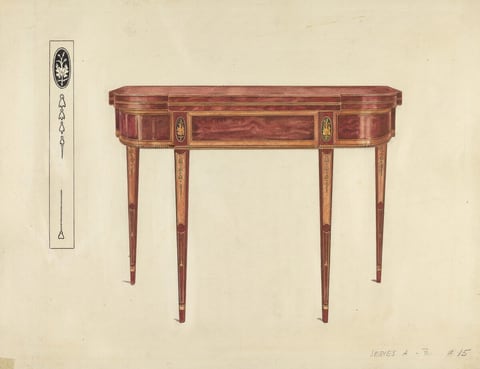
  1. The image shows a wooden side table with a smooth surface and four tapered legs, as well as a decorative drawer front. The table has a rich brown color with gold accents and black inlay details. It is positioned towards the center of the image. On the left, there are design patterns in an oval shape and a thin line drawing. The background is off-white. There are handwritten numbers and letters at the bottom right corner of the image.
    Card TableFlorence Choate, c. 1953Courtesy National Gallery of Art, Washington
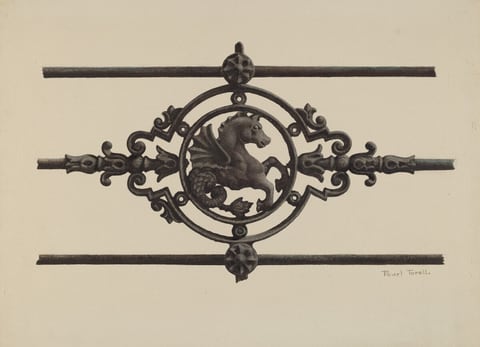
  2. The image shows an ornate metalwork design with a winged creature. The design features intricate wrought iron decoration with a mythical figure, resembling a Pegasus, enclosed within a circular frame. The central circle is surrounded by symmetrical, stylized scrollwork motifs and horizontal bars, suggesting an architectural or ornamental fixture intended for use in structures like gates or window grills. The detailed craftsmanship and balanced design highlight the creature's form and the harmonious symmetry of the patterns.
    Fence - Sea Horse DesignPearl Torell, c. 1939Courtesy National Gallery of Art, Washington
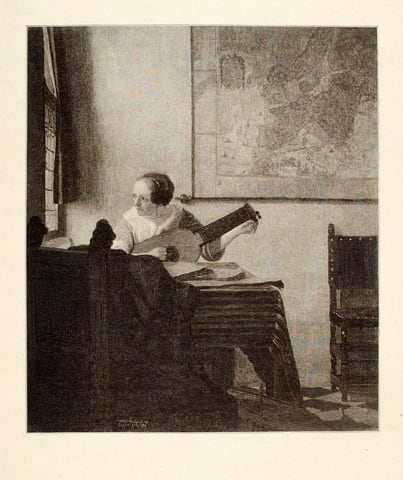
  3. Lady with the Lute, by Henry Wolf, 1909
    Lady with the LuteHenry Wolf, 1909Courtesy of the Smithsonian American Art Museum
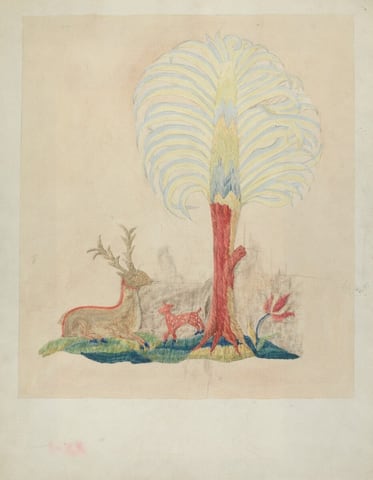
  4. This is a painting of two deer under a tree. The larger deer has antlers and is resting next to a smaller deer. They are depicted with red and brown strokes. The background shows a patch of earth and grass in green and blue. Beside the deer is a tree with colorful leaves or a feather-like structure and a red trunk. A pink flower is near the tree's base. The background is neutral. This painting is in the style of Henri Rousseau.
    Crewel EmbroideryHelen Dana, 1935/1942Courtesy National Gallery of Art, Washington