Floor plan

Time and place20th-century United States
20th-century United States
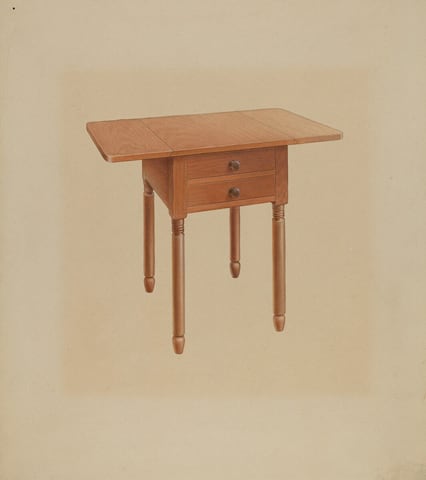
The image shows a wooden drop-leaf table with four turned legs and two drawers. The table's surface includes two side panels that can be raised or lowered. The color palette is warm brown tones. The table is centered in the image, with both leaves partially visible.
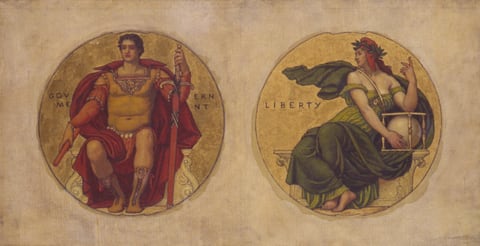
Study for mosaic in the Wisconsin State Capital "Government and Liberty", by Kenyon Cox, ca. 1912
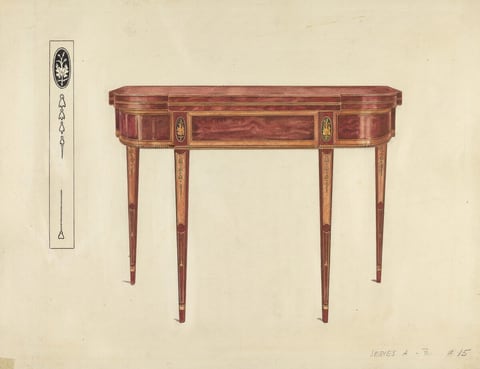
The image shows a wooden side table with a smooth surface and four tapered legs, as well as a decorative drawer front. The table has a rich brown color with gold accents and black inlay details. It is positioned towards the center of the image. On the left, there are design patterns in an oval shape and a thin line drawing. The background is off-white. There are handwritten numbers and letters at the bottom right corner of the image.
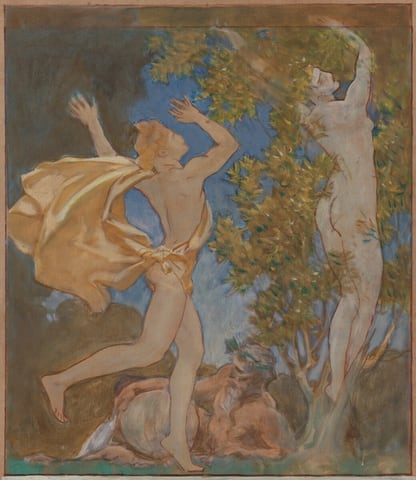
This is a painting showing two people in nature. The person on the left appears to be running towards the right, with one leg in the air and their arms outstretched. They have tan, golden-toned skin, blond hair, and golden fabric draped loosely around them, billowing backward as they run. On the right is a pale person standing upright in a tree, their arms outstretched. They appear intertwined with the tree, with their feet nestled in the light brown trunk and their head and hands covered in olive-green leaves. The background features indistinct brown shapes against a clear blue sky.

The works in this room are listed below.

Works in this room

Works made in the United States in the 20th century.

Section 1, north wall

  1. The image shows a wooden drop-leaf table with four turned legs and two drawers. The table's surface includes two side panels that can be raised or lowered. The color palette is warm brown tones. The table is centered in the image, with both leaves partially visible.
    Shaker TableAlfred H. Smith, c. 1938Courtesy National Gallery of Art, Washington
  2. Study for mosaic in the Wisconsin State Capital "Government and Liberty", by Kenyon Cox, ca. 1912
    Study for mosaic in the Wisconsin State Capital "Government and Liberty"Kenyon Cox, ca. 1912Courtesy of the Smithsonian American Art Museum

Section 1, south wall

  1. The image shows a wooden side table with a smooth surface and four tapered legs, as well as a decorative drawer front. The table has a rich brown color with gold accents and black inlay details. It is positioned towards the center of the image. On the left, there are design patterns in an oval shape and a thin line drawing. The background is off-white. There are handwritten numbers and letters at the bottom right corner of the image.
    Card TableFlorence Choate, c. 1953Courtesy National Gallery of Art, Washington
  2. This is a painting showing two people in nature. The person on the left appears to be running towards the right, with one leg in the air and their arms outstretched. They have tan, golden-toned skin, blond hair, and golden fabric draped loosely around them, billowing backward as they run. On the right is a pale person standing upright in a tree, their arms outstretched. They appear intertwined with the tree, with their feet nestled in the light brown trunk and their head and hands covered in olive-green leaves. The background features indistinct brown shapes against a clear blue sky.
    Apollo and DaphneJohn Singer Sargent, c. 1916/1919Courtesy National Gallery of Art, Washington

Section 2, south wall
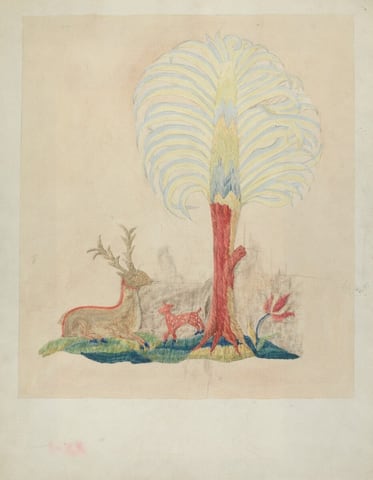
  1. This is a painting of two deer under a tree. The larger deer has antlers and is resting next to a smaller deer. They are depicted with red and brown strokes. The background shows a patch of earth and grass in green and blue. Beside the deer is a tree with colorful leaves or a feather-like structure and a red trunk. A pink flower is near the tree's base. The background is neutral. This painting is in the style of Henri Rousseau.
    Crewel EmbroideryHelen Dana, 1935/1942Courtesy National Gallery of Art, Washington
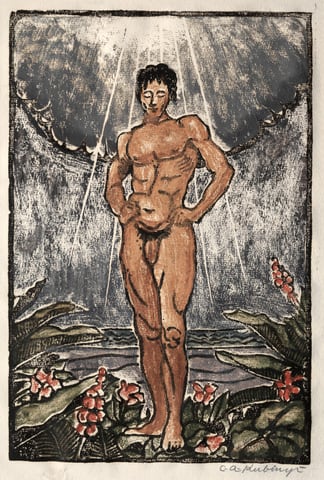
  2. The Creation, by Kálmán Kubinyi, before 1927
    The CreationKálmán Kubinyi, before 1927Courtesy of the Cleveland Museum of Art
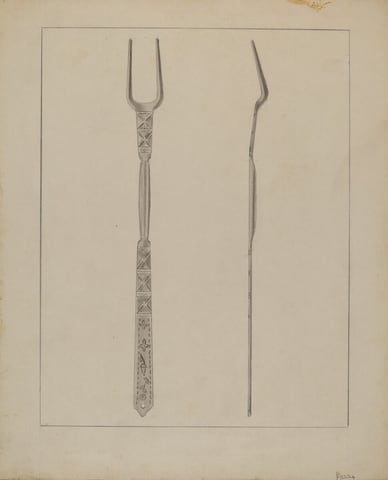
  3. This is a drawing of a tool with intricate patterns. The tool appears elongated with a pronged end, and features symmetrical geometric designs etched along the handle. The drawing also includes a side profile showing its slender form.
    ForkAnthony Zuccarello, c. 1936Courtesy National Gallery of Art, Washington

Section 2, north wall
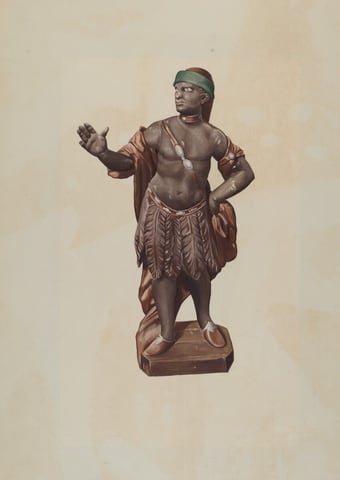
  1. The sculpture depicts a male figure standing upright with one hand raised and the other resting on his hip. The subject is wearing a garment that drapes over one shoulder and a feather-patterned skirt, accessorized with a headband. The colors of the sculpture are predominantly earth tones, including browns and a green headband. The material appears to be a type of stone or ceramic with a polished finish. The figure is slightly larger than everyday objects, allowing viewers to appreciate the intricacies of the carving and the details in the drapery and texture. The statue stands on a rectangular base that is consistent with the overall color palette.
    Cigar Store IndianRosamond P. Gray, 1935/1942Courtesy National Gallery of Art, Washington
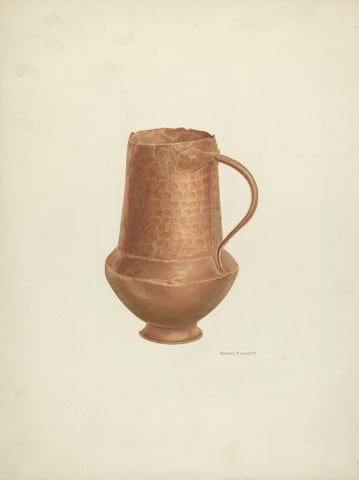
  2. The image shows a large, copper-colored pitcher with a hammered texture and a curving handle on the right side. The color palette consists of muted, warm tones of copper and brown against a pale beige background. The pitcher is centrally placed in the image, with its handle positioned on the right side.
    Copper CruetEdward Jewett, 1937Courtesy National Gallery of Art, Washington

Section 3, north wall
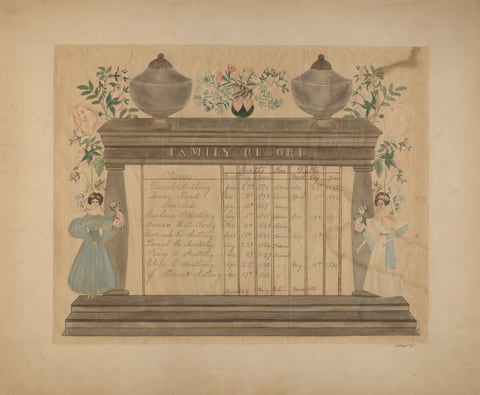
  1. This is a drawing of a decorative family record. The central feature is a structure resembling a classical monument or altar labeled "FAMILY RECORD" at the top. The structure has columns and a pediment with names and dates. Flanking the list are two figures holding flowers, dressed in long gowns of blue and white. Above the structure are two large urns and a floral arrangement with pink flowers and green foliage. The background is a soft, neutral color. Green leaves and small flowers further embellish the scene.
    Family Record of Susan B. AnthonyJohn Wilkes, c. 1937Courtesy National Gallery of Art, Washington
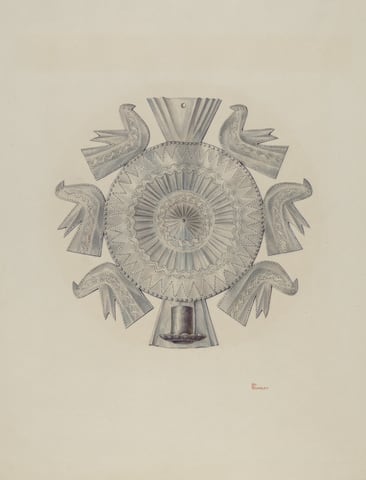
  2. The image shows an abstract composition with circular and linear shapes. In the center is a large, intricately patterned circle with concentric rings, zigzag, and radiating lines. Around it are six identical abstract forms resembling birds or wings, radiating outward. The shapes create a symmetrical pattern reminiscent of a rotating wheel or a sunburst.
    Cut Tin CandleholderHal Blakeley, 1940Courtesy National Gallery of Art, Washington

Section 3, south wall
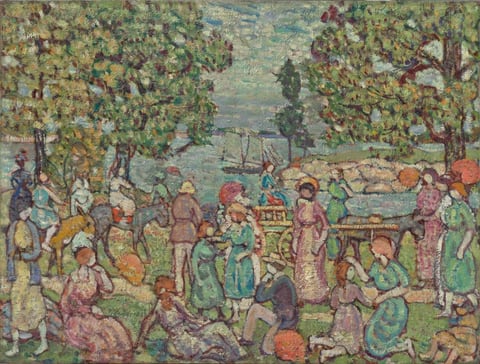
  1. On the Beach, No. 3, by Maurice Prendergast, c. 1915–18
    On the Beach, No. 3Maurice Prendergast, c. 1915–18Courtesy of the Cleveland Museum of Art
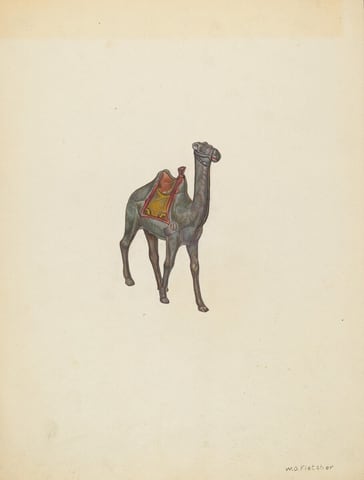
  2. This is a painting of a camel with a colorful saddle. The camel is centered in the image, standing against a plain, light-colored background. The animal is drawn with careful attention to detail, showcasing its distinctive humps, elongated neck, and slender legs. It is adorned with a vibrant saddle that features bright orange and red tones. The simplicity of the background emphasizes the camel.
    Bank CamelWilliam O. Fletcher, c. 1940Courtesy National Gallery of Art, Washington

Section 4, south wall
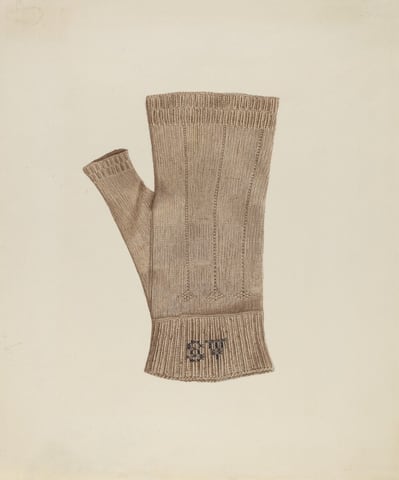
  1. The image shows a beige knitted fingerless glove on a light-colored background. The glove is flat and displayed vertically, with the thumb-piece extending to the left. There is a subtle dark pattern or lettering at the base of the glove. The color palette is warm with beige tones against the light background, emphasizing the texture and design of the glove.
    Knitted GloveElizabeth Moutal, c. 1936Courtesy National Gallery of Art, Washington
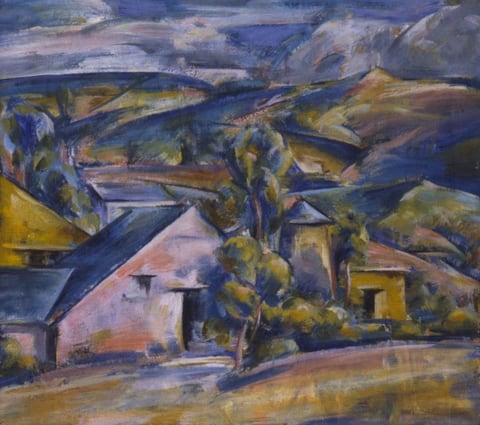
  2. The Hills, by Preston Dickinson, ca. 1919
    The HillsPreston Dickinson, ca. 1919Courtesy of the Smithsonian American Art Museum
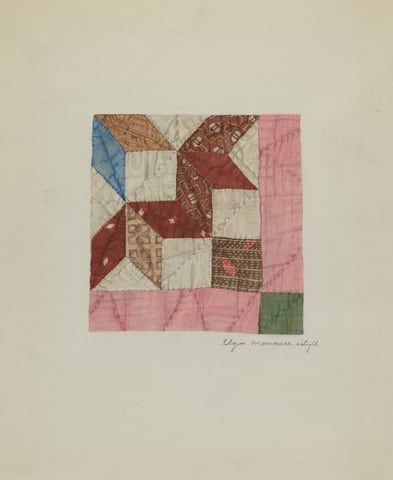
  3. This is a painting of a quilt design pattern. The image depicts a square quilt block featuring a variety of geometric shapes and patterns pieced together. The quilt features a mix of colors, including blues, reds, browns, and a pink border, with intricate patterns in the fabric segments. The textures and colors create an intricate optical composition resembling different geometric forms and depth. The piece is delicately framed within a larger white space, which emphasizes the detail of the quilt pattern. This is in the style of a traditional textile or quilting pattern illustrator.
    Cotton Bed QuiltElgin Moncure Styll, c. 1941Courtesy National Gallery of Art, Washington