Floor plan

Time and place18th-century United States, room 2
18th-century United States, room 2
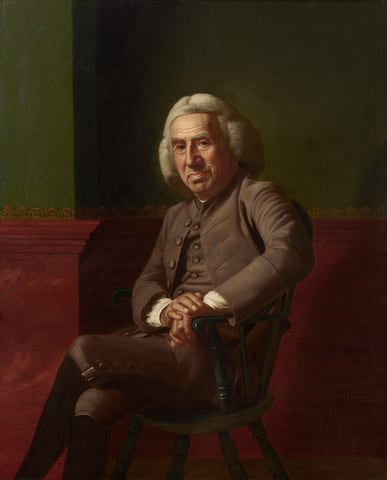
A pale-skinned, clean-shaven man with a heavily lined, paunchy face sits against a green and red wall in this vertical portrait painting. The man sits in a wooden chair painted forest green and rests both hands on the closer arm. His body and knees are angled to our left, and he turns his wide, square face to look at with heavy-lidded eyes. One brow seems slightly cocked, and he has a large nose. His lips are pulled up on one side over a round double chin. He wears a white, shoulder-length wig and a sable-brown suit. The cuffs of a white shirt are visible at his wrists where his hands are stacked on the arm of the chair. The knee-length breeches are buckled at the knee over black stockings. His legs are crossed away from us, and his feet extend off the bottom edge of the composition. The bottom half of the wall behind him is painted burgundy red up to and including a chair rail, and the wall above is moss green. The wall is lined with a gold scallop pattern along the top of the chair rail and a sliver of brown on across the bottom of the composition suggests a wood floor. The artist signed and dated the painting as if he had inscribed the red wall near the man’s knees, “John Singleton Copley pinx 1772. Boston.”
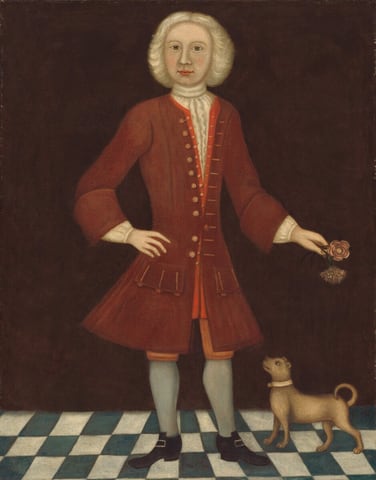
Jonathan Bentham, c. 1725
Artist: Charles Willson Peale, Sitter: Charles Willson Peale, Current owner: National Portrait Gallery, Smithsonian Institution
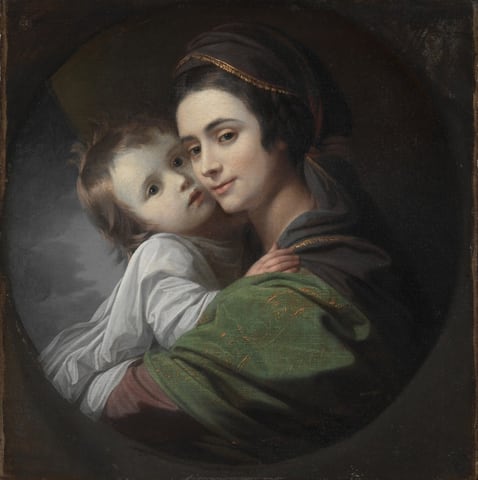
Elizabeth Shewell West and Her Son, Raphael, by Benjamin West, c. 1770
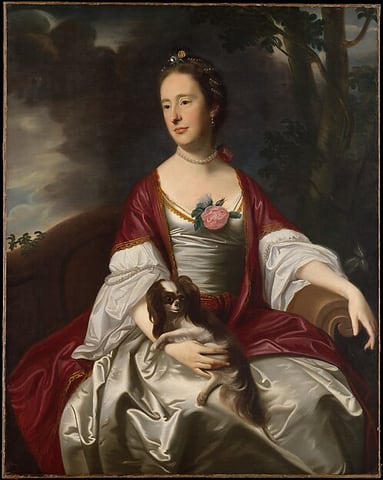
Mrs. Jerathmael Bowers, by John Singleton Copley, ca. 1763

The works in this room are listed below.

Works in this room

Works made in the United States in the 18th century.

Section 1, north wall

  1. A pale-skinned, clean-shaven man with a heavily lined, paunchy face sits against a green and red wall in this vertical portrait painting. The man sits in a wooden chair painted forest green and rests both hands on the closer arm. His body and knees are angled to our left, and he turns his wide, square face to look at with heavy-lidded eyes. One brow seems slightly cocked, and he has a large nose. His lips are pulled up on one side over a round double chin. He wears a white, shoulder-length wig and a sable-brown suit. The cuffs of a white shirt are visible at his wrists where his hands are stacked on the arm of the chair. The knee-length breeches are buckled at the knee over black stockings. His legs are crossed away from us, and his feet extend off the bottom edge of the composition. The bottom half of the wall behind him is painted burgundy red up to and including a chair rail, and the wall above is moss green. The wall is lined with a gold scallop pattern along the top of the chair rail and a sliver of brown on across the bottom of the composition suggests a wood floor. The artist signed and dated the painting as if he had inscribed the red wall near the man’s knees, “John Singleton Copley pinx 1772. Boston.”
    Eleazer TyngJohn Singleton Copley, 1772Courtesy National Gallery of Art, Washington
  2. Jonathan Bentham, c. 1725
    Jonathan BenthamUnrecorded American maker, c. 1725Courtesy National Gallery of Art, Washington
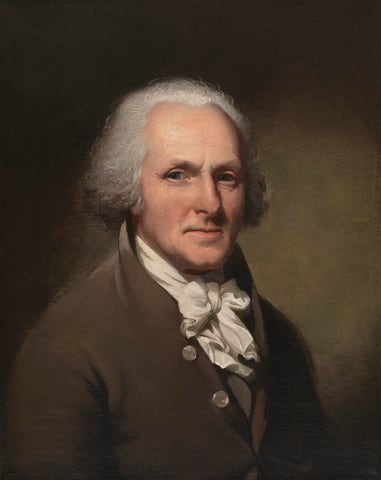
  3. Artist: Charles Willson Peale, Sitter: Charles Willson Peale, Current owner: National Portrait Gallery, Smithsonian Institution
    Charles Willson Peale Self-PortraitCharles Willson Peale, c. 1791Courtesy of the National Portrait Gallery, Smithsonian Institution

Section 1, south wall

  1. Elizabeth Shewell West and Her Son, Raphael, by Benjamin West, c. 1770
    Elizabeth Shewell West and Her Son, RaphaelBenjamin West, c. 1770Courtesy of the Cleveland Museum of Art
  2. Mrs. Jerathmael Bowers, by John Singleton Copley, ca. 1763
    Mrs. Jerathmael BowersJohn Singleton Copley, ca. 1763Courtesy of The Metropolitan Museum of Art