Floor plan

Time and placeThe 16th century

The 16th century

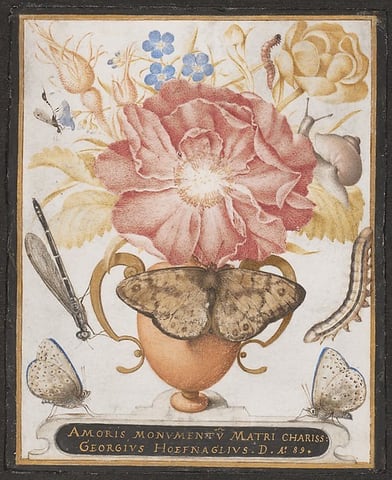
Still Life with Flowers, a Snail and Insects, by Joris Hoefnagel, 1589
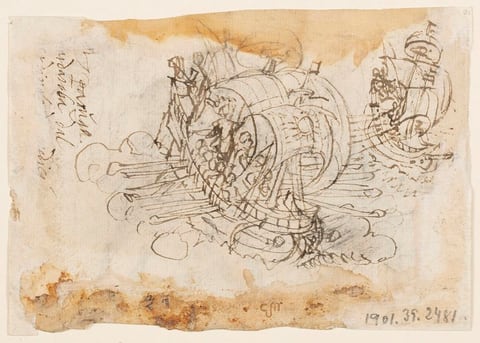
TWO GALLEYS AT SEA
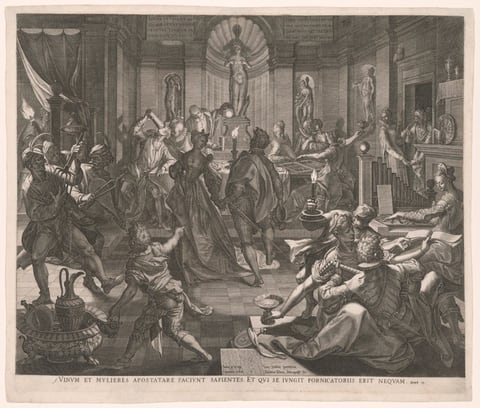
A work made of engraving in black on cream laid paper.
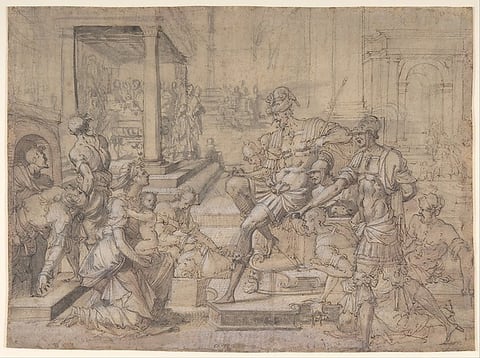
Amya Petitioning Faustus for the Custody of Saint Mamas, by Jean Cousin the Elder, ca. 1543
A work made of black chalk on laid paper, laid down on tan laid pulp board.
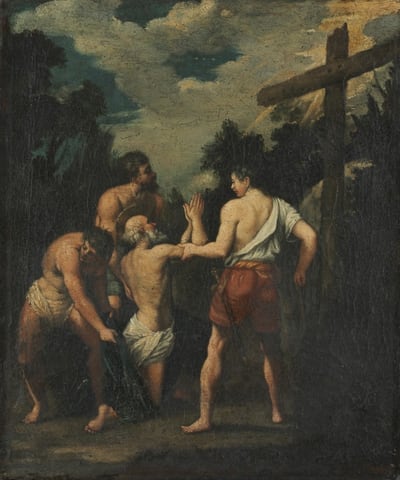
Martyrdom of Saint Andrew, by Guido Reni, 1600s
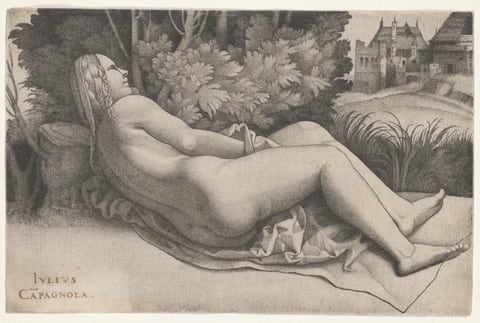
Venus Reclining in a Landscape, by Giulio Campagnola, c. 1508–9
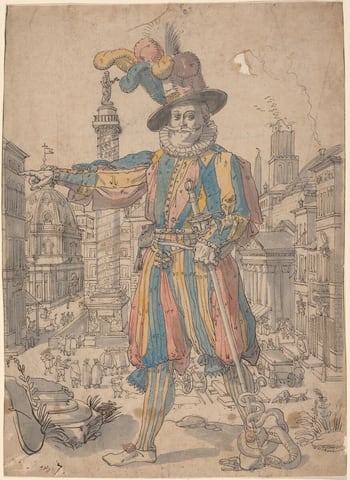
The artwork features a person standing prominently in front of an architectural scene. The individual has one arm extended out to the side, pointing with a gloved hand. The other hand holds a staff with a snake wrapped around it. The person has a stern facial expression, a beard and mustache, and wears a large hat with colorful feathers. They are dressed in a colorful suit with vertical stripes in red, blue, and yellow, paired with a ruffled collar and cuffs. The person also has an oversized sword at their hip. In the background, there is a Renaissance-style cityscape with architectural elements, people, and horse-drawn carriages.

The works in this room are listed below.

Works in this room

Works made in the 16th century, anywhere in the world.

First room, north wall

  1. Still Life with Flowers, a Snail and Insects, by Joris Hoefnagel, 1589
    Still Life with Flowers, a Snail and InsectsJoris Hoefnagel, 1589Courtesy of The Metropolitan Museum of Art
  2. TWO GALLEYS AT SEA
    Two Galleys at SeaJan van der Straet, called Stradanus, ca. 1587 – 1590Courtesy of Cooper Hewitt, Smithsonian Design Museum
  3. A work made of engraving in black on cream laid paper.
    The Carnival (or the Prodigal Son)Jan Sadeler, I, 1588Courtesy of the Art Institute of Chicago
  4. Amya Petitioning Faustus for the Custody of Saint Mamas, by Jean Cousin the Elder, ca. 1543
    Amya Petitioning Faustus for the Custody of Saint MamasJean Cousin the Elder, ca. 1543Courtesy of The Metropolitan Museum of Art

First room, south wall

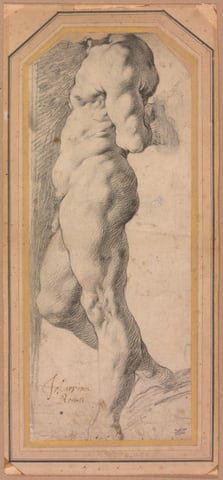
  1. A work made of black chalk on laid paper, laid down on tan laid pulp board.
    Study of a Standing Male NudeGiuseppe Cesari, called Cavaliere d'Arpino, 1595/96Courtesy of the Art Institute of Chicago
  2. Martyrdom of Saint Andrew, by Guido Reni, 1600s
    Martyrdom of Saint AndrewGuido Reni, 1600sCourtesy of the Cleveland Museum of Art
  3. Venus Reclining in a Landscape, by Giulio Campagnola, c. 1508–9
    Venus Reclining in a LandscapeGiulio Campagnola, c. 1508–9Courtesy of the Cleveland Museum of Art
  4. The artwork features a person standing prominently in front of an architectural scene. The individual has one arm extended out to the side, pointing with a gloved hand. The other hand holds a staff with a snake wrapped around it. The person has a stern facial expression, a beard and mustache, and wears a large hat with colorful feathers. They are dressed in a colorful suit with vertical stripes in red, blue, and yellow, paired with a ruffled collar and cuffs. The person also has an oversized sword at their hip. In the background, there is a Renaissance-style cityscape with architectural elements, people, and horse-drawn carriages.
    Giovanni Grosso of the Swiss Guards Standing before a View of RomeUnrecorded Swiss makerCourtesy National Gallery of Art, Washington

Second room, south wall
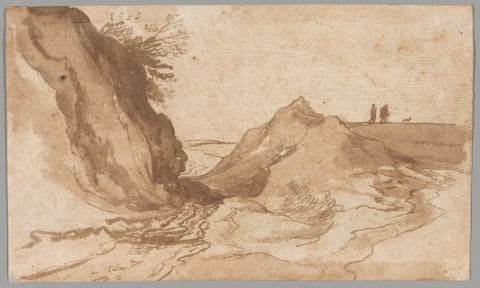
  1. A work made of pen and brush and brown ink and brush and brown wash on ivory laid paper.
    A Hilly Landscape with Figures Near a RavineJan Brueghel the Elder, 1595Courtesy of the Art Institute of Chicago
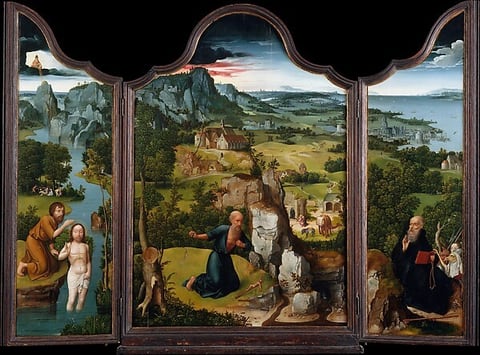
  2. The Penitence of Saint Jerome, by Joachim Patinir, ca. 1515
    The Penitence of Saint JeromeJoachim Patinir, ca. 1515Courtesy of The Metropolitan Museum of Art
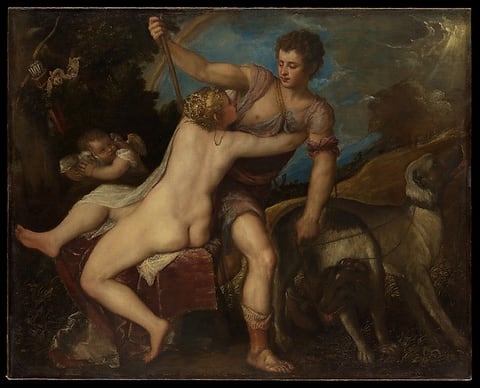
  3. Venus and Adonis, by Titian, 1550s
    Venus and AdonisTitian, 1550sCourtesy of The Metropolitan Museum of Art

Second room, north wall
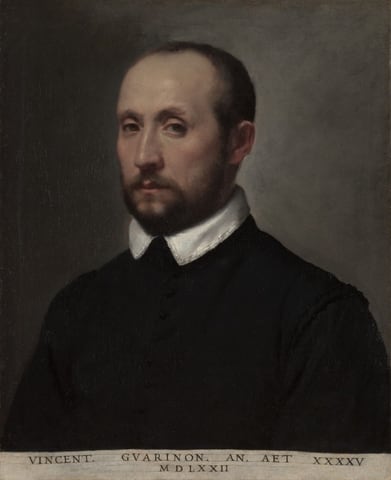
  1. Portrait of Vincenzo Guarignoni, by Giovanni Battista Moroni, c. 1572
    Portrait of Vincenzo GuarignoniGiovanni Battista Moroni, c. 1572Courtesy of the Cleveland Museum of Art
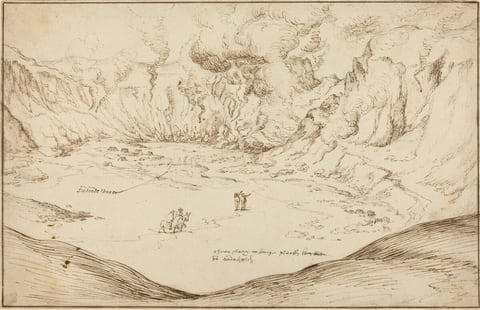
  2. The image shows an elevated view looking down into a crater-like landscape with steep surrounding cliffs. The horizon is high in the image, obscured by rocky formations and rising plumes of smoke. The detailed drawing has a sketch-like quality with fine lines depicting the cliffs and swirling smoke. The color palette is monochromatic, using shades of brown and beige. Two figures and a horse stand on a sloped terrain, providing scale. The crater's basin is visible, with smoke plumes and rock formations in the distance, stretching towards the horizon.
    Forum Vulcani: The Hot Springs at PozzuoliJoris Hoefnagel, 1578Courtesy National Gallery of Art, Washington
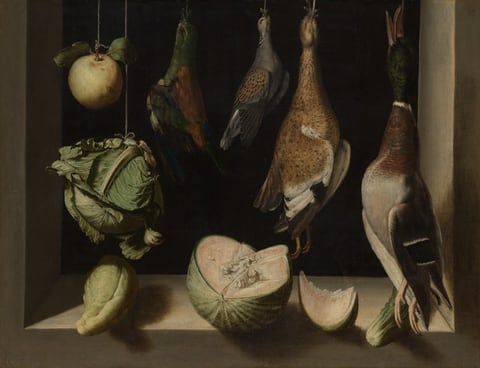
  3. Still life painting of dead waterfowl and vegetables in windowsill.
    Still Life with Game FowlJuan Sánchez Cotán, c. 1600–3Courtesy of the Art Institute of Chicago

Third room, north wall
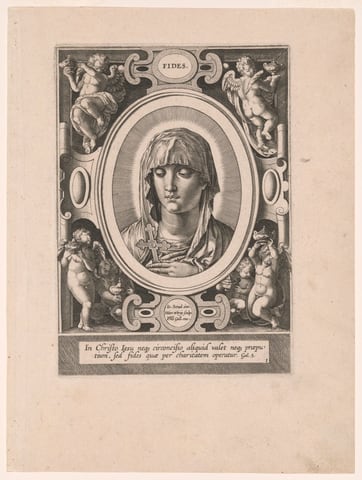
  1. A work made of engraving on ivory laid paper.
    Fides, plate 1 from The Seven VirtuesHieronymous Wierix, c. 1598Courtesy of the Art Institute of Chicago
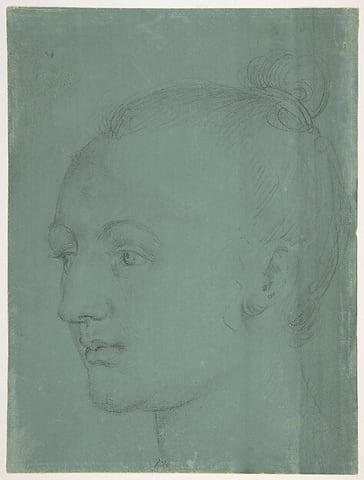
  2. Head of a Young Woman, by Albrecht Dürer, 1522
    Head of a Young WomanAlbrecht Dürer, 1522Courtesy of The Metropolitan Museum of Art