Floor plan

Artist galleriesUnrecorded makers

Unrecorded makers

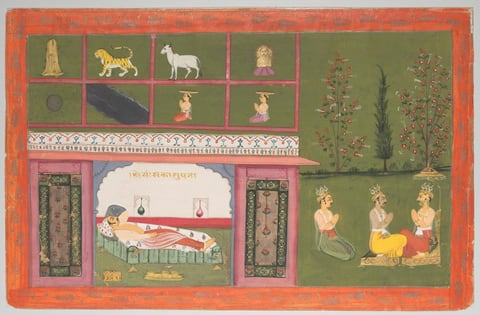
Prince Shreyamsa dreams of the coming of Rishabha, from a Panchakalyanaka (Five Auspicious Events), 1670–80
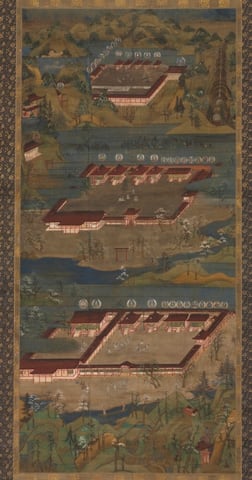
Mandala of the Three Shrines at Kumano, 1300s
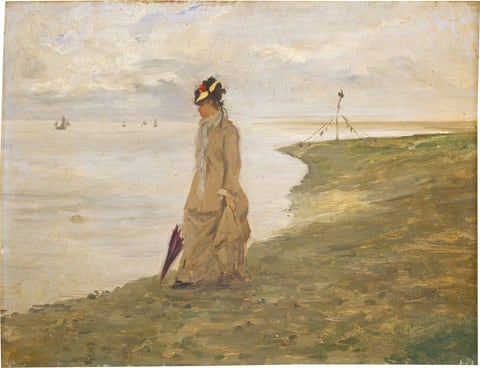
This painting shows a woman in a tan dress and a tan hat with red flowers, walking on a grassy shoreline, holding a dark purple umbrella. The woman is positioned in the center of the painting, and she faces the left, standing at the edge of the water, looking downward. She has light skin and dark hair put up under her hat. The horizon is high in the painting, where the blue-gray sky and water meet. Small ships are visible in the distance, floating on the horizon. On the right side of the painting, the yellow and green ground curves, sloping slightly downward to meet the water. The painting has loose, visible brushstrokes.
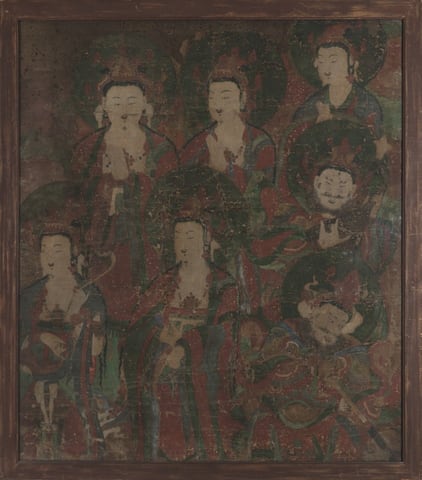
A work made of ink and color on hemp cloth.
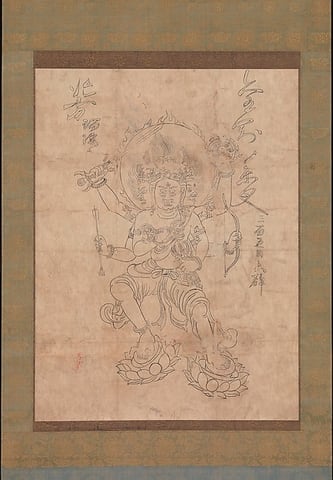
Kongōyasha Myōō, 12th century
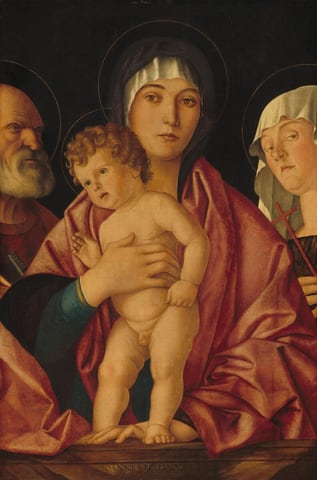
The painting depicts three adults and a child. The central adult, a woman, holds the child securely to her chest. The woman has pale skin and a white cloth covering her head, and she is wearing a dark cloak over a red robe. The child has curly light brown hair and is unclothed, looking towards the left. A bald man with a white beard, wearing a red garment and holding a key is on the left. On the right, another woman wears a white headscarf and a dark garment, holding a red cross. The background is dark, highlighting the people and their attire. All four of them have thin halos around their heads.
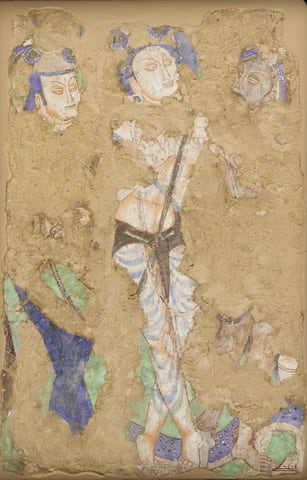
Three Figures, from Cave 224, 4th-6th century
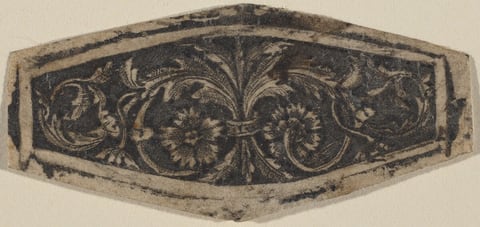
This is a drawing of an ornamental floral design. The image shows a central floral motif resembling a flower with radiating petals, surrounded by swirling leaf patterns. The background is dark, contrasting with the lighter line work of the floral design. The drawing's borders are uneven and have an antique appearance.

The works in this room are listed below.

Works in this room

Works whose makers the museums don't name.

First room, north wall

  1. Prince Shreyamsa dreams of the coming of Rishabha, from a Panchakalyanaka (Five Auspicious Events), 1670–80
    Prince Shreyamsa dreams of the coming of Rishabha, from a Panchakalyanaka (Five Auspicious Events)Unrecorded Indian maker, 1670–80Courtesy of the Cleveland Museum of Art
  2. Mandala of the Three Shrines at Kumano, 1300s
    Mandala of the Three Shrines at KumanoUnrecorded Japanese maker, 1300sCourtesy of the Cleveland Museum of Art
  3. This painting shows a woman in a tan dress and a tan hat with red flowers, walking on a grassy shoreline, holding a dark purple umbrella. The woman is positioned in the center of the painting, and she faces the left, standing at the edge of the water, looking downward. She has light skin and dark hair put up under her hat. The horizon is high in the painting, where the blue-gray sky and water meet. Small ships are visible in the distance, floating on the horizon. On the right side of the painting, the yellow and green ground curves, sloping slightly downward to meet the water. The painting has loose, visible brushstrokes.
    Woman by the SeasideUnrecorded French maker, 19th centuryCourtesy National Gallery of Art, Washington
  4. A work made of ink and color on hemp cloth.
    Korean Buddhist PaintingUnrecorded Korean maker, late 19th-early 20th centuryCourtesy of the Art Institute of Chicago

First room, south wall

  1. Kongōyasha Myōō, 12th century
    Kongōyasha MyōōUnrecorded Japanese maker, 12th centuryCourtesy of The Metropolitan Museum of Art
  2. The painting depicts three adults and a child. The central adult, a woman, holds the child securely to her chest. The woman has pale skin and a white cloth covering her head, and she is wearing a dark cloak over a red robe. The child has curly light brown hair and is unclothed, looking towards the left. A bald man with a white beard, wearing a red garment and holding a key is on the left. On the right, another woman wears a white headscarf and a dark garment, holding a red cross. The background is dark, highlighting the people and their attire. All four of them have thin halos around their heads.
    Madonna and Child with SaintsUnrecorded maker, c. 1490/1500Courtesy National Gallery of Art, Washington
  3. Three Figures, from Cave 224, 4th-6th century
    Three Figures, from Cave 224Unrecorded maker, 4th-6th centuryCourtesy of the Smithsonian American Art Museum
  4. This is a drawing of an ornamental floral design. The image shows a central floral motif resembling a flower with radiating petals, surrounded by swirling leaf patterns. The background is dark, contrasting with the lighter line work of the floral design. The drawing's borders are uneven and have an antique appearance.
    Ornament in Hexagonal ShapeUnrecorded Italian maker, c. 1480/1510Courtesy National Gallery of Art, Washington

Second room, south wall
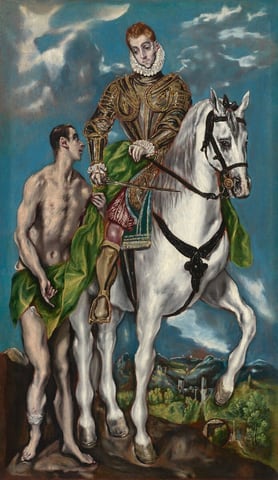
  1. A nearly nude man with peachy skin stands next to and looks up at a man with ashen, ivory-colored skin, wearing armor and riding a bright white horse in this vertical painting. The horizon line comes less than a quarter of the way up the composition, and the sky behind the men and horse is vivid, aqua blue with a few silvery-gray and pale, yellow clouds floating along the top edge of the composition. The painting is created with long, blended brushstrokes, and the limbs and features of the two men and horse are elongated and have delicate, dark outlines. The horse’s body is angled to our right but it looks at us from the corners of its dark eyes. One front leg is raised. The rider looks down toward the man on foot at his side, to our left. The rider has dark, arched eyebrows, a long, straight nose, a pointed chin, and short, copper-orange hair. Wide ruffs pleated into figure-eights encircle his neck and wrists. His chest and arms are covered with plates of steel-gray armor edged and decorated with gold bands and medallions. He wears crimson-red pantaloons and stockings with mustard-yellow boots. With his right hand, to our left, he holds the gold hilt of a long, thin sword along the horse’s body. With his other hand, he holds a swath of lime-green fabric, which drapes down the side of the horse and across the hips of the man standing next to the rider. The sheen of the fabric is suggested with canary-yellow highlights where it catches the light. The standing man has short, dark brown hair and eyebrows. He looks to our right in profile, toward the rider, with pink lips parted. He holds the green fabric with his left hand, to our right, and he has a bandage around his leg near his right ankle. The horse and man stand on a spit of dark brown land, with a landscape of trees, buildings, and mountains deep in the distance beyond.
    Saint Martin and the BeggarUnrecorded Greek maker, 1600/1614Courtesy National Gallery of Art, Washington
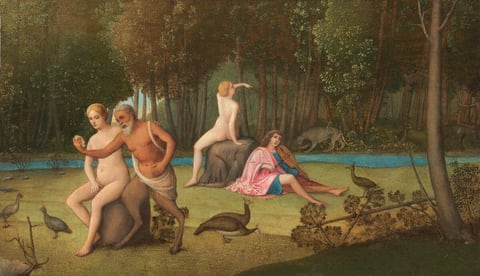
  2. Two women, a man, and a satyr, a man with goat’s legs, are in two pairs in a forested landscape in this horizontal painting. The pale-skinned women are nude, and their blond hair is tied up and back. One woman sits on a brown boulder to the left of center. One hand covers her groin, and the other hand rests on the satyr’s shoulder. The satyr has deeply tanned skin, short white hair, and a long white beard. A white cloth wraps over one shoulder and across his hips. He holds up an object, perhaps a shell, with one hand. That arm crosses over the woman’s breasts. His other hand is by his lower belly, and he looks at the shell. A bit farther back and to our right, a second nude woman also sits on a boulder. She faces away from us and holds up a long stick with her left arm, which arcs over her body. A clean-shaven, pale-skinned man sits with his back against the boulder. He has long brown hair and looks off to the distance to our right. He wears a carnation-pink robe over a sapphire-blue tunic. His legs splay in front of him, his feet bare, as he holds a bow to a violin-like instrument tucked under his chin. The two pairs sit in a grassy glade occupied also by five pheasant- or peacock-like birds. A thin river running behind the glade is lined with spindly trees that together make an impenetrable bronze-brown and laurel-green canopy. The second woman’s stick points or is directed to a gray, mountain lion-like cat on the far bank. Closer inspection reveals deer and another person, who points, tucked among the trunks. A glimpse of blue sky is visible through a break in the tree trunks.
    OrpheusUnrecorded Italian maker, c. 1515Courtesy National Gallery of Art, Washington
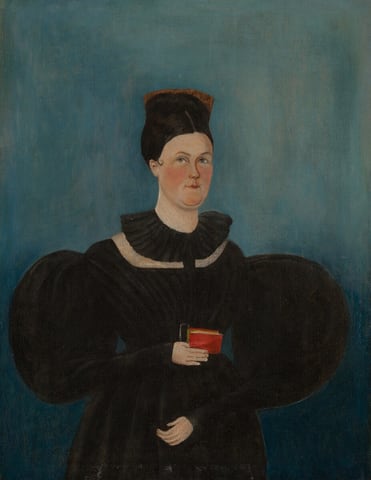
  3. The image shows a woman standing upright with a small red book in her right hand. She has a fair complexion, neutral expression, slightly arched eyebrows, and small, rounded lips. Her dark brown hair is styled in an updo with a black accessory. She wears a high-necked dark dress with puffed sleeves and a white collar. The background is plain blue. The woman is not wearing any visible jewelry, and the setting is minimalistic with only the book present.
    Anonymous WomanUnrecorded American maker, c. 1830Courtesy National Gallery of Art, Washington
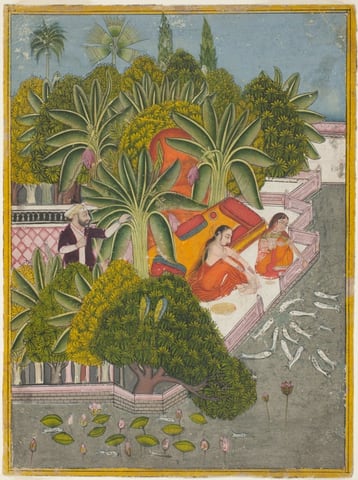
  4. A work made of opaque watercolor on paper.
    Royal Women Feeding FishUnrecorded Indian maker, c. 1740Courtesy of the Art Institute of Chicago

Second room, north wall
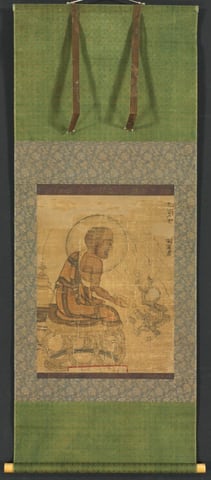
  1. Arhat, 1235
    ArhatUnrecorded Korean maker, 1235Courtesy of the Cleveland Museum of Art
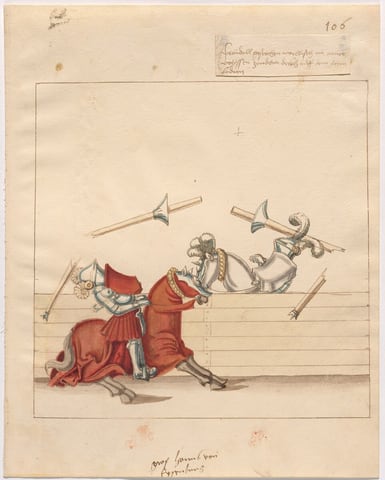
  2. This is a drawing of two armored figures on horseback engaged in a joust. Both knights are clad in ornate armor and mounted on horses as they participate in the match. The scene captures the moment of impact, with splintered lances flying in the air. One knight in silver armor with blue accents is being unseated from his horse, while the other knight in red and silver armor remains mounted. Both horses are draped in colors matching their riders' armors. The focus is on the dynamic action and energy of the joust, with fine details showing the armor's shine and the movement of the horses. The drawing is bordered, and there is some script at the top and bottom.
    Italian Joust of PeaceUnrecorded German maker, c.1512-1515Courtesy National Gallery of Art, Washington
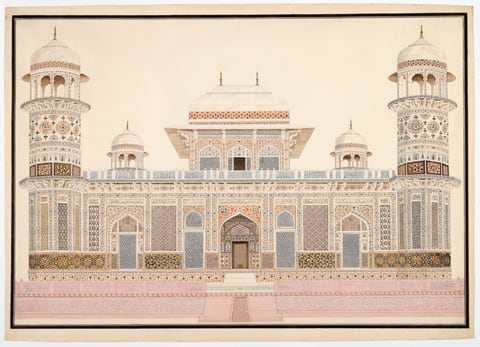
  3. A work made of watercolor on paper watermarked j. whatman with pencil, pen, ink and gold.
    I'timad-ud-Daula's Tomb at AgraUnrecorded Indian maker, c. 1820Courtesy of the Art Institute of Chicago
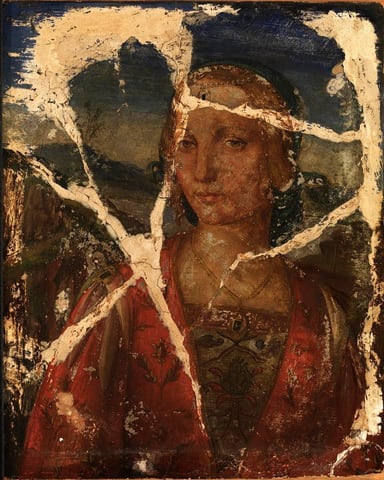
  4. Head of a Young Woman, 15th century
    Head of a Young WomanUnrecorded Italian maker, 15th centuryCourtesy of the Smithsonian American Art Museum