Floor plan

Artist galleriesGiovanni Battista Piazzetta's contemporaries
Giovanni Battista Piazzetta's contemporaries
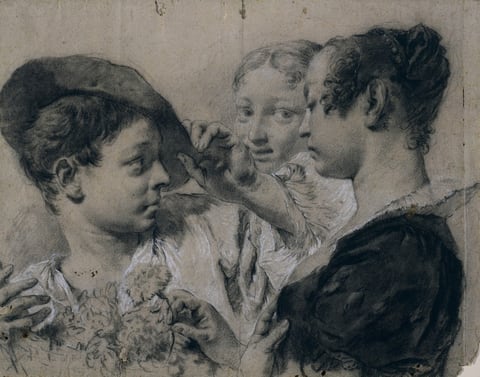
A Young Woman Buying a Pink from a Young Man, by Giovanni Battista Piazzetta, c. 1740
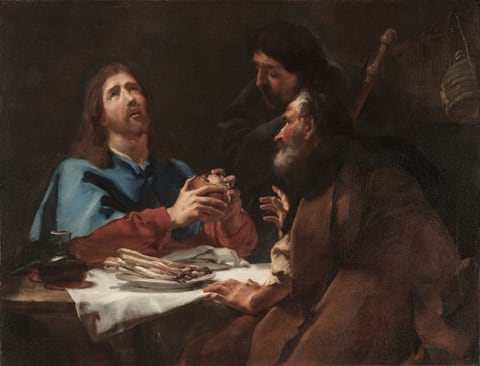
The Supper at Emmaus, by Giovanni Battista Piazzetta, c. 1720
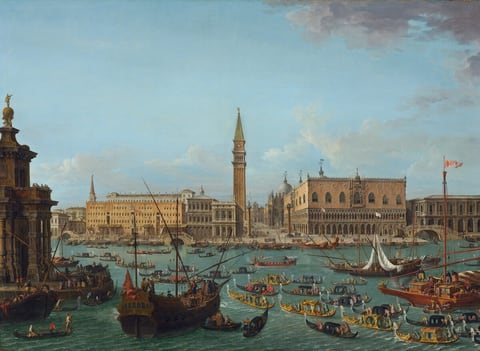
The painting depicts many large and small ships on blue-green water. Gondolas in shades of gold, black, red, and blue drift across the water, small people on them pushing long poles through the water. There are also large sailboats and long boats with several rowers. They create a colorful mix. On the left, a large brown building with columns is visible. Some of the boats pull up to it, and many people in colorful clothing are visible on the shore. Behind the water are more large buildings in shades of brown, cream, and tan, with even more people visible on the streets below them. There is a large tower in the center of the painting, and several blue domes are visible in the distance. The sky is light blue, with white and gray clouds drifting across it.
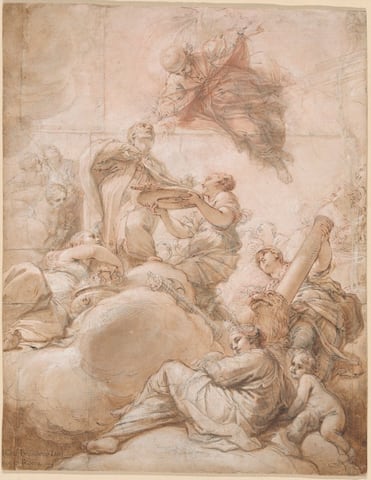
A work made of pen and brown ink and brush and brown wash, over black and red chalk, heightened with white opaque watercolor, on joined sheets of laid paper, mounted to paperboard.
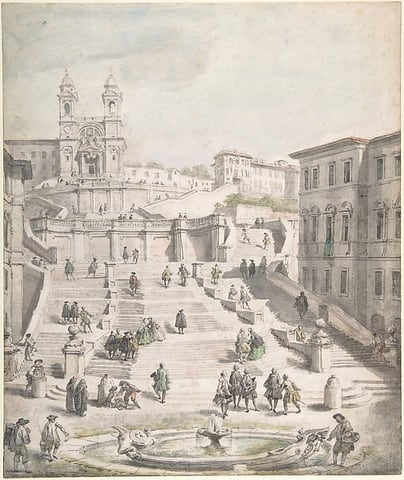
Scalinata della Trinità dei Monti, by Giovanni Paolo Panini, ca. 1756–58

The works in this room are listed below.

Works in this room

A few works by Giovanni Battista Piazzetta, then their contemporaries: makers of the same nationality born within 25 years of them, then works from the same century and place.

Section 1, north wall

  1. A Young Woman Buying a Pink from a Young Man, by Giovanni Battista Piazzetta, c. 1740
    A Young Woman Buying a Pink from a Young ManGiovanni Battista Piazzetta, c. 1740Courtesy of the Cleveland Museum of Art
  2. The Supper at Emmaus, by Giovanni Battista Piazzetta, c. 1720
    The Supper at EmmausGiovanni Battista Piazzetta, c. 1720Courtesy of the Cleveland Museum of Art

Their contemporaries

  1. The painting depicts many large and small ships on blue-green water. Gondolas in shades of gold, black, red, and blue drift across the water, small people on them pushing long poles through the water. There are also large sailboats and long boats with several rowers. They create a colorful mix. On the left, a large brown building with columns is visible. Some of the boats pull up to it, and many people in colorful clothing are visible on the shore. Behind the water are more large buildings in shades of brown, cream, and tan, with even more people visible on the streets below them. There is a large tower in the center of the painting, and several blue domes are visible in the distance. The sky is light blue, with white and gray clouds drifting across it.
    Procession of Gondolas in the Bacino di San Marco, VeniceAntonio Joli, 1742 or afterCourtesy National Gallery of Art, Washington
  2. A work made of pen and brown ink and brush and brown wash, over black and red chalk, heightened with white opaque watercolor, on joined sheets of laid paper, mounted to paperboard.
    Allegory of the Elevation of Cardinal Deacon Oddone Colonna to the Papal Chair as Pope Martin VBenedetto Luti, 1700Courtesy of the Art Institute of Chicago
  3. Scalinata della Trinità dei Monti, by Giovanni Paolo Panini, ca. 1756–58
    Scalinata della Trinità dei MontiGiovanni Paolo Panini, ca. 1756–58Courtesy of The Metropolitan Museum of Art

Their contemporaries, second
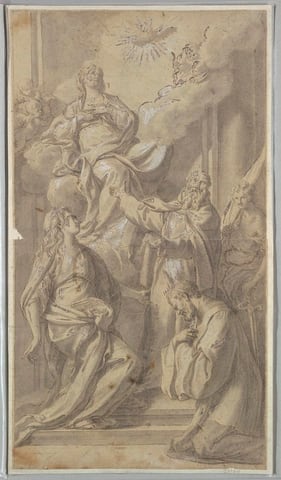
  1. MADONNA AND SAINTS
    Madonna and SaintsSebastiano Conca, ca. 1730Courtesy of Cooper Hewitt, Smithsonian Design Museum
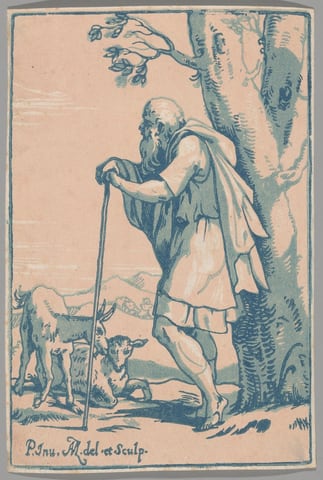
  2. A work made of chiaroscuro woodcut, from three blocks in pink, dark blue, and light blue, on cream laid paper.
    The Old ShepherdConte Antonio Maria Zanetti, the Elder, 1722Courtesy of the Art Institute of Chicago
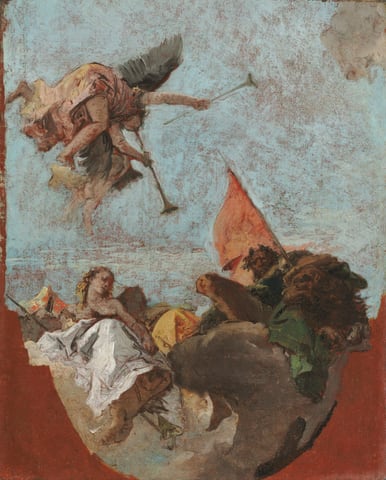
  3. Sketch for a Ceiling, by Giovanni Battista Tiepolo, 1750s
    Sketch for a CeilingGiovanni Battista Tiepolo, 1750sCourtesy of the Cleveland Museum of Art