Floor plan

Artist galleriesGeorg Eisenmann's contemporaries
Georg Eisenmann's contemporaries
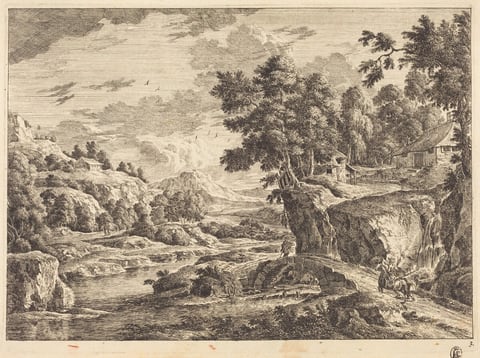
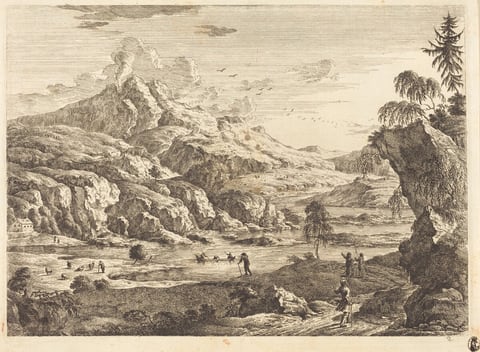
The image shows a landscape scene with an elevated perspective. The horizon is placed low, emphasizing the sky with swirling clouds and scattered birds. A river winds through a valley with a stone bridge. A rocky outcrop with trees and a small building are on the right. In the distance, hills lead to mountains. The style uses intricate cross-hatching for texture and depth. The color palette is monochrome with varying shades of sepia.
The image depicts a landscape scene from an elevated point of view. The horizon shows distant mountains with smoke rising from the tallest peak. Linear brushstrokes create detailed textures of the rocky landscape, clouds, and birds in the sky. The color palette is monochromatic with earthy tones. Figures are shown engaging in activities near a river, surrounded by trees, rocks, and meadows. Hills lead to mountainous formations on the far horizon, under a cloudy sky with a flock of birds.
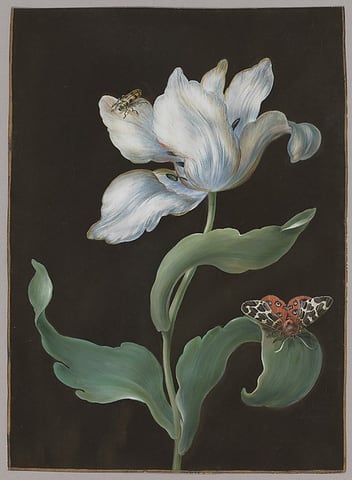
A tulip, a butterfly of the species Arctia caja (garden tiger moth), and a beetle (possibly a longhorn), by Barbara Regina Dietzsch, ca. 1750-60
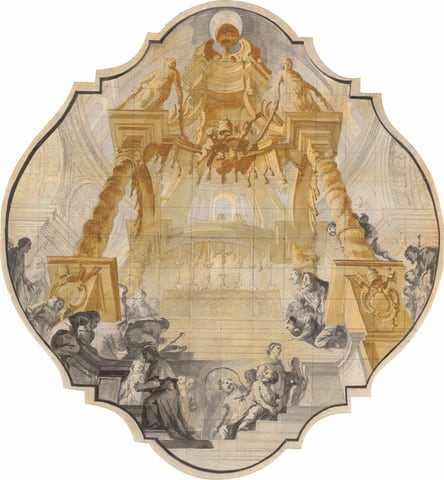
This is a painting of an architectural scene with decorative and religious elements. The painting features a grand interior setting, possibly a church or cathedral, dominated by ornate columns and a ceiling structure. Figures appear on pedestals atop the columns. In the background, there is a depiction of a religious or ceremonial space with detailed balustrades and steps, where figures are shown in dynamic poses. The color palette consists of warm golden hues contrasted with cooler grey tones, highlighting the intricate details of the architecture and figures. This is in the style of Giovanni Battista Tiepolo.
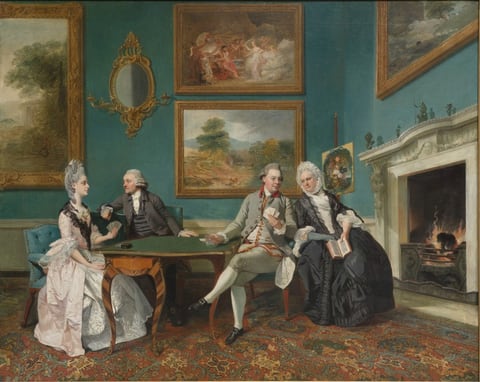
The Dutton Family in the Drawing Room of Sherborne Park, Gloucestershire, by Johann Zoffany, c. 1772
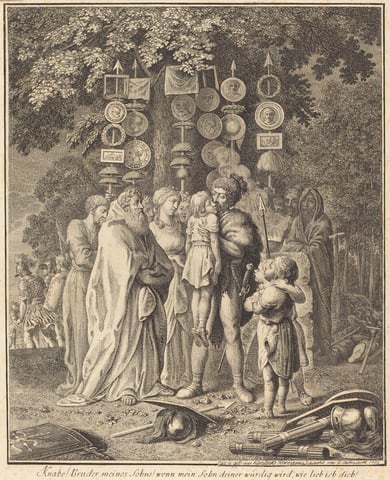
The image depicts a group of people in varying poses and outfits. A central figure, possibly a child, is being held up by a man. Those around them are positioned differently, some standing closely. The figures have detailed faces and wear garments resembling classical attire. Shields and banners decorated with symbols are present in the background. Armor and helmets are scattered on the ground. Trees and a group of people in the distance are part of the background.

The works in this room are listed below.

Works in this room

A few works by Georg Eisenmann, then their contemporaries: makers of the same nationality born within 25 years of them, then works from the same century and place.

Section 1, north wall

  1. The image shows a landscape scene with an elevated perspective. The horizon is placed low, emphasizing the sky with swirling clouds and scattered birds. A river winds through a valley with a stone bridge. A rocky outcrop with trees and a small building are on the right. In the distance, hills lead to mountains. The style uses intricate cross-hatching for texture and depth. The color palette is monochrome with varying shades of sepia.
    Landscape with a Bridge and Three Farm BuildingsGeorg EisenmannCourtesy National Gallery of Art, Washington
  2. The image depicts a landscape scene from an elevated point of view. The horizon shows distant mountains with smoke rising from the tallest peak. Linear brushstrokes create detailed textures of the rocky landscape, clouds, and birds in the sky. The color palette is monochromatic with earthy tones. Figures are shown engaging in activities near a river, surrounded by trees, rocks, and meadows. Hills lead to mountainous formations on the far horizon, under a cloudy sky with a flock of birds.
    Mountainous Riverscape with FiguresGeorg EisenmannCourtesy National Gallery of Art, Washington

Their contemporaries

  1. A tulip, a butterfly of the species Arctia caja (garden tiger moth), and a beetle (possibly a longhorn), by Barbara Regina Dietzsch, ca. 1750-60
    A tulip, a butterfly of the species Arctia caja (garden tiger moth), and a beetle (possibly a longhorn)Barbara Regina Dietzsch, ca. 1750-60Courtesy of The Metropolitan Museum of Art
  2. This is a painting of an architectural scene with decorative and religious elements. The painting features a grand interior setting, possibly a church or cathedral, dominated by ornate columns and a ceiling structure. Figures appear on pedestals atop the columns. In the background, there is a depiction of a religious or ceremonial space with detailed balustrades and steps, where figures are shown in dynamic poses. The color palette consists of warm golden hues contrasted with cooler grey tones, highlighting the intricate details of the architecture and figures. This is in the style of Giovanni Battista Tiepolo.
    Worshippers at the Tomb of Saint PeterMatthäus Günther, 1740/1741Courtesy National Gallery of Art, Washington
  3. The Dutton Family in the Drawing Room of Sherborne Park, Gloucestershire, by Johann Zoffany, c. 1772
    The Dutton Family in the Drawing Room of Sherborne Park, GloucestershireJohann Zoffany, c. 1772Courtesy of the Cleveland Museum of Art
  4. The image depicts a group of people in varying poses and outfits. A central figure, possibly a child, is being held up by a man. Those around them are positioned differently, some standing closely. The figures have detailed faces and wear garments resembling classical attire. Shields and banners decorated with symbols are present in the background. Armor and helmets are scattered on the ground. Trees and a group of people in the distance are part of the background.
    Ancient TeutonsDaniel Nikolaus Chodowiecki, 1782Courtesy National Gallery of Art, Washington

Their contemporaries, second
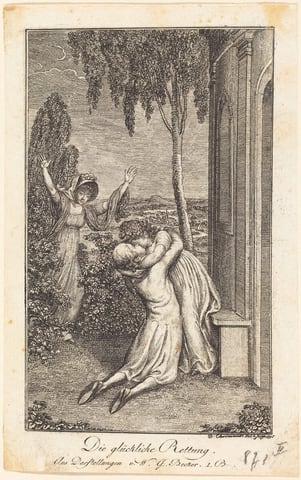
  1. The image shows three figures. Two of them are embracing in the foreground, kneeling on the ground and facing each other in a kiss. The person on the left has curly hair and appears to be wearing a coat-like garment, while the person on the right has long hair tied back and is dressed in a long robe. The third figure emerges from the bushes in the background, with shoulder-length hair, wearing a dress with a sash and a light shawl or scarf over their head. The setting includes tall trees, shrubs, and a structure with columns and arches on the right side, suggesting a garden or courtyard. Rolling hills and cloudy skies are in the distant background.
    The Fortunate RescueDaniel Nikolaus Chodowiecki, 1791Courtesy National Gallery of Art, Washington
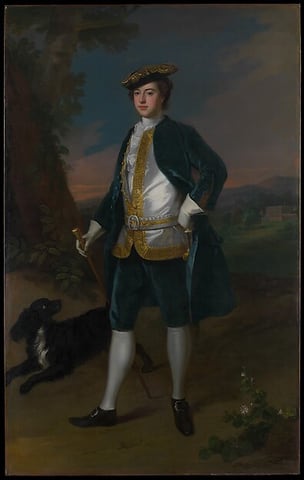
  2. Sir James Dashwood (1715–1779), by Enoch Seeman the Younger, 1737
    Sir James Dashwood (1715–1779)Enoch Seeman the Younger, 1737Courtesy of The Metropolitan Museum of Art