Floor plan

Artist galleriesEugène Isabey's contemporaries
Eugène Isabey's contemporaries
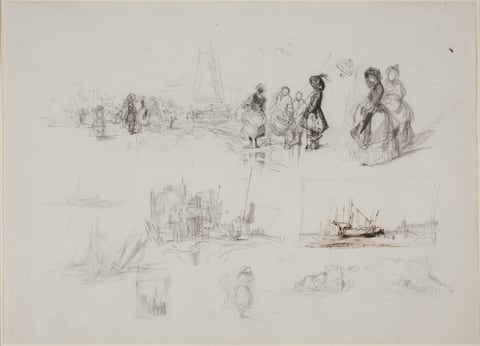
This image is a pencil sketch on paper with a monochrome palette of graphite gray. The viewer sees various scenes without a defined horizon line. The upper section shows figures in period clothing, possibly mid-19th century women's fashion. The middle area has abstract architectural forms. In the lower right corner, a sailing ship or boat is sketched with more detail than the rest. The drawing style consists of quick, expressive strokes. The image conveys multiple narrative or compositional ideas on a single sheet.
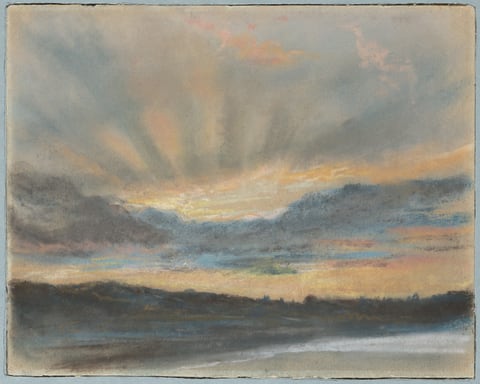
Sunset, by Eugène Delacroix, ca. 1850
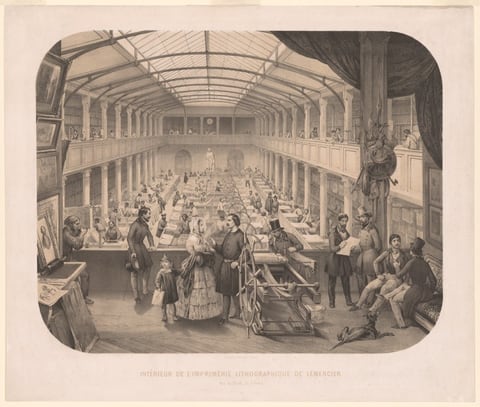
A work made of lithograph from two stones on off-white wove paper.
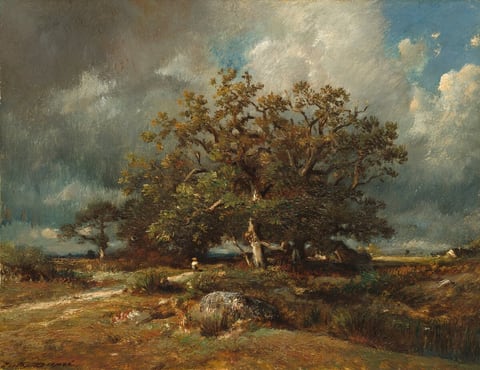
The painting depicts a landscape with a field, trees, and a dramatic cloudy sky. Grass, rocks, and a group of large trees are visible in the center of the composition. Below the trees, there is a small shape that could be a person looking up. Farther back, there are some small triangular structures that might be houses. The brushstrokes are expressive and not much detail is visible in the smaller shapes. The grass and foliage are painted in earthy tones of brown, orange, and green, while the sky is blue with areas of thick gray and white clouds.
A work made of oil on canvas.

The works in this room are listed below.

Works in this room

A few works by Eugène Isabey, then their contemporaries: makers of the same nationality born within 25 years of them, then works from the same century and place.

With their contemporaries

  1. This image is a pencil sketch on paper with a monochrome palette of graphite gray. The viewer sees various scenes without a defined horizon line. The upper section shows figures in period clothing, possibly mid-19th century women's fashion. The middle area has abstract architectural forms. In the lower right corner, a sailing ship or boat is sketched with more detail than the rest. The drawing style consists of quick, expressive strokes. The image conveys multiple narrative or compositional ideas on a single sheet.
    Seaside StudiesEugène Isabey, 1830sCourtesy National Gallery of Art, Washington
  2. Sunset, by Eugène Delacroix, ca. 1850
    SunsetEugène Delacroix, ca. 1850Courtesy of The Metropolitan Museum of Art
  3. A work made of lithograph from two stones on off-white wove paper.
    Interior of the Lemercier Lithographic Printing HouseCharles Villemin, n.d.Courtesy of the Art Institute of Chicago
  4. The painting depicts a landscape with a field, trees, and a dramatic cloudy sky. Grass, rocks, and a group of large trees are visible in the center of the composition. Below the trees, there is a small shape that could be a person looking up. Farther back, there are some small triangular structures that might be houses. The brushstrokes are expressive and not much detail is visible in the smaller shapes. The grass and foliage are painted in earthy tones of brown, orange, and green, while the sky is blue with areas of thick gray and white clouds.
    The Old OakJules Dupré, c. 1870Courtesy National Gallery of Art, Washington

Their contemporaries

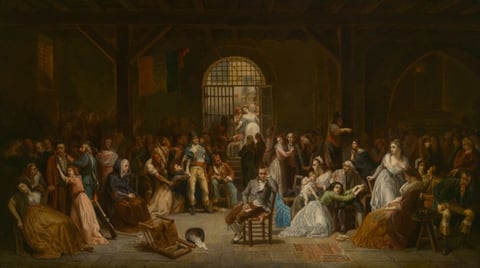
  1. A work made of oil on canvas.
    The Roll Call of the Last Victims of the TerrorCharles Louis-Lucien Muller, c. 1850Courtesy of the Art Institute of Chicago
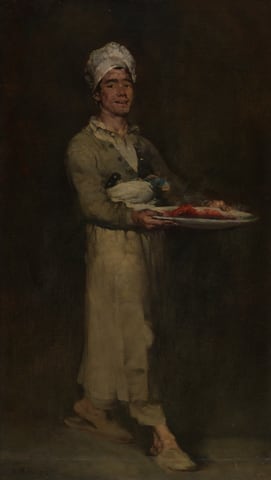
  2. A work made of oil on canvas.
    The ScullionAugustin Théodule Ribot, c. 1865Courtesy of the Art Institute of Chicago

Their contemporaries, second
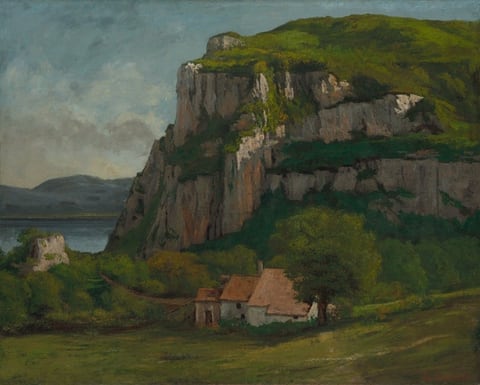
  1. A work made of oil on canvas.
    The Rock of HautepierreGustave Courbet, c. 1869Courtesy of the Art Institute of Chicago
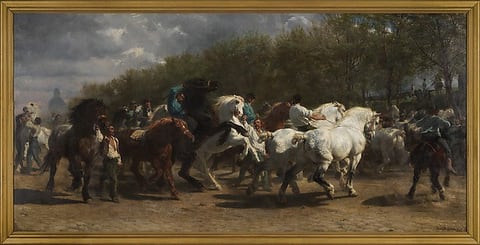
  2. The Horse Fair, by Rosa Bonheur, 1852–55
    The Horse FairRosa Bonheur, 1852–55Courtesy of The Metropolitan Museum of Art