Floor plan

Artist galleriesAbraham Walkowitz's contemporaries
Abraham Walkowitz's contemporaries
Abraham Walkowitz
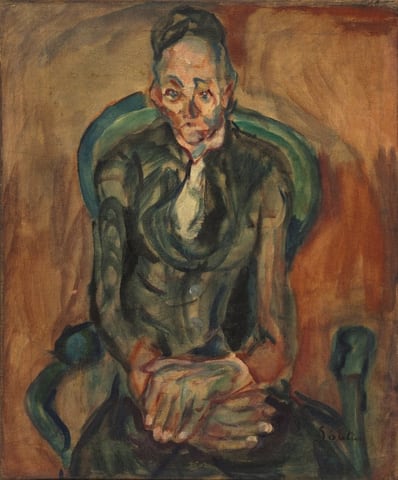
Old Woman, by Chaïm Soutine, c. 1923–24
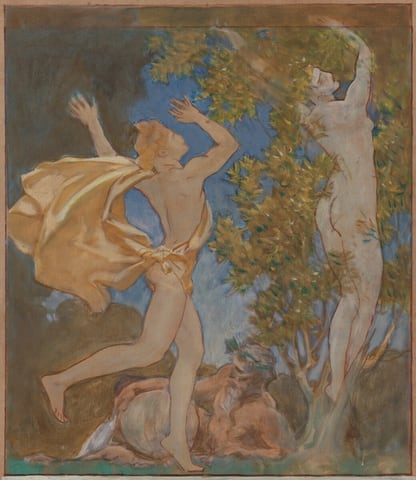
This is a painting showing two people in nature. The person on the left appears to be running towards the right, with one leg in the air and their arms outstretched. They have tan, golden-toned skin, blond hair, and golden fabric draped loosely around them, billowing backward as they run. On the right is a pale person standing upright in a tree, their arms outstretched. They appear intertwined with the tree, with their feet nestled in the light brown trunk and their head and hands covered in olive-green leaves. The background features indistinct brown shapes against a clear blue sky.
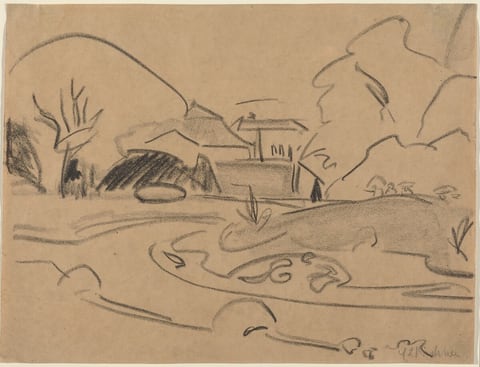
The image shows a landscape drawing with buildings, trees, and a winding path or water feature. The drawing is done in black charcoal on brownish background paper, creating a monochromatic color palette.

The works in this room are listed below.

Works in this room

A few works by Abraham Walkowitz, then their contemporaries: makers of the same nationality born within 25 years of them, then works from the same century and place.

With their contemporaries

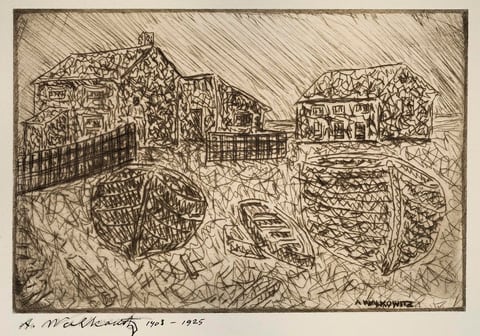
  1. Abraham Walkowitz
    Untitled (One Of Six Prints)Abraham Walkowitz, 1903-1925Courtesy of the Hirshhorn Museum and Sculpture Garden, Smithsonian Institution
  2. Old Woman, by Chaïm Soutine, c. 1923–24
    Old WomanChaïm Soutine, c. 1923–24Courtesy of the Cleveland Museum of Art

Their contemporaries

  1. This is a painting showing two people in nature. The person on the left appears to be running towards the right, with one leg in the air and their arms outstretched. They have tan, golden-toned skin, blond hair, and golden fabric draped loosely around them, billowing backward as they run. On the right is a pale person standing upright in a tree, their arms outstretched. They appear intertwined with the tree, with their feet nestled in the light brown trunk and their head and hands covered in olive-green leaves. The background features indistinct brown shapes against a clear blue sky.
    Apollo and DaphneJohn Singer Sargent, c. 1916/1919Courtesy National Gallery of Art, Washington
  2. The image shows a landscape drawing with buildings, trees, and a winding path or water feature. The drawing is done in black charcoal on brownish background paper, creating a monochromatic color palette.
    Footpaths and Pavilion in the Dresden Grosser GartenErnst Ludwig Kirchner, c. 1909Courtesy National Gallery of Art, Washington

Their contemporaries, second
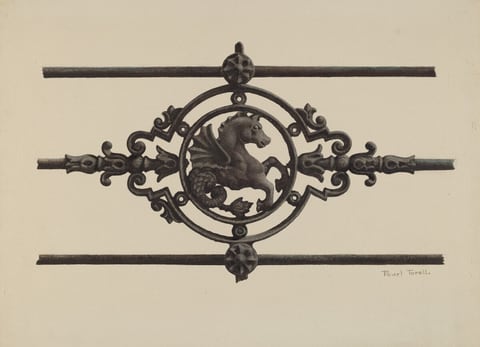
  1. The image shows an ornate metalwork design with a winged creature. The design features intricate wrought iron decoration with a mythical figure, resembling a Pegasus, enclosed within a circular frame. The central circle is surrounded by symmetrical, stylized scrollwork motifs and horizontal bars, suggesting an architectural or ornamental fixture intended for use in structures like gates or window grills. The detailed craftsmanship and balanced design highlight the creature's form and the harmonious symmetry of the patterns.
    Fence - Sea Horse DesignPearl Torell, c. 1939Courtesy National Gallery of Art, Washington
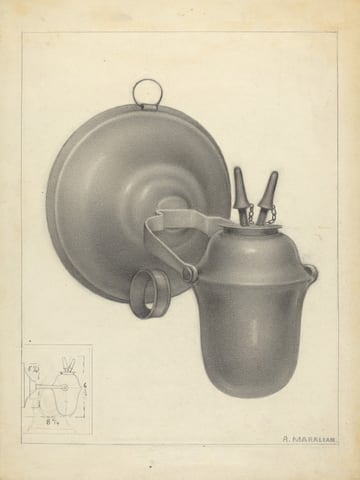
  2. The image depicts a detailed drawing of a wall-mounted vessel. It consists of a large, spherical body attached to a flat disc, with two smaller protrusions resembling handles or clips. The color palette is monochromatic with shades of gray, giving it a metallic or ceramic appearance. The objects are centrally positioned, with a small inset illustration in the bottom left corner showing annotations. The artist's signature, "A. Marshall," is located near the lower right corner of the image.
    LampArsen Maralian, c. 1936Courtesy National Gallery of Art, Washington

Their contemporaries, third
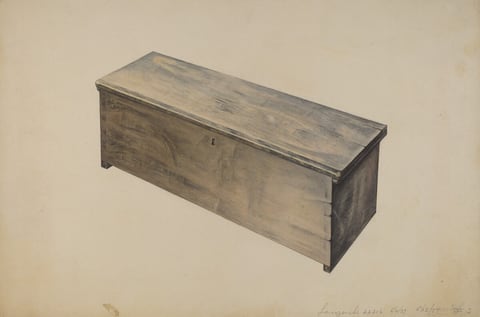
  1. The image shows a large wooden chest with a rectangular design and a keyhole on its front panel. The chest has a weathered look in muted browns and grays. It is positioned in the center with its top, front, and side panels visible. The background is plain and light in color.
    Utility ChestHenry Tomaszewski, 1937Courtesy National Gallery of Art, Washington
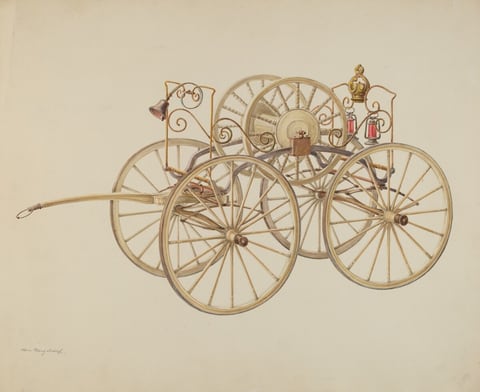
  2. This is a painting of a vintage fire hose cart. It is intricately designed, featuring a four-wheeled cart meant to hold a coiled fire hose. The painting showcases the cart's wooden spoked wheels and hose mechanism, as well as ornate wrought iron designs and a brass figure. A bell is depicted above one wheel. The painting captures the craftsmanship of the era and is reminiscent of the style of Charles Demuth, known for his attention to detail and focus on industrial and architectural elements.
    Fire Hose ReelHans Mangelsdorf, c. 1938Courtesy National Gallery of Art, Washington