Floor plan

Style galleriesAmerican folk and design
American folk and design
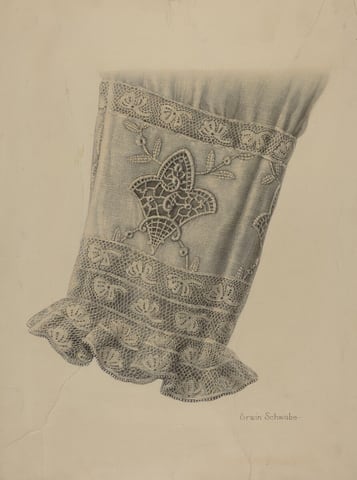
The image shows a lace-trimmed sleeve with a floral lace design in the center, primarily in shades of gray and off-white. The sleeve is positioned vertically in the center of the image, with the top slightly obscured by shadow and the ruffled lace edge at the bottom. The lace details are intricate and precise, enhancing the texture and complexity of the design.
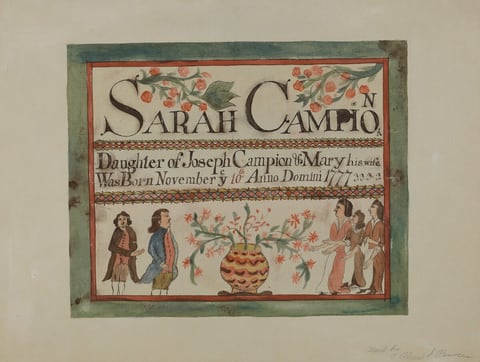
This painting is a birth record for Sarah Campion, daughter of Joseph and Mary Campion, born on November 16th, 1777. It features elaborate calligraphy and ornamental designs. The borders contain floral patterns with red and orange-colored flowers and green leaves. The central text is decorative, and at the bottom are human-like figures in colonial attire standing beside a flower vase. The artwork reflects a style reminiscent of early American folk art, created by an anonymous folk artist capturing the essence of 18th-century American artistry.
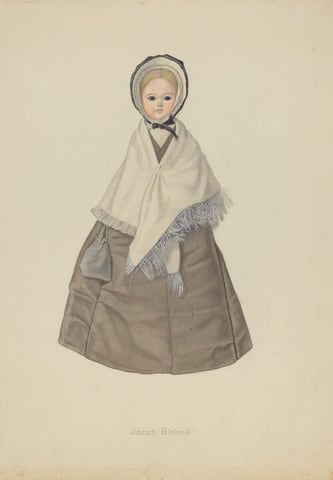
The image depicts a young person standing upright with distinct facial features including rounded cheeks, a small mouth, and large eyes. They are wearing a brown dress with a cream-colored shawl, a bonnet with dark trim, and a pouch hanging from their left side. The background is plain and cream-colored.
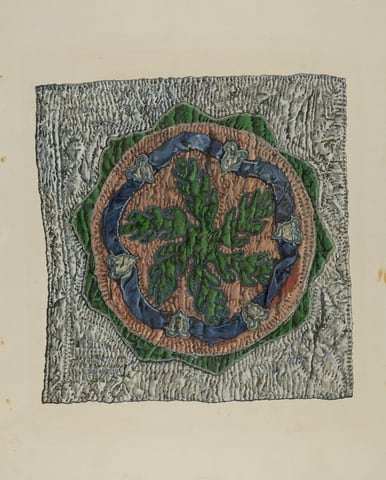
The image shows various shapes and lines within a square border. In the center, there is an abstract circular pattern resembling a stylized floral design. The inner circle contains leaf-like shapes in green, surrounded by a ring resembling petals or decorative motifs. The overall effect is similar to a decorative shield or medallion. The background texture adds depth to the composition.
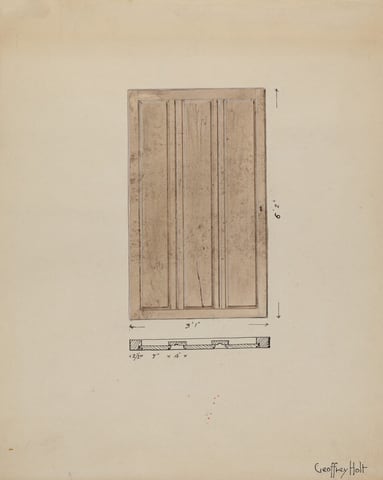
This is a drawing of a wooden door panel. It features a detailed rendering of a rectangular wooden door panel with vertical lines. Below the door panel, there is an elevation view showing the construction detail of the door in cross-section, with measurements indicating dimensions and proportions. The color palette is in shades of brown and beige. A signature in the lower right corner attributes the drawing to an artist named Geoffrey Holt.
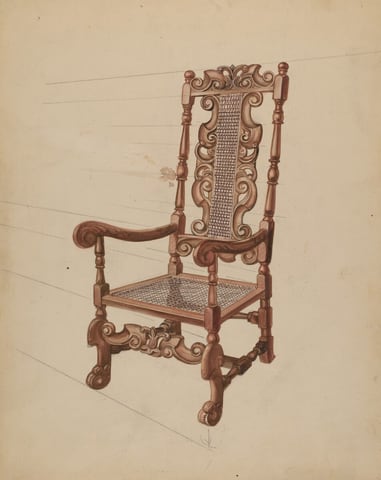
The image shows an ornate chair with a high back, decorative carvings along its arms, legs, and backrest, a woven or cane seat and back, and intricate patterns. The chair is detailed with earthy brown tones and subtle shading accentuating the wood texture and design motifs. It is placed in the center of the image, facing slightly to the left, with linear guides indicating perspective and depth on a plain background.

The works in this room are listed below.

Works in this room

The everyday art of early America, recorded in watercolour by the Index of American Design.

Section 1, north wall

  1. The image shows a lace-trimmed sleeve with a floral lace design in the center, primarily in shades of gray and off-white. The sleeve is positioned vertically in the center of the image, with the top slightly obscured by shadow and the ruffled lace edge at the bottom. The lace details are intricate and precise, enhancing the texture and complexity of the design.
    Cuff LaceErwin Schwabe, c. 1937Courtesy National Gallery of Art, Washington
  2. This painting is a birth record for Sarah Campion, daughter of Joseph and Mary Campion, born on November 16th, 1777. It features elaborate calligraphy and ornamental designs. The borders contain floral patterns with red and orange-colored flowers and green leaves. The central text is decorative, and at the bottom are human-like figures in colonial attire standing beside a flower vase. The artwork reflects a style reminiscent of early American folk art, created by an anonymous folk artist capturing the essence of 18th-century American artistry.
    Pa. German Birth CertificateGlenn Pearce, c. 1936Courtesy National Gallery of Art, Washington
  3. The image depicts a young person standing upright with distinct facial features including rounded cheeks, a small mouth, and large eyes. They are wearing a brown dress with a cream-colored shawl, a bonnet with dark trim, and a pouch hanging from their left side. The background is plain and cream-colored.
    Quaker DollJacob Gielens, 1935/1942Courtesy National Gallery of Art, Washington

Section 1, south wall

  1. The image shows various shapes and lines within a square border. In the center, there is an abstract circular pattern resembling a stylized floral design. The inner circle contains leaf-like shapes in green, surrounded by a ring resembling petals or decorative motifs. The overall effect is similar to a decorative shield or medallion. The background texture adds depth to the composition.
    Quilt Block - "E. Cooper" DesignFlorence Truelson, 1935/1942Courtesy National Gallery of Art, Washington
  2. This is a drawing of a wooden door panel. It features a detailed rendering of a rectangular wooden door panel with vertical lines. Below the door panel, there is an elevation view showing the construction detail of the door in cross-section, with measurements indicating dimensions and proportions. The color palette is in shades of brown and beige. A signature in the lower right corner attributes the drawing to an artist named Geoffrey Holt.
    One of Original Inside Doors to SacristyGeoffrey Holt, c. 1936Courtesy National Gallery of Art, Washington
  3. The image shows an ornate chair with a high back, decorative carvings along its arms, legs, and backrest, a woven or cane seat and back, and intricate patterns. The chair is detailed with earthy brown tones and subtle shading accentuating the wood texture and design motifs. It is placed in the center of the image, facing slightly to the left, with linear guides indicating perspective and depth on a plain background.
    ArmchairAgnes Karlin, c. 1936Courtesy National Gallery of Art, Washington

Section 2, south wall
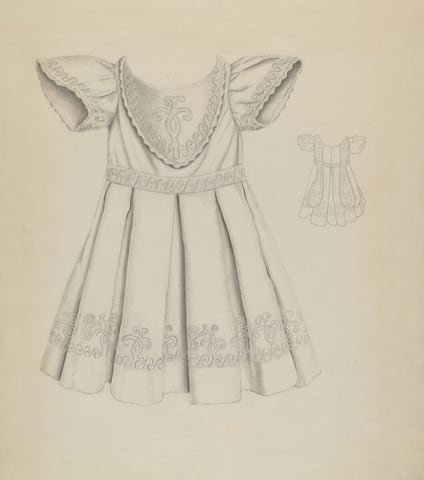
  1. The image shows a detailed sketch of a dress with short, puffed sleeves and a decorative neckline. There is a smaller sketch of the same dress to the right. The color palette is monochrome gray scale, with darker gray outlines and details against a light gray background. The main dress is centered, with the smaller sketch positioned to the right.
    Child's DressRay Price, c. 1937Courtesy National Gallery of Art, Washington
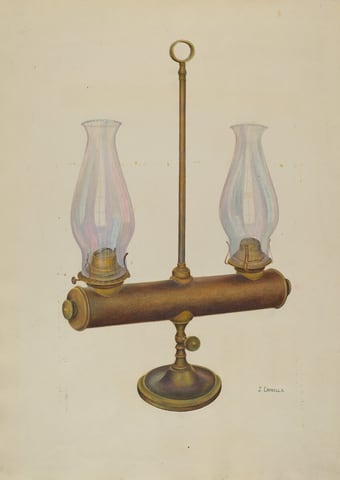
  2. The image shows an antique double kerosene lamp with ornate glass chimneys set atop a horizontal cylindrical base with a central vertical support ending in a circular handle. The base and lamp parts have a bronze-like color with a textured appearance, and the glass chimneys are primarily clear but show hints of colorful reflections. Positioned centrally in the image, the lamp stands upright with the two chimneys equally spaced on either side of the vertical support, which is topped by a circular loop handle, while the signature "J. Cannella" is visible towards the lower right side of the image.
    Reading LampJoseph Cannella, 1941Courtesy National Gallery of Art, Washington
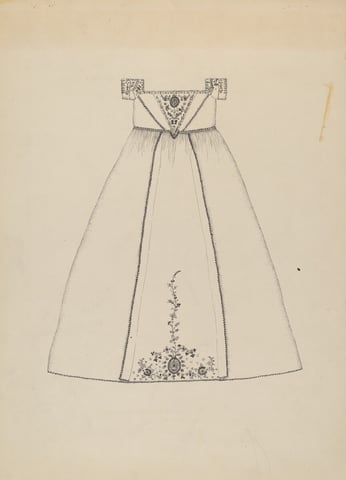
  3. This is a drawing of a dress design. The illustration features a dress with a square neckline, adorned with embroidery around the bust area. The dress has a high waistline with a gathered skirt. The lower part of the dress also features floral embroidery patterns. The design emphasizes fine lines and delicate patterns.
    Baptismal DressEvelyn Bailey, c. 1936Courtesy National Gallery of Art, Washington

Section 2, north wall
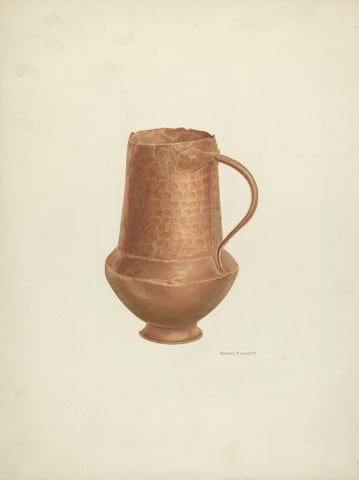
  1. The image shows a large, copper-colored pitcher with a hammered texture and a curving handle on the right side. The color palette consists of muted, warm tones of copper and brown against a pale beige background. The pitcher is centrally placed in the image, with its handle positioned on the right side.
    Copper CruetEdward Jewett, 1937Courtesy National Gallery of Art, Washington
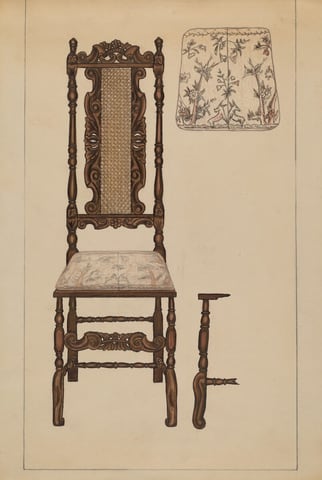
  2. This is a drawing of a wooden chair with detailed upholstery. The chair has an ornate, high backrest with elaborate scrollwork and a woven central panel. The seat is cushioned and covered with a floral patterned fabric. There is also a separate drawing of the fabric pattern used on the seat and a sketch of one of the chair's legs to show the craftsmanship and decorative elements.
    Side ChairUnrecorded American maker, 1935/1942Courtesy National Gallery of Art, Washington
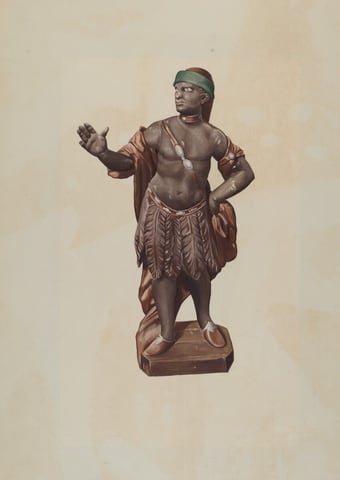
  3. The sculpture depicts a male figure standing upright with one hand raised and the other resting on his hip. The subject is wearing a garment that drapes over one shoulder and a feather-patterned skirt, accessorized with a headband. The colors of the sculpture are predominantly earth tones, including browns and a green headband. The material appears to be a type of stone or ceramic with a polished finish. The figure is slightly larger than everyday objects, allowing viewers to appreciate the intricacies of the carving and the details in the drapery and texture. The statue stands on a rectangular base that is consistent with the overall color palette.
    Cigar Store IndianRosamond P. Gray, 1935/1942Courtesy National Gallery of Art, Washington

Section 3, north wall
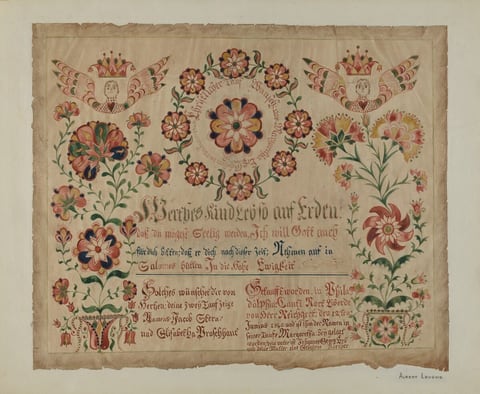
  1. This is a painting of a colorful floral design with text. The artwork features stylized flowers in shades of red, green, and yellow scattered across the page. In the center, there is calligraphic text in varying boldness and fonts, likely in German. Two symmetrical bird-like figures with human faces and crowns are above the text. The piece combines imagery with artistic lettering in a style reminiscent of traditional Pennsylvania German fraktur. The artwork is bordered by a thin line, suggesting it's part of a larger artifact or document.
    Pa. German Birth CertificateAlbert Levone, c. 1940Courtesy National Gallery of Art, Washington
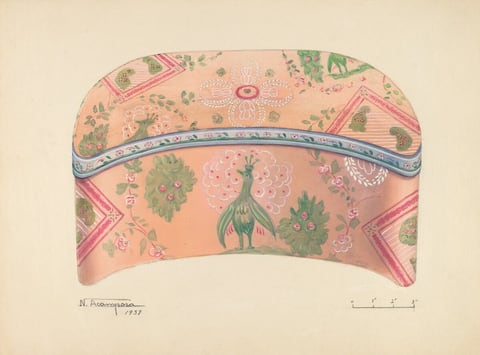
  2. The image shows a decorative curved object with intricate patterns. There is a large green peacock motif in the center, surrounded by floral and geometric patterns. The color palette includes soft pinks, greens, and blue accents outlining the curve of the object. The object is placed on a plain light background.
    BandboxNicholas Acampora, 1937Courtesy National Gallery of Art, Washington

Section 3, south wall
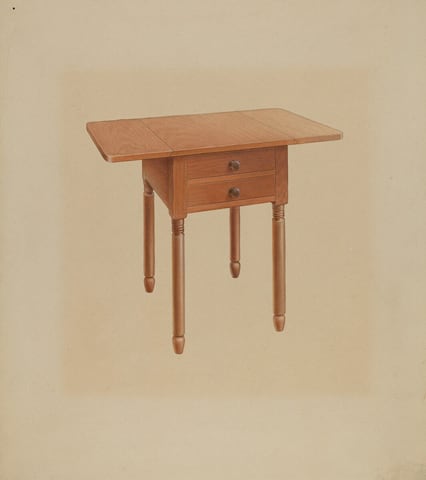
  1. The image shows a wooden drop-leaf table with four turned legs and two drawers. The table's surface includes two side panels that can be raised or lowered. The color palette is warm brown tones. The table is centered in the image, with both leaves partially visible.
    Shaker TableAlfred H. Smith, c. 1938Courtesy National Gallery of Art, Washington
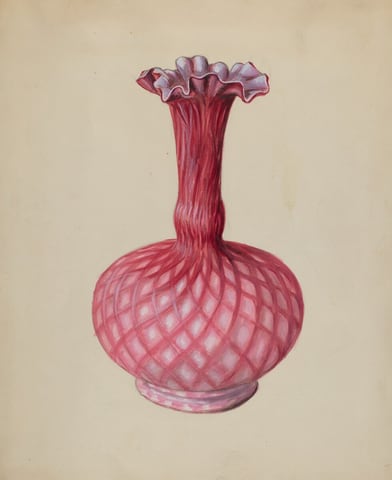
  2. The image displays a single ornate vase with a bulbous base and a ruffled top, taking up most of the frame. The vase is predominantly pink with red accents, the ruffled top is highlighted with white on the inner edges, and there's a crisscross pattern visible on the body. Against a plain beige background, the vase is centrally positioned.
    Ornamental Ruby VaseRobert Stewart, c. 1936Courtesy National Gallery of Art, Washington