Floor plan

Style galleriesAmerican folk and design
American folk and design
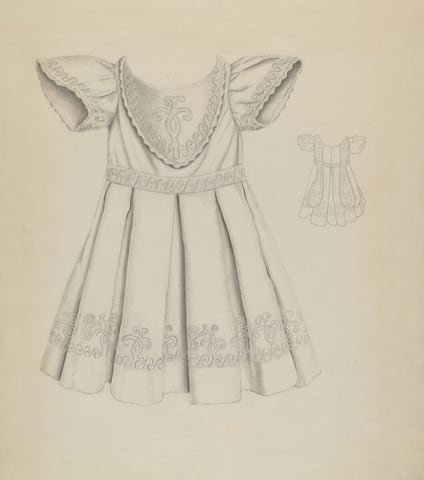
The image shows a detailed sketch of a dress with short, puffed sleeves and a decorative neckline. There is a smaller sketch of the same dress to the right. The color palette is monochrome gray scale, with darker gray outlines and details against a light gray background. The main dress is centered, with the smaller sketch positioned to the right.
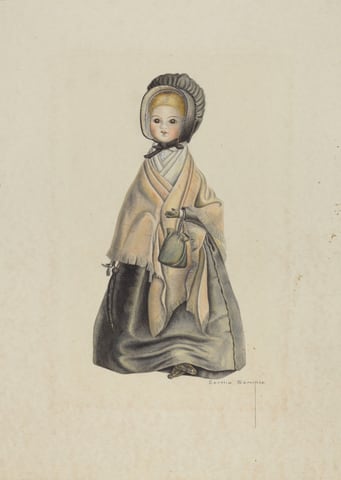
The image displays a full-body illustration of a person standing upright. They have a delicate and round face with rosy cheeks and small, pink lips. Their eyes are large and expressive, and they have light-colored hair peeking out from under a bonnet. The person's attire consists of a long, dark skirt and a light-colored shawl draped over their shoulders. They wear a hooded cloak tied with a bow at the neck, and hold a small bag in their left hand. The background is plain with a light-colored texture. The artwork is a painted illustration with visible fine lines and shading to enhance details of the clothing and facial features.
A brown tree branch with several thick, bifurcated limbs is central in the image. The background is a muted beige with aged discoloration marks. The branch is oriented horizontally, with its thicker end on the left and split limbs extending to the right. In the top left corner, there is a rectangular inset with a simplified line drawing of the branch's shape.
The image depicts a young person standing upright with distinct facial features including rounded cheeks, a small mouth, and large eyes. They are wearing a brown dress with a cream-colored shawl, a bonnet with dark trim, and a pouch hanging from their left side. The background is plain and cream-colored.
This is a drawing of a wooden chair with detailed upholstery. The chair has an ornate, high backrest with elaborate scrollwork and a woven central panel. The seat is cushioned and covered with a floral patterned fabric. There is also a separate drawing of the fabric pattern used on the seat and a sketch of one of the chair's legs to show the craftsmanship and decorative elements.
The image shows a spinning wheel with intricate details, surrounded by smaller insets highlighting specific components. The color palette consists of muted browns, greens, and beiges. The spinning wheel is positioned in the center, with its circular wheel on the right and the spinning mechanism on the left. Detailed insets are placed around the spinning wheel, each showing different mechanical elements.

The works in this room are listed below.

Works in this room

The everyday art of early America, recorded in watercolour by the Index of American Design.

Section 1, north wall

  1. The image shows a detailed sketch of a dress with short, puffed sleeves and a decorative neckline. There is a smaller sketch of the same dress to the right. The color palette is monochrome gray scale, with darker gray outlines and details against a light gray background. The main dress is centered, with the smaller sketch positioned to the right.
    Child's DressRay Price, c. 1937Courtesy National Gallery of Art, Washington
  2. The image displays a full-body illustration of a person standing upright. They have a delicate and round face with rosy cheeks and small, pink lips. Their eyes are large and expressive, and they have light-colored hair peeking out from under a bonnet. The person's attire consists of a long, dark skirt and a light-colored shawl draped over their shoulders. They wear a hooded cloak tied with a bow at the neck, and hold a small bag in their left hand. The background is plain with a light-colored texture. The artwork is a painted illustration with visible fine lines and shading to enhance details of the clothing and facial features.
    Quaker DollBertha Semple, 1935/1942Courtesy National Gallery of Art, Washington
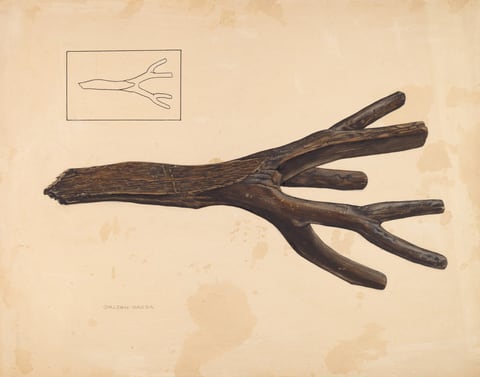
  3. A brown tree branch with several thick, bifurcated limbs is central in the image. The background is a muted beige with aged discoloration marks. The branch is oriented horizontally, with its thicker end on the left and split limbs extending to the right. In the top left corner, there is a rectangular inset with a simplified line drawing of the branch's shape.
    BootjackLloyd A. Davidson, c. 1942Courtesy National Gallery of Art, Washington

Section 1, south wall

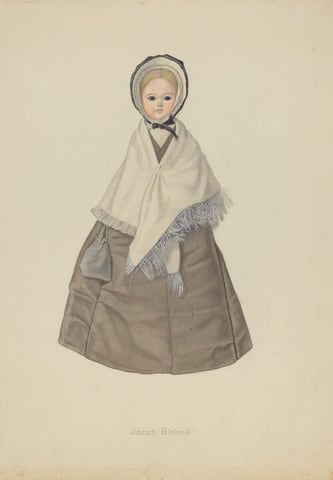
  1. The image depicts a young person standing upright with distinct facial features including rounded cheeks, a small mouth, and large eyes. They are wearing a brown dress with a cream-colored shawl, a bonnet with dark trim, and a pouch hanging from their left side. The background is plain and cream-colored.
    Quaker DollJacob Gielens, 1935/1942Courtesy National Gallery of Art, Washington
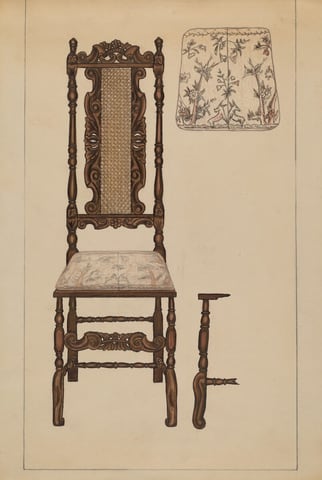
  2. This is a drawing of a wooden chair with detailed upholstery. The chair has an ornate, high backrest with elaborate scrollwork and a woven central panel. The seat is cushioned and covered with a floral patterned fabric. There is also a separate drawing of the fabric pattern used on the seat and a sketch of one of the chair's legs to show the craftsmanship and decorative elements.
    Side ChairUnrecorded American maker, 1935/1942Courtesy National Gallery of Art, Washington
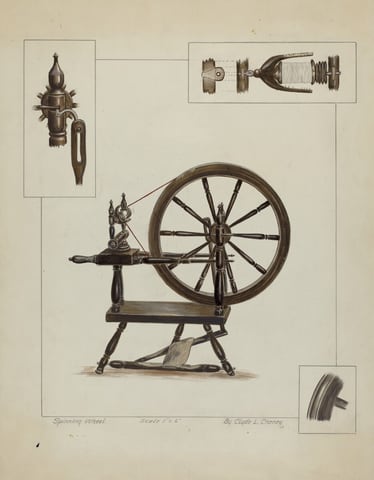
  3. The image shows a spinning wheel with intricate details, surrounded by smaller insets highlighting specific components. The color palette consists of muted browns, greens, and beiges. The spinning wheel is positioned in the center, with its circular wheel on the right and the spinning mechanism on the left. Detailed insets are placed around the spinning wheel, each showing different mechanical elements.
    Spinning WheelClyde L. Cheney, 1935/1942Courtesy National Gallery of Art, Washington

Section 2, south wall
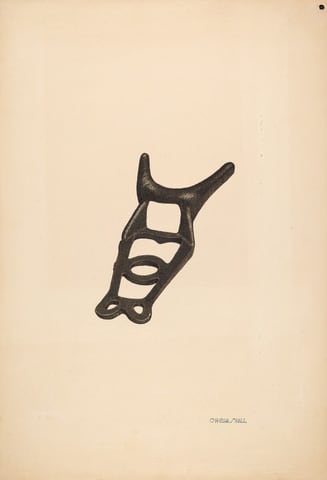
  1. This is a drawing of an abstract shape or artifact. The image features a central black object positioned against a plain, light-colored background. The object has a slightly irregular, elongated triangular form with rounded edges and contours. It includes a series of geometric holes and protrusions. The subtle shadowing suggests a three-dimensional form, yet the drawing maintains a simplicity that emphasizes the object's unique contours and cutouts.
    BootjackClaude Marshall, c. 1940Courtesy National Gallery of Art, Washington
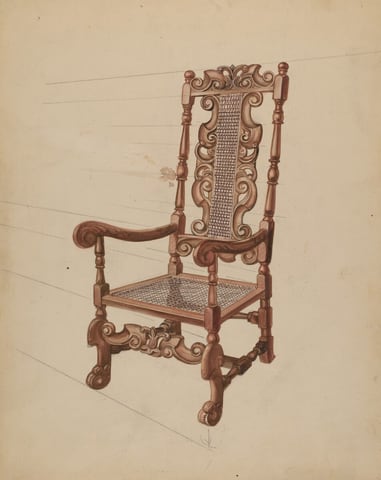
  2. The image shows an ornate chair with a high back, decorative carvings along its arms, legs, and backrest, a woven or cane seat and back, and intricate patterns. The chair is detailed with earthy brown tones and subtle shading accentuating the wood texture and design motifs. It is placed in the center of the image, facing slightly to the left, with linear guides indicating perspective and depth on a plain background.
    ArmchairAgnes Karlin, c. 1936Courtesy National Gallery of Art, Washington
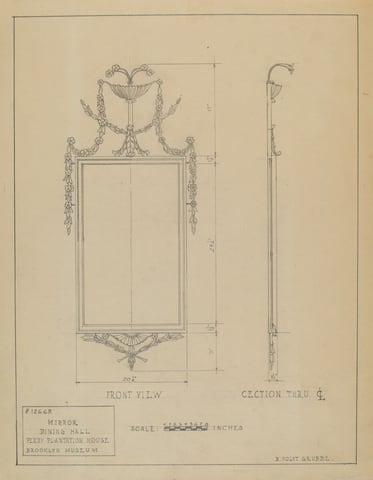
  3. This is a drawing of a decorative mirror. It presents a detailed design of an ornate mirror with two views: a front view and a sectional view. The mirror frame is embellished with elaborate motifs, including scrolls and floral elements. The sectional view shows the mirror's depth and structural details, indicating attention to construction. Measurements are included in inches, with title and notes providing context on the mirror's location and purpose as part of interior furnishings.
    MirrorB. Holst-Grubbe, 1935/1942Courtesy National Gallery of Art, Washington

Section 2, north wall

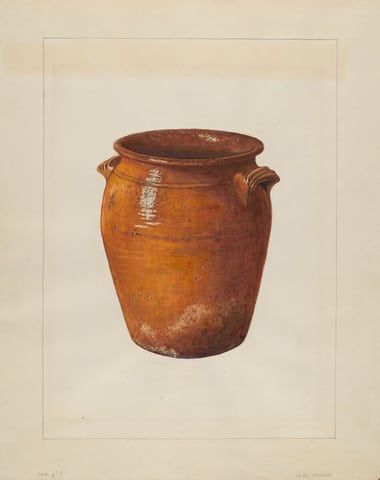
  1. The image features a large terracotta pot with two small handles on its sides. The pot is primarily in shades of earthy orange and brown with some lighter patches that suggest a slightly weathered texture. It is positioned centrally against a plain, light background.
    Preserving JarWilford H. Shurtliff, c. 1938Courtesy National Gallery of Art, Washington
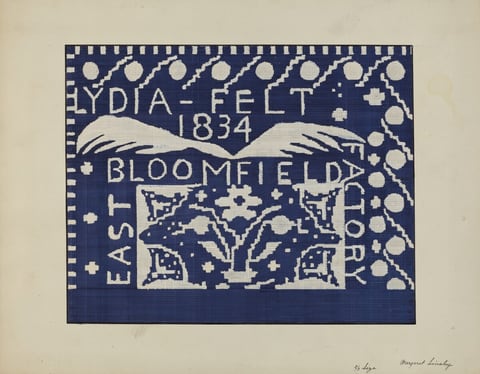
  2. This is a drawing of a textile design. The image consists of a pattern with the text "LYDIA FELT 1834 BLOOMFIELD" displayed along with decorative motifs of abstract leaves and floral shapes in a contrasting color against a dark background. The composition also includes the word "EAST" placed vertically and "YORK" placed horizontally. The combination of geometric shapes and organic elements forms a unified aesthetic typical of traditional textile patterns.
    CoverletMargaret Linsley, c. 1940Courtesy National Gallery of Art, Washington
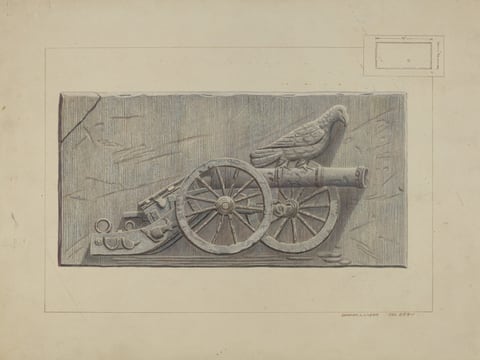
  3. This image shows an engraved design featuring a cannon with large wheels next to an eagle perched on top, situated on the left side of a rectangular stone slab. The color scheme is predominantly grayscale with subtle hints of blue and gray tones throughout the stone surface. The cannon is positioned slightly to the left in the composition, with its barrel pointing to the right, while the eagle is perched on the cannon barrel facing forward, wings tucked close to its body. To accompany the cannon, a stack of cannonballs is carved on the lower left, further anchoring the scene within the carved rectangle.
    Bas ReliefEdward L. Loper, c. 1938Courtesy National Gallery of Art, Washington

Section 3, north wall
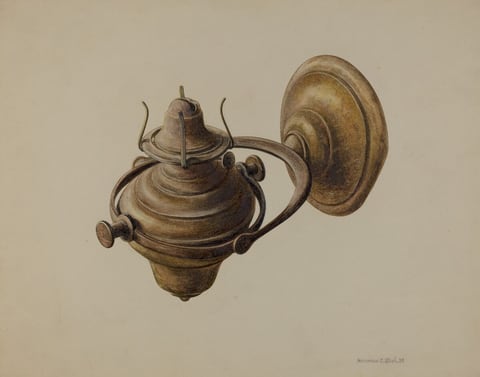
  1. The image displays a detailed drawing of a vintage wall-mounted lamp. The color palette consists of primarily browns and earthy tones, with hints of a metallic sheen. The lamp is centered in the image, with its base attached to the right side and extending to the left. A subtle shadow and highlights give the lamp a three-dimensional appearance against a plain, light beige background.
    Binnacle LampHerman O. Stroh, 1938Courtesy National Gallery of Art, Washington
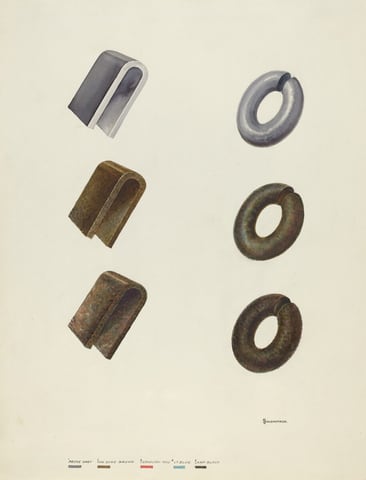
  2. The image shows five metallic objects arranged in a vertical column. These include three L-shaped brackets and two circular rings, in muted gray and rust-brown shades with a metallic sheen. The objects are positioned against a light, neutral background.
    Color Notes on IronGerald Transpota, 1935/1942Courtesy National Gallery of Art, Washington

Section 3, south wall
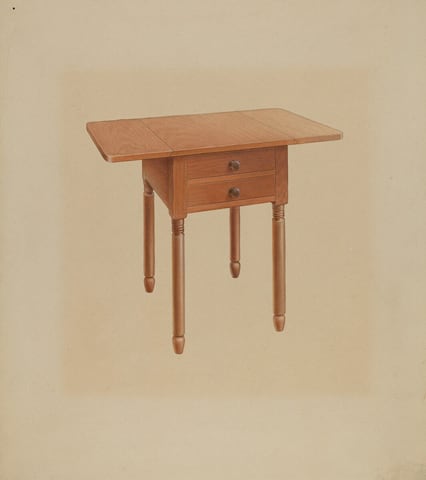
  1. The image shows a wooden drop-leaf table with four turned legs and two drawers. The table's surface includes two side panels that can be raised or lowered. The color palette is warm brown tones. The table is centered in the image, with both leaves partially visible.
    Shaker TableAlfred H. Smith, c. 1938Courtesy National Gallery of Art, Washington
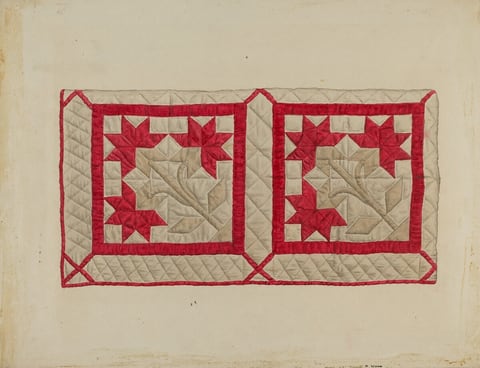
  2. The image shows two large quilt blocks with a matching design, side by side. Each block consists of red and beige fabric with quilted stitching creating a textured appearance. The color palette includes primarily red, beige, and dark stitching outlining the patterns. The quilt blocks are placed centrally on a light-colored surface.
    Patchwork QuiltPaul Ward, c. 1936Courtesy National Gallery of Art, Washington