Floor plan

Style galleriesAmerican folk and design, room 3
American folk and design, room 3
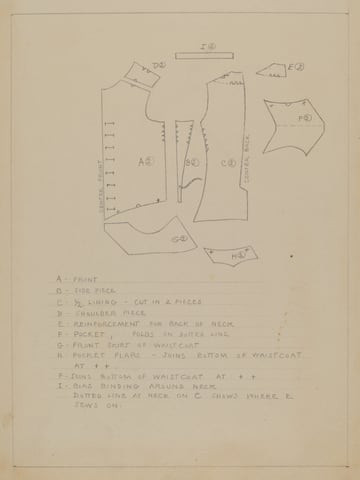
This is a drawing depicting instructional annotations on a pattern for tailoring or assembling clothing. The pattern includes various pieces labeled with letters and numbers corresponding to specific parts of a garment, like "FRONT," "SIDE BACK," and "COLLAR." The layout is precise and technical, resembling a guide for constructing a garment with detailed cutting and assembly instructions.
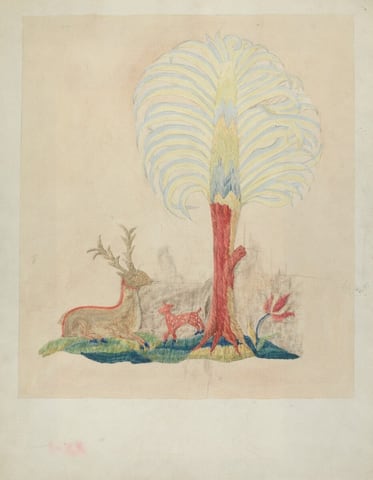
This is a painting of two deer under a tree. The larger deer has antlers and is resting next to a smaller deer. They are depicted with red and brown strokes. The background shows a patch of earth and grass in green and blue. Beside the deer is a tree with colorful leaves or a feather-like structure and a red trunk. A pink flower is near the tree's base. The background is neutral. This painting is in the style of Henri Rousseau.
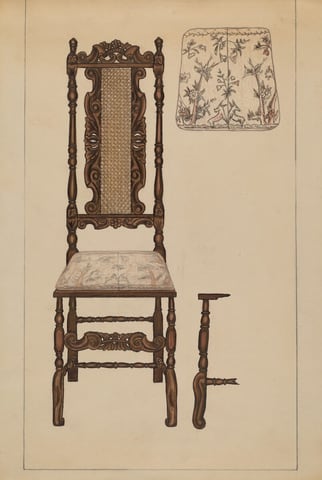
This is a drawing of a wooden chair with detailed upholstery. The chair has an ornate, high backrest with elaborate scrollwork and a woven central panel. The seat is cushioned and covered with a floral patterned fabric. There is also a separate drawing of the fabric pattern used on the seat and a sketch of one of the chair's legs to show the craftsmanship and decorative elements.
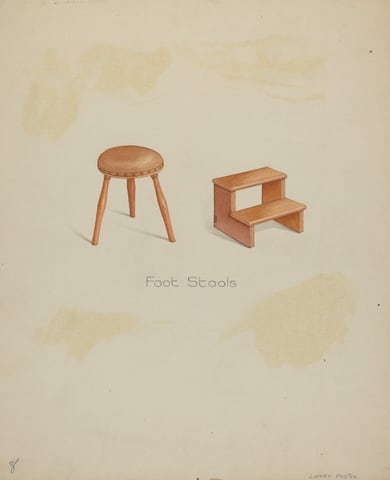
The image shows two foot stools. One is a round stool with four legs and the other is a small two-step wooden staircase. The color palette includes shades of brown and tan against a light beige background. The round stool is positioned to the left, and the step-stool is to the right. Both are labeled with the words "Foot Stools" below them.
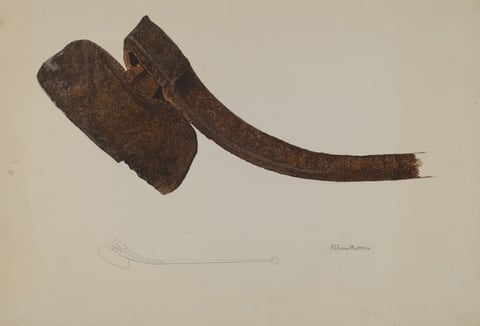
The image shows a large, rusted ax with a curved brown handle placed diagonally across the canvas. The color palette consists of muted browns and beiges, highlighting the aged appearance of the ax. Beneath the ax, there is a faint outline sketch of a similar object, and the artist's signature is located to the right of the sketch. The ax is in the upper half of the image, while the sketch and signature are in the center-bottom section.
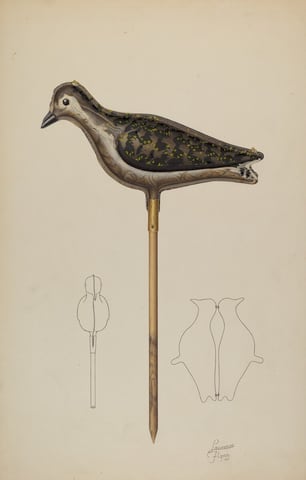
The image shows a painted decoy of a bird mounted on a wooden stake. The decoy has intricate details with spots of yellow and green on top of a dark body. The colors are naturalistic with brown, black, yellow, white, and beige. In the lower left section of the image, there are two line drawings of a bird.

The works in this room are listed below.

Works in this room

The everyday art of early America, recorded in watercolour by the Index of American Design.

Section 1, north wall

  1. This is a drawing depicting instructional annotations on a pattern for tailoring or assembling clothing. The pattern includes various pieces labeled with letters and numbers corresponding to specific parts of a garment, like "FRONT," "SIDE BACK," and "COLLAR." The layout is precise and technical, resembling a guide for constructing a garment with detailed cutting and assembly instructions.
    Waistcoat PatternRosalia Lane, c. 1936Courtesy National Gallery of Art, Washington
  2. This is a painting of two deer under a tree. The larger deer has antlers and is resting next to a smaller deer. They are depicted with red and brown strokes. The background shows a patch of earth and grass in green and blue. Beside the deer is a tree with colorful leaves or a feather-like structure and a red trunk. A pink flower is near the tree's base. The background is neutral. This painting is in the style of Henri Rousseau.
    Crewel EmbroideryHelen Dana, 1935/1942Courtesy National Gallery of Art, Washington
  3. This is a drawing of a wooden chair with detailed upholstery. The chair has an ornate, high backrest with elaborate scrollwork and a woven central panel. The seat is cushioned and covered with a floral patterned fabric. There is also a separate drawing of the fabric pattern used on the seat and a sketch of one of the chair's legs to show the craftsmanship and decorative elements.
    Side ChairUnrecorded American maker, 1935/1942Courtesy National Gallery of Art, Washington

Section 1, south wall

  1. The image shows two foot stools. One is a round stool with four legs and the other is a small two-step wooden staircase. The color palette includes shades of brown and tan against a light beige background. The round stool is positioned to the left, and the step-stool is to the right. Both are labeled with the words "Foot Stools" below them.
    Shaker StoolsLawrence Foster, 1935/1942Courtesy National Gallery of Art, Washington
  2. The image shows a large, rusted ax with a curved brown handle placed diagonally across the canvas. The color palette consists of muted browns and beiges, highlighting the aged appearance of the ax. Beneath the ax, there is a faint outline sketch of a similar object, and the artist's signature is located to the right of the sketch. The ax is in the upper half of the image, while the sketch and signature are in the center-bottom section.
    Dumb IronAlfonso Moreno, c. 1938Courtesy National Gallery of Art, Washington
  3. The image shows a painted decoy of a bird mounted on a wooden stake. The decoy has intricate details with spots of yellow and green on top of a dark body. The colors are naturalistic with brown, black, yellow, white, and beige. In the lower left section of the image, there are two line drawings of a bird.
    Snipe DecoyLawrence Flynn, 1941Courtesy National Gallery of Art, Washington

Section 2, south wall
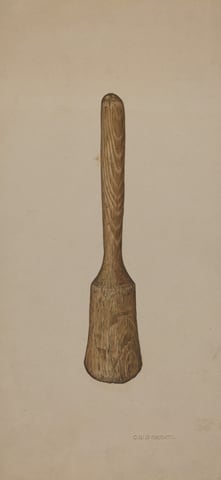
  1. A wooden mallet is displayed on a beige background. The mallet has a rounded handle and a broad head, showcasing earthy brown tones with variations in the wood grain. Positioned centrally, the mallet stands upright in the image.
    Potato MasherClarence W. Dawson, c. 1940Courtesy National Gallery of Art, Washington
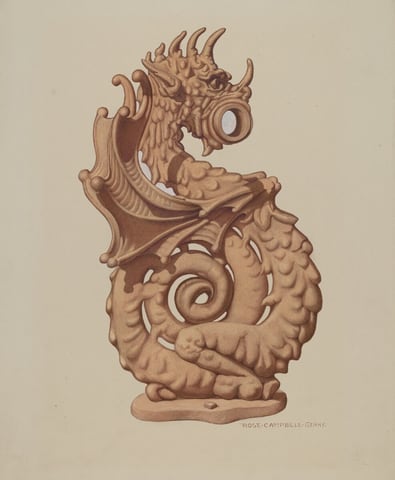
  2. The sculpture depicts a mythical creature resembling a dragon. It has a long spiraled body and an intricate head with spiky protrusions. The sculpture is a warm brown color. The dragon has bat-like wings, an open mouth, detailed texture with scales, and is standing on a small base.
    FenceRose Campbell-Gerke, c. 1941Courtesy National Gallery of Art, Washington
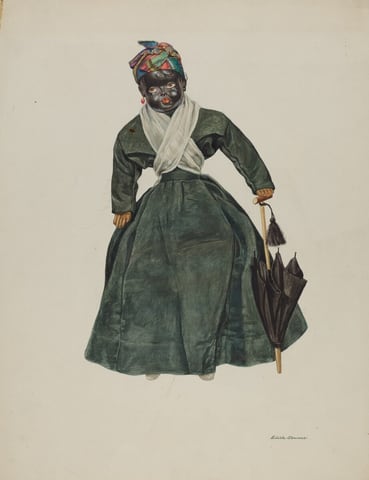
  3. The image depicts a person standing upright. They are wearing a dark green dress with long sleeves and a floor-length skirt. Over the dress, there is a white fabric wrapped around their shoulders. The person is holding a closed umbrella in their right hand. Their face is dark with distinguishable eyes and a nose, but specific facial features are not detailed. The person's hair is covered by a colorful headscarf with shades of blue, pink, and yellow. They are wearing large earrings, possibly pink or red. The background is plain and light with no additional objects present.
    Doll--"Hannah Hitch"Edith Towner, c. 1940Courtesy National Gallery of Art, Washington

Section 2, north wall
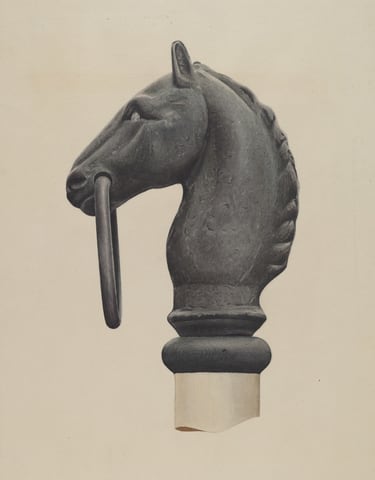
  1. The sculpture is a depiction of a horse's head crafted from a dark material that appears to be metal. The horse's ears are perked up, and its mane is depicted with smooth, curving lines trailing down the back of the neck. The sculpture includes a ring that extends from the horse's mouth. Positioned on a simple cylindrical pedestal, the sculpture's material and design suggest a robust and timeless feel. The details of the horse's expression and mane are rendered with a smooth finish.
    Hitching PostAlbert Ryder, c. 1938Courtesy National Gallery of Art, Washington
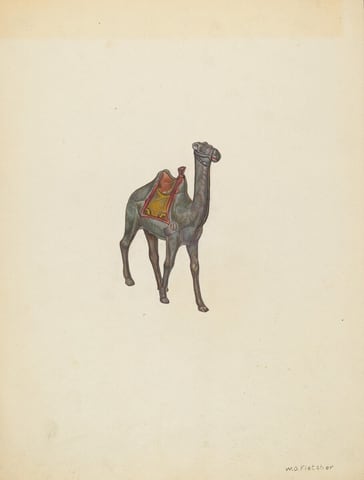
  2. This is a painting of a camel with a colorful saddle. The camel is centered in the image, standing against a plain, light-colored background. The animal is drawn with careful attention to detail, showcasing its distinctive humps, elongated neck, and slender legs. It is adorned with a vibrant saddle that features bright orange and red tones. The simplicity of the background emphasizes the camel.
    Bank CamelWilliam O. Fletcher, c. 1940Courtesy National Gallery of Art, Washington
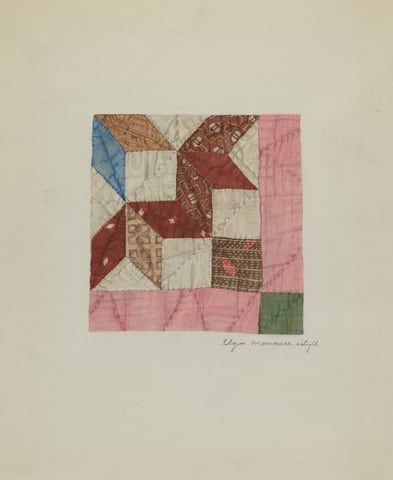
  3. This is a painting of a quilt design pattern. The image depicts a square quilt block featuring a variety of geometric shapes and patterns pieced together. The quilt features a mix of colors, including blues, reds, browns, and a pink border, with intricate patterns in the fabric segments. The textures and colors create an intricate optical composition resembling different geometric forms and depth. The piece is delicately framed within a larger white space, which emphasizes the detail of the quilt pattern. This is in the style of a traditional textile or quilting pattern illustrator.
    Cotton Bed QuiltElgin Moncure Styll, c. 1941Courtesy National Gallery of Art, Washington

Section 3, north wall
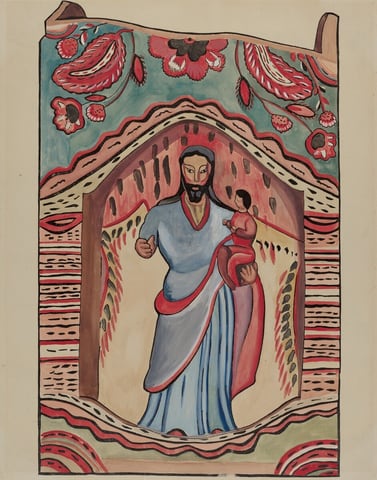
  1. This is a painting of stylized figures within an ornate frame. The artwork features two central figures that are reminiscent of a traditional religious iconography but rendered in a simplified and almost cartoonish form. The larger figure is draped in blue with red accents, while a smaller figure is held in one hand, enrobed in red. The background is decorated with a variety of patterns including an arch-like structure with wavy designs and lines, all outlining the central figures. The outer sections feature floral patterns with bold, contrasting colors of red, black, and teal. The use of thick outlines and vivid colors suggests a playful and decorative approach to the portrayal of the figures, drawing inspiration possibly from folk art traditions.
    St. JosephE. Boyd, 1936Courtesy National Gallery of Art, Washington
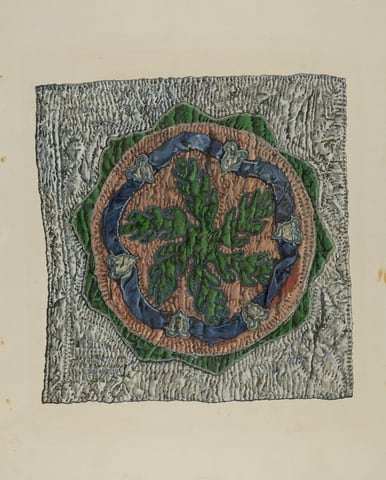
  2. The image shows various shapes and lines within a square border. In the center, there is an abstract circular pattern resembling a stylized floral design. The inner circle contains leaf-like shapes in green, surrounded by a ring resembling petals or decorative motifs. The overall effect is similar to a decorative shield or medallion. The background texture adds depth to the composition.
    Quilt Block - "E. Cooper" DesignFlorence Truelson, 1935/1942Courtesy National Gallery of Art, Washington

Section 3, south wall
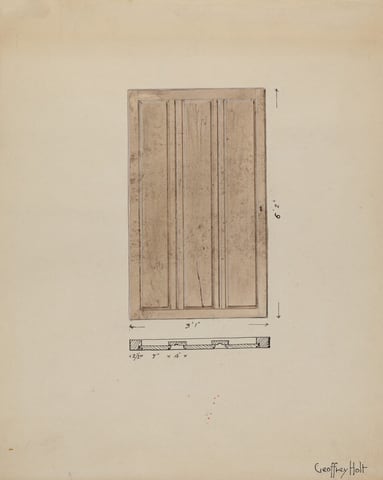
  1. This is a drawing of a wooden door panel. It features a detailed rendering of a rectangular wooden door panel with vertical lines. Below the door panel, there is an elevation view showing the construction detail of the door in cross-section, with measurements indicating dimensions and proportions. The color palette is in shades of brown and beige. A signature in the lower right corner attributes the drawing to an artist named Geoffrey Holt.
    One of Original Inside Doors to SacristyGeoffrey Holt, c. 1936Courtesy National Gallery of Art, Washington
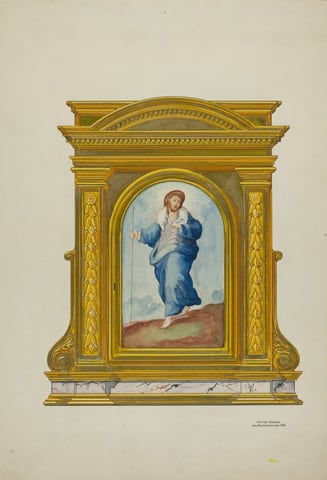
  2. The image shows a painted artwork within an ornate frame. The artwork features a figure standing with one hand raised. The figure has long hair and a beard, and wears flowing blue and white garments. The background shows an earthy surface and a sky. The frame is gold and elaborately designed. The scene is set against a blank, light-colored background.
    Original Tabernacle, for Communion VesselsDayton Brown, 1936Courtesy National Gallery of Art, Washington