Floor plan

Time and placeThe 20th century

The 20th century

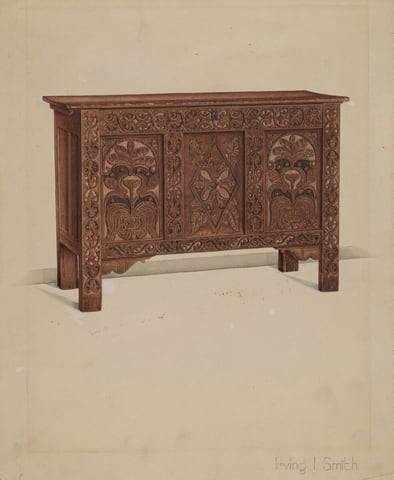
The image shows a large wooden chest with intricate floral patterns on the front panels. The color palette consists of various shades of brown, emphasizing the natural wood tones. The chest is centrally positioned on a plain background with subtle shadows indicating it is slightly elevated.
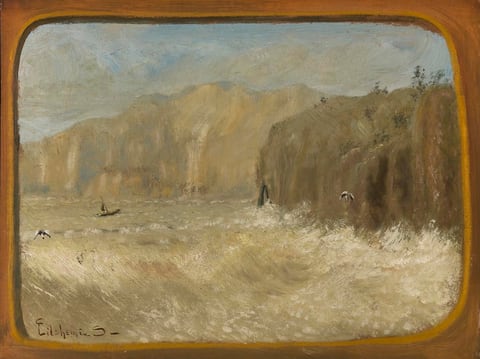
Two Gulls and Cliffs, by Louis M. Eilshemius, ca. 1913-1921
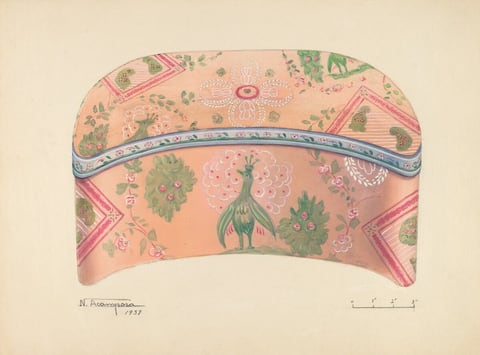
The image shows a decorative curved object with intricate patterns. There is a large green peacock motif in the center, surrounded by floral and geometric patterns. The color palette includes soft pinks, greens, and blue accents outlining the curve of the object. The object is placed on a plain light background.
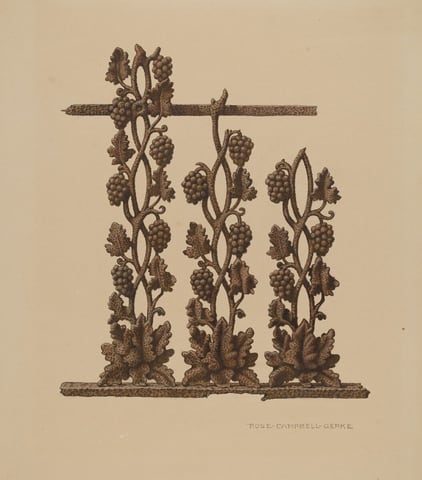
The image depicts an iron sculpture with grapevine motifs. The color scheme is primarily brown, with a textured appearance. The grapevine design is arranged vertically and includes grape clusters and leaves. The sculpture is mounted on a base and includes an iron bar at the top. The artist's signature "ROSE CAMPBELL GERKE" is visible in the lower right corner of the image.
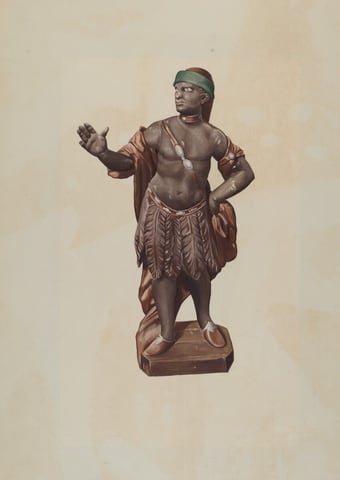
The sculpture depicts a male figure standing upright with one hand raised and the other resting on his hip. The subject is wearing a garment that drapes over one shoulder and a feather-patterned skirt, accessorized with a headband. The colors of the sculpture are predominantly earth tones, including browns and a green headband. The material appears to be a type of stone or ceramic with a polished finish. The figure is slightly larger than everyday objects, allowing viewers to appreciate the intricacies of the carving and the details in the drapery and texture. The statue stands on a rectangular base that is consistent with the overall color palette.
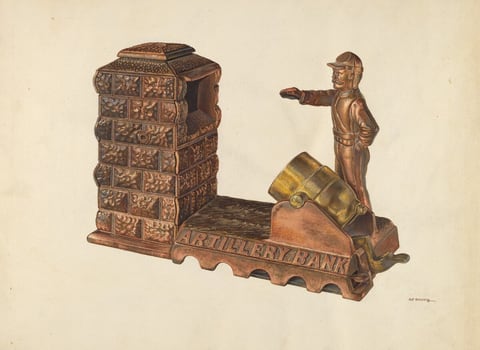
The image displays a vintage mechanical bank with a brick-patterned tower on the left and a soldier figure on the right, prepared to operate a cannon. The color scheme is mainly earthy tones including brown, bronze, and hints of gold, creating a retro metallic appearance. The label "ARTILLERY BANK" is engraved on the base in front of the cannon.

The works in this room are listed below.

Works in this room

Works made in the 20th century, anywhere in the world.

Section 1, north wall

  1. The image shows a large wooden chest with intricate floral patterns on the front panels. The color palette consists of various shades of brown, emphasizing the natural wood tones. The chest is centrally positioned on a plain background with subtle shadows indicating it is slightly elevated.
    ChestIrving I. Smith, c. 1936Courtesy National Gallery of Art, Washington
  2. Two Gulls and Cliffs, by Louis M. Eilshemius, ca. 1913-1921
    Two Gulls and CliffsLouis M. Eilshemius, ca. 1913-1921Courtesy of the Smithsonian American Art Museum
  3. The image shows a decorative curved object with intricate patterns. There is a large green peacock motif in the center, surrounded by floral and geometric patterns. The color palette includes soft pinks, greens, and blue accents outlining the curve of the object. The object is placed on a plain light background.
    BandboxNicholas Acampora, 1937Courtesy National Gallery of Art, Washington

Section 1, south wall

  1. The image depicts an iron sculpture with grapevine motifs. The color scheme is primarily brown, with a textured appearance. The grapevine design is arranged vertically and includes grape clusters and leaves. The sculpture is mounted on a base and includes an iron bar at the top. The artist's signature "ROSE CAMPBELL GERKE" is visible in the lower right corner of the image.
    FenceRose Campbell-Gerke, c. 1940Courtesy National Gallery of Art, Washington
  2. The sculpture depicts a male figure standing upright with one hand raised and the other resting on his hip. The subject is wearing a garment that drapes over one shoulder and a feather-patterned skirt, accessorized with a headband. The colors of the sculpture are predominantly earth tones, including browns and a green headband. The material appears to be a type of stone or ceramic with a polished finish. The figure is slightly larger than everyday objects, allowing viewers to appreciate the intricacies of the carving and the details in the drapery and texture. The statue stands on a rectangular base that is consistent with the overall color palette.
    Cigar Store IndianRosamond P. Gray, 1935/1942Courtesy National Gallery of Art, Washington
  3. The image displays a vintage mechanical bank with a brick-patterned tower on the left and a soldier figure on the right, prepared to operate a cannon. The color scheme is mainly earthy tones including brown, bronze, and hints of gold, creating a retro metallic appearance. The label "ARTILLERY BANK" is engraved on the base in front of the cannon.
    Mechanical Artillery BankAlf Bruseth, c. 1940Courtesy National Gallery of Art, Washington

Section 2, south wall
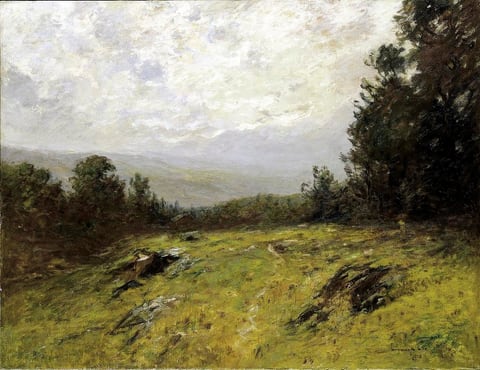
  1. Hillside, by Edward Gay, 1908
    HillsideEdward Gay, 1908Courtesy of the Smithsonian American Art Museum
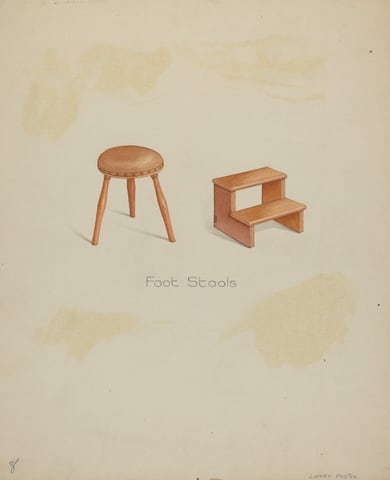
  2. The image shows two foot stools. One is a round stool with four legs and the other is a small two-step wooden staircase. The color palette includes shades of brown and tan against a light beige background. The round stool is positioned to the left, and the step-stool is to the right. Both are labeled with the words "Foot Stools" below them.
    Shaker StoolsLawrence Foster, 1935/1942Courtesy National Gallery of Art, Washington

Section 2, north wall
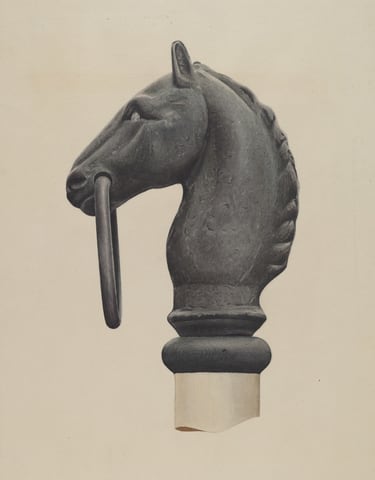
  1. The sculpture is a depiction of a horse's head crafted from a dark material that appears to be metal. The horse's ears are perked up, and its mane is depicted with smooth, curving lines trailing down the back of the neck. The sculpture includes a ring that extends from the horse's mouth. Positioned on a simple cylindrical pedestal, the sculpture's material and design suggest a robust and timeless feel. The details of the horse's expression and mane are rendered with a smooth finish.
    Hitching PostAlbert Ryder, c. 1938Courtesy National Gallery of Art, Washington
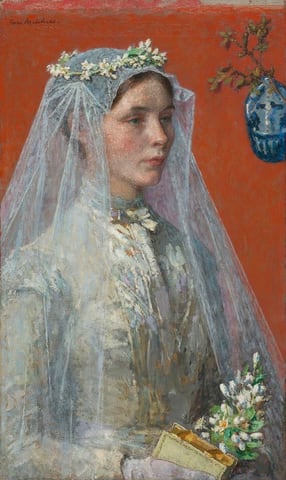
  2. The Bride, by Gari Melchers, ca. 1907
    The BrideGari Melchers, ca. 1907Courtesy of the Smithsonian American Art Museum

Section 3, north wall
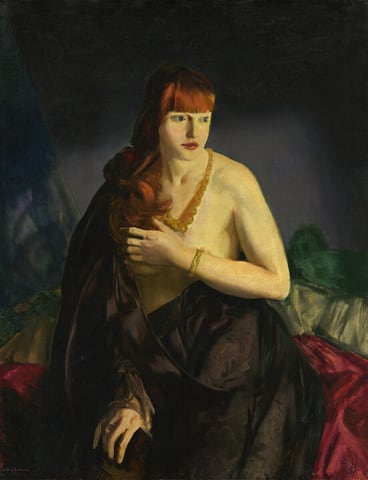
  1. Shown from the knees up, a woman sits partially covered by a black cloth as she holds one forearm across her bare breasts in this vertical painting. The woman has pale, yellow-tinged skin and long, copper-red hair and bangs. Her body faces us, but she turns her head to look off to our right with large blue, wide-set eyes. Her cheeks are flushed, and her full, dark pink lips are closed. A strand of gradually larger amber-yellow beads hangs around her neck, and she wears a gold-colored bracelet on the arm braced across her chest, her left arm, to our right. Glimpses of pale pink nipples are visible. The voluminous black cloth drapes down over one shoulder and across her hips. She wears a ring on the other hand, which emerges from the cloth to rest on that knee. Piles of garnet red, peridot green, and forest green are piled up to chest height behind her, and the background is nickel gray around her body and darkens to black around the top and side edges. The scene is loosely painted, especially in the fabric and background. The artist signed the canvas in the lower left corner, “Geo. Bellows E.S.B.”
    Nude with Red HairGeorge Bellows, 1920Courtesy National Gallery of Art, Washington
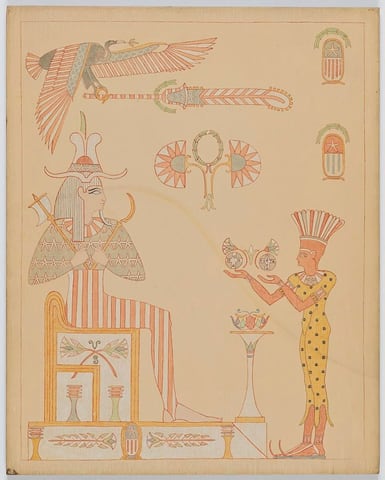
  2. THE TRIUMPH OF UNCLE SAM
    The Triumph of Uncle SamVictor Wilbour, 1917Courtesy of Cooper Hewitt, Smithsonian Design Museum

Section 3, south wall
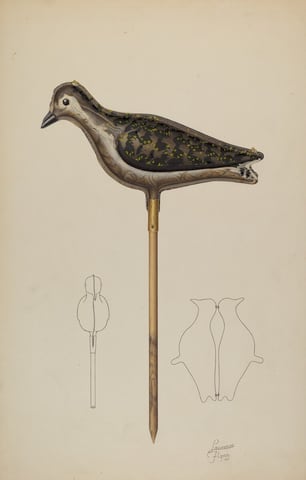
  1. The image shows a painted decoy of a bird mounted on a wooden stake. The decoy has intricate details with spots of yellow and green on top of a dark body. The colors are naturalistic with brown, black, yellow, white, and beige. In the lower left section of the image, there are two line drawings of a bird.
    Snipe DecoyLawrence Flynn, 1941Courtesy National Gallery of Art, Washington
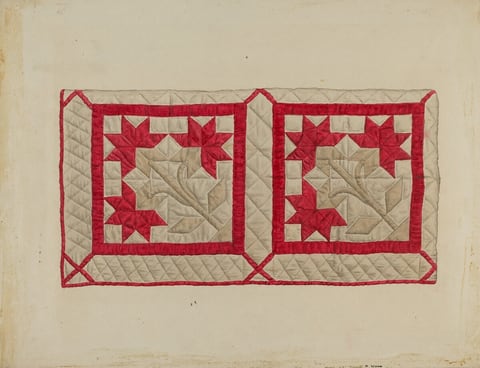
  2. The image shows two large quilt blocks with a matching design, side by side. Each block consists of red and beige fabric with quilted stitching creating a textured appearance. The color palette includes primarily red, beige, and dark stitching outlining the patterns. The quilt blocks are placed centrally on a light-colored surface.
    Patchwork QuiltPaul Ward, c. 1936Courtesy National Gallery of Art, Washington

Section 4, south wall
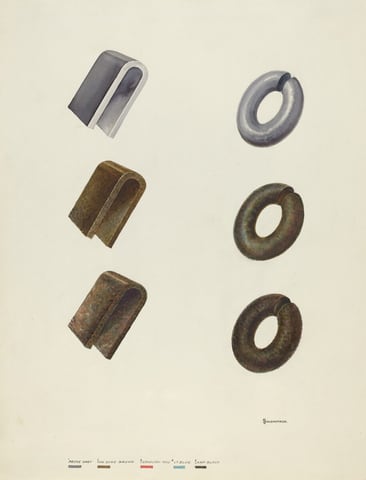
  1. The image shows five metallic objects arranged in a vertical column. These include three L-shaped brackets and two circular rings, in muted gray and rust-brown shades with a metallic sheen. The objects are positioned against a light, neutral background.
    Color Notes on IronGerald Transpota, 1935/1942Courtesy National Gallery of Art, Washington
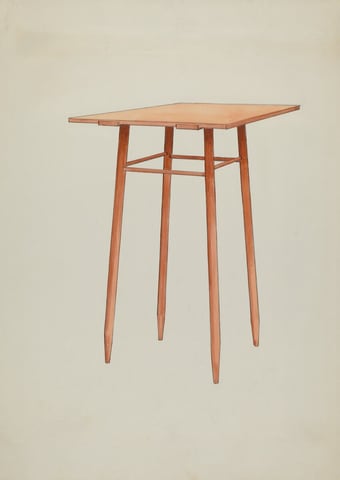
  2. The image shows a tall, narrow wooden table with a square top and four long, slender legs. The color palette is warm with shades of light brown and reddish-brown on the table. Positioned centrally, the table stands against a plain, light-colored background.
    Shaker StandRay Holden, c. 1936Courtesy National Gallery of Art, Washington