Floor plan

Time and place20th-century United States
20th-century United States
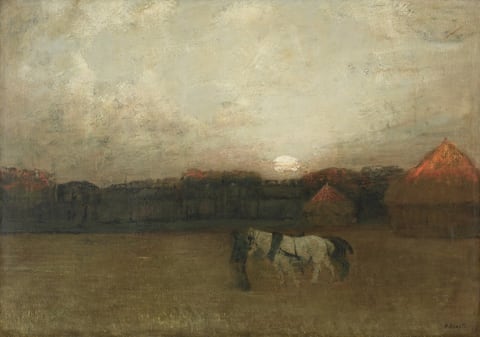
The Stubble Field, by Henry Golden Dearth, c. 1909
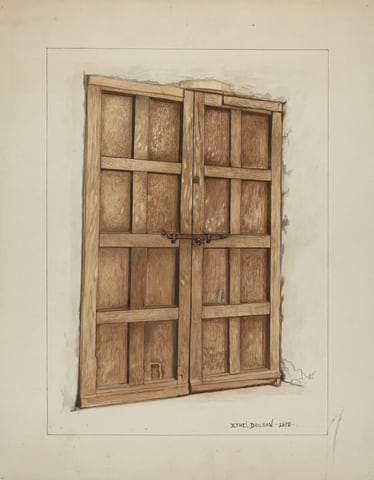
This is a drawing of a wooden window shutter in a light-colored wall. The detailed study shows the craftsmanship of the shutter, with a focus on texture, form, wood grain, and panels. The aged and weathered texture suggests exposure to the elements. The shutter is secured with a metal latch in the center. The wall is subtly shaded to imply depth and setting, with slight distress marks adding to the aged ambiance of the scene.
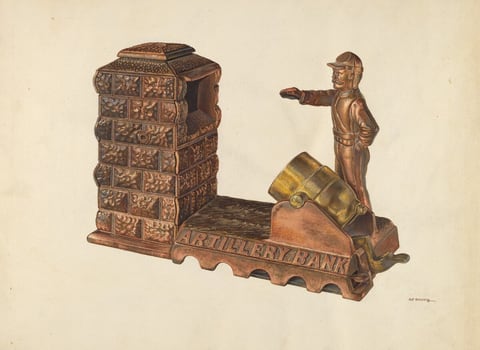
The image displays a vintage mechanical bank with a brick-patterned tower on the left and a soldier figure on the right, prepared to operate a cannon. The color scheme is mainly earthy tones including brown, bronze, and hints of gold, creating a retro metallic appearance. The label "ARTILLERY BANK" is engraved on the base in front of the cannon.
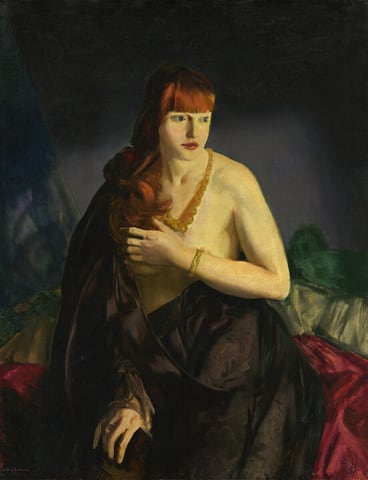
Shown from the knees up, a woman sits partially covered by a black cloth as she holds one forearm across her bare breasts in this vertical painting. The woman has pale, yellow-tinged skin and long, copper-red hair and bangs. Her body faces us, but she turns her head to look off to our right with large blue, wide-set eyes. Her cheeks are flushed, and her full, dark pink lips are closed. A strand of gradually larger amber-yellow beads hangs around her neck, and she wears a gold-colored bracelet on the arm braced across her chest, her left arm, to our right. Glimpses of pale pink nipples are visible. The voluminous black cloth drapes down over one shoulder and across her hips. She wears a ring on the other hand, which emerges from the cloth to rest on that knee. Piles of garnet red, peridot green, and forest green are piled up to chest height behind her, and the background is nickel gray around her body and darkens to black around the top and side edges. The scene is loosely painted, especially in the fabric and background. The artist signed the canvas in the lower left corner, “Geo. Bellows E.S.B.”

The works in this room are listed below.

Works in this room

Works made in the United States in the 20th century.

Section 1, north wall

  1. The Stubble Field, by Henry Golden Dearth, c. 1909
    The Stubble FieldHenry Golden Dearth, c. 1909Courtesy of the Cleveland Museum of Art
  2. This is a drawing of a wooden window shutter in a light-colored wall. The detailed study shows the craftsmanship of the shutter, with a focus on texture, form, wood grain, and panels. The aged and weathered texture suggests exposure to the elements. The shutter is secured with a metal latch in the center. The wall is subtly shaded to imply depth and setting, with slight distress marks adding to the aged ambiance of the scene.
    Sacristy Door at Mission San Juan BautistaEthel Dougan, 1938Courtesy National Gallery of Art, Washington

Section 1, south wall

  1. The image displays a vintage mechanical bank with a brick-patterned tower on the left and a soldier figure on the right, prepared to operate a cannon. The color scheme is mainly earthy tones including brown, bronze, and hints of gold, creating a retro metallic appearance. The label "ARTILLERY BANK" is engraved on the base in front of the cannon.
    Mechanical Artillery BankAlf Bruseth, c. 1940Courtesy National Gallery of Art, Washington
  2. Shown from the knees up, a woman sits partially covered by a black cloth as she holds one forearm across her bare breasts in this vertical painting. The woman has pale, yellow-tinged skin and long, copper-red hair and bangs. Her body faces us, but she turns her head to look off to our right with large blue, wide-set eyes. Her cheeks are flushed, and her full, dark pink lips are closed. A strand of gradually larger amber-yellow beads hangs around her neck, and she wears a gold-colored bracelet on the arm braced across her chest, her left arm, to our right. Glimpses of pale pink nipples are visible. The voluminous black cloth drapes down over one shoulder and across her hips. She wears a ring on the other hand, which emerges from the cloth to rest on that knee. Piles of garnet red, peridot green, and forest green are piled up to chest height behind her, and the background is nickel gray around her body and darkens to black around the top and side edges. The scene is loosely painted, especially in the fabric and background. The artist signed the canvas in the lower left corner, “Geo. Bellows E.S.B.”
    Nude with Red HairGeorge Bellows, 1920Courtesy National Gallery of Art, Washington

Section 2, south wall
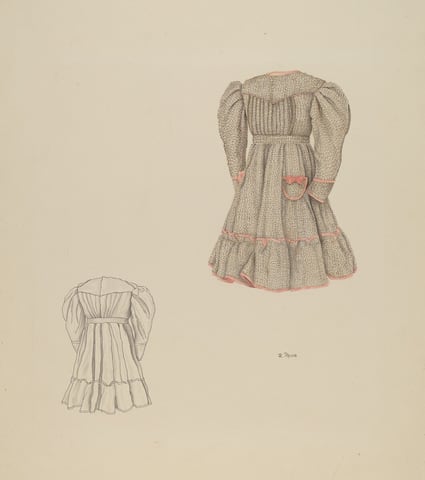
  1. The image depicts a detailed illustration of a dress with exaggerated puff sleeves and ruffles towards the bottom. It is created using a dotted pattern with red accents around the edges and seams. The color palette consists of mostly muted tones with touches of red. The dress is positioned in the upper right quadrant of the image, while a smaller, less detailed sketch of the same dress without colors is located in the lower left quadrant.
    Child's DressRay Price, c. 1937Courtesy National Gallery of Art, Washington
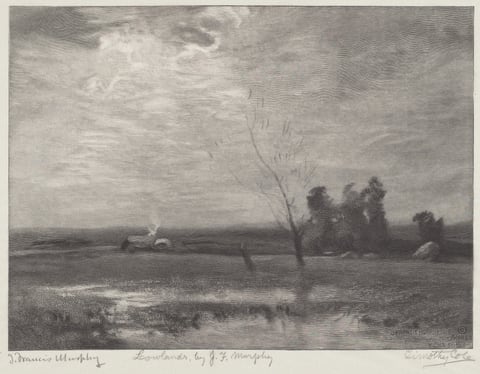
  2. This print displays a landscape with a wide view of flat land stretching towards the horizon. The ground is covered in small black dots, with some bare patches in the bottom center. A few silhouetted trees and a hint of smoke coming up from behind some rocks are visible in the distance. The gray sky dominates the scene with soft, swirling clouds.
    LowlandsTimothy Cole, 1918Courtesy National Gallery of Art, Washington

Section 2, north wall
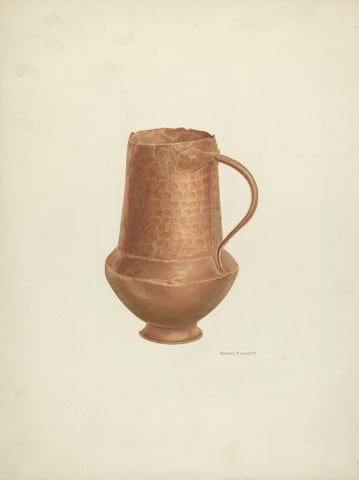
  1. The image shows a large, copper-colored pitcher with a hammered texture and a curving handle on the right side. The color palette consists of muted, warm tones of copper and brown against a pale beige background. The pitcher is centrally placed in the image, with its handle positioned on the right side.
    Copper CruetEdward Jewett, 1937Courtesy National Gallery of Art, Washington
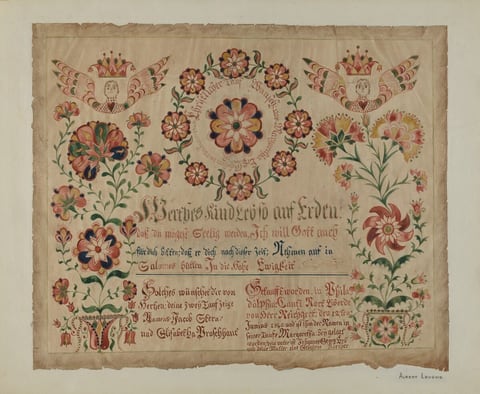
  2. This is a painting of a colorful floral design with text. The artwork features stylized flowers in shades of red, green, and yellow scattered across the page. In the center, there is calligraphic text in varying boldness and fonts, likely in German. Two symmetrical bird-like figures with human faces and crowns are above the text. The piece combines imagery with artistic lettering in a style reminiscent of traditional Pennsylvania German fraktur. The artwork is bordered by a thin line, suggesting it's part of a larger artifact or document.
    Pa. German Birth CertificateAlbert Levone, c. 1940Courtesy National Gallery of Art, Washington
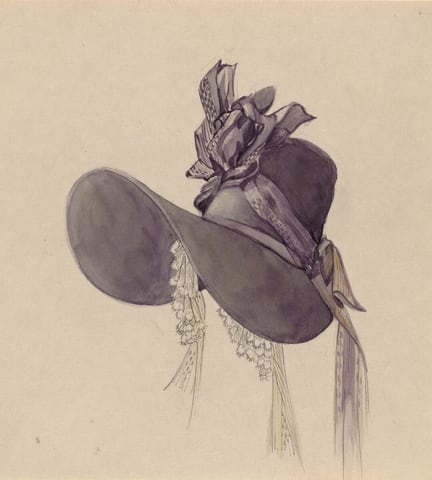
  3. The image shows a large hat with a broad brim, decorated with a ribbon and floral or lace-like embellishments. The color palette consists of shades of gray and soft purples. The hat is centered in the frame, with its brim curving to the left and the decorative elements extending to the sides.
    BonnetRosalia Lane, 1935/1942Courtesy National Gallery of Art, Washington

Section 3, north wall
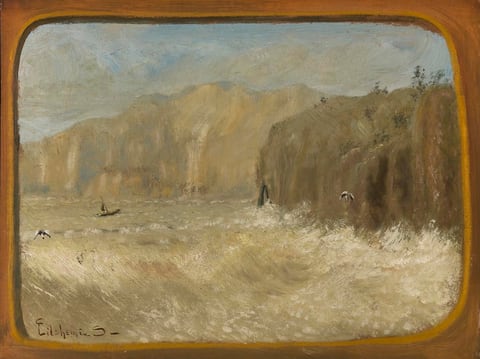
  1. Two Gulls and Cliffs, by Louis M. Eilshemius, ca. 1913-1921
    Two Gulls and CliffsLouis M. Eilshemius, ca. 1913-1921Courtesy of the Smithsonian American Art Museum
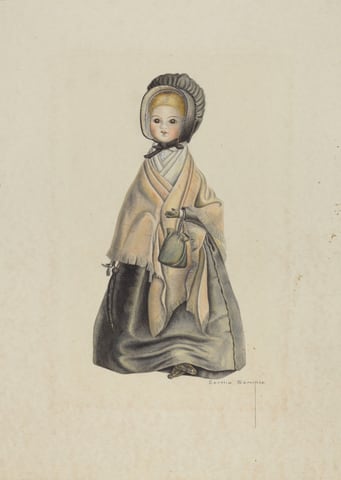
  2. The image displays a full-body illustration of a person standing upright. They have a delicate and round face with rosy cheeks and small, pink lips. Their eyes are large and expressive, and they have light-colored hair peeking out from under a bonnet. The person's attire consists of a long, dark skirt and a light-colored shawl draped over their shoulders. They wear a hooded cloak tied with a bow at the neck, and hold a small bag in their left hand. The background is plain with a light-colored texture. The artwork is a painted illustration with visible fine lines and shading to enhance details of the clothing and facial features.
    Quaker DollBertha Semple, 1935/1942Courtesy National Gallery of Art, Washington
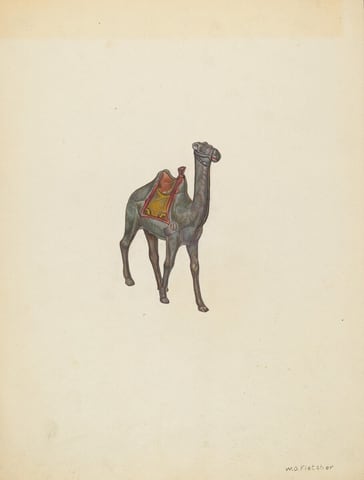
  3. This is a painting of a camel with a colorful saddle. The camel is centered in the image, standing against a plain, light-colored background. The animal is drawn with careful attention to detail, showcasing its distinctive humps, elongated neck, and slender legs. It is adorned with a vibrant saddle that features bright orange and red tones. The simplicity of the background emphasizes the camel.
    Bank CamelWilliam O. Fletcher, c. 1940Courtesy National Gallery of Art, Washington

Section 3, south wall
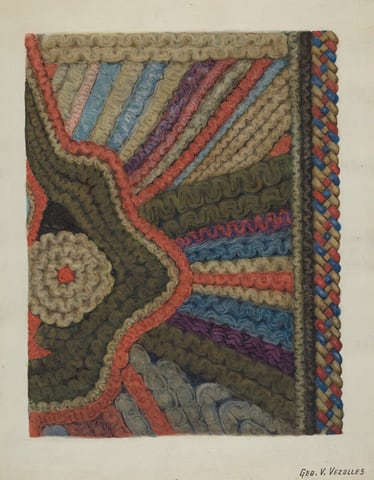
  1. The image displays wavy lines and shapes with a mix of colors, creating an abstract composition. Curved lines are intertwined, resembling braided patterns or woven fabric textures. On the left, there is a large, organic shape bordered by red, green, and beige. The right side showcases a rhythmic pattern resembling a braided rug, with strands of red, blue, and brown. The overall composition resembles a textured textile piece.
    Shaker Woolen RugGeorge V. Vezolles, 1935/1942Courtesy National Gallery of Art, Washington
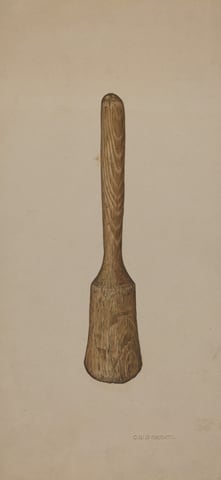
  2. A wooden mallet is displayed on a beige background. The mallet has a rounded handle and a broad head, showcasing earthy brown tones with variations in the wood grain. Positioned centrally, the mallet stands upright in the image.
    Potato MasherClarence W. Dawson, c. 1940Courtesy National Gallery of Art, Washington
Section 4, south wall

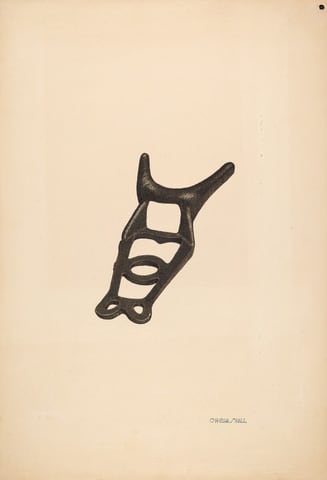
  1. This is a drawing of an abstract shape or artifact. The image features a central black object positioned against a plain, light-colored background. The object has a slightly irregular, elongated triangular form with rounded edges and contours. It includes a series of geometric holes and protrusions. The subtle shadowing suggests a three-dimensional form, yet the drawing maintains a simplicity that emphasizes the object's unique contours and cutouts.
    BootjackClaude Marshall, c. 1940Courtesy National Gallery of Art, Washington
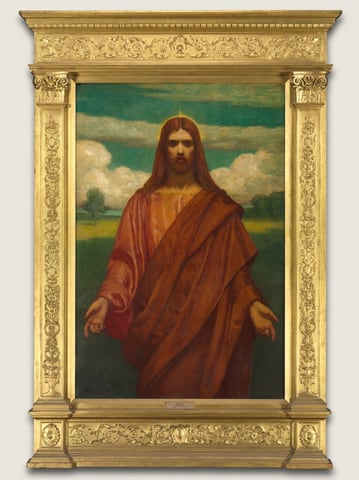
  2. Christ, by Kenyon Cox, 1905
    ChristKenyon Cox, 1905Courtesy of the Cleveland Museum of Art