Floor plan

Artist galleriesJohann Michael Rottmayr's contemporaries
Johann Michael Rottmayr's contemporaries
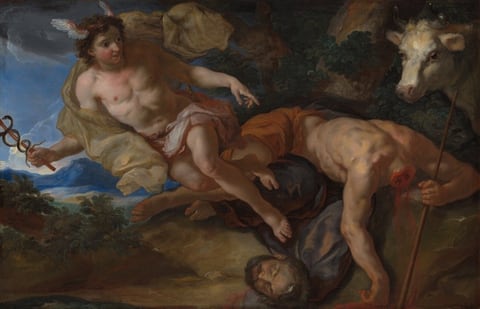
A work made of oil on canvas.
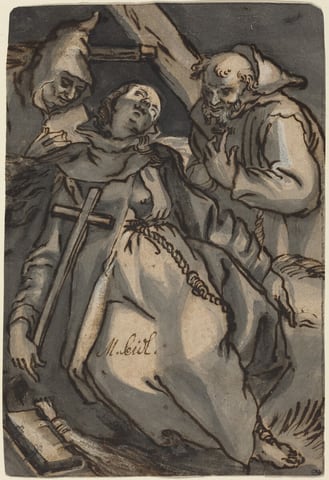
The image displays three figures. The central figure is seated and supported by the other two. The central figure has wavy dark hair, eyes closed, and wears a robe with a cross. The figure on the left looks serene, while the one on the right holds onto the cross. The background is sketchy with dark and light contrast, possibly depicting a dimly lit or nighttime setting with visible wooden beams.
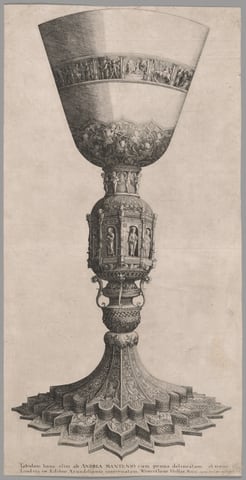
A work made of etching on ivory laid paper.
A work made of etching in black on ivory wove paper.
Portrait of Gerard de Lairesse, by Rembrandt van Rijn, 1665–67
A work made of pen and brown ink, with traces of black chalk, on cream laid paper.
A work made of ink on paper.
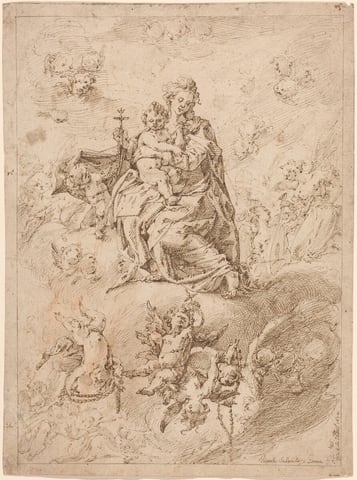
The image depicts a woman seated with a child in her lap. The woman looks down at the child, who has curly hair. Both figures are intricately drawn in a detailed line drawing style. The woman wears a headdress and flowing garment, holding a cross-topped staff. The child clutches her arm. Surrounding them are cloud-like forms and cherubic figures with wings, some holding rosary beads. In the background, more clouds and angelic faces are sketched.

The works in this room are listed below.

Works in this room

A few works by Johann Michael Rottmayr, then their contemporaries: makers of the same nationality born within 25 years of them, then works from the same century and place.

With their contemporaries

  1. A work made of oil on canvas.
    Mercury Rescues the Disguised Io after Beheading ArgusJohann Michael Rottmayr, c. 1695Courtesy of the Art Institute of Chicago
  2. The image displays three figures. The central figure is seated and supported by the other two. The central figure has wavy dark hair, eyes closed, and wears a robe with a cross. The figure on the left looks serene, while the one on the right holds onto the cross. The background is sketchy with dark and light contrast, possibly depicting a dimly lit or nighttime setting with visible wooden beams.
    Saint EuphrosyneMelchior Steidl, c. 1695Courtesy National Gallery of Art, Washington
  3. A work made of etching on ivory laid paper.
    A ChaliceWenceslaus Hollar, 1640Courtesy of the Art Institute of Chicago
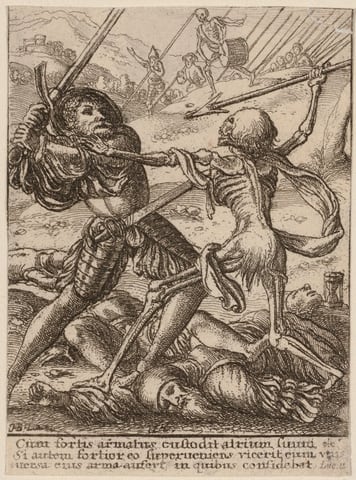
  4. A work made of etching in black on ivory wove paper.
    The Knight and Death, from The Dance of DeathWenceslaus Hollar, 1651Courtesy of the Art Institute of Chicago

Their contemporaries

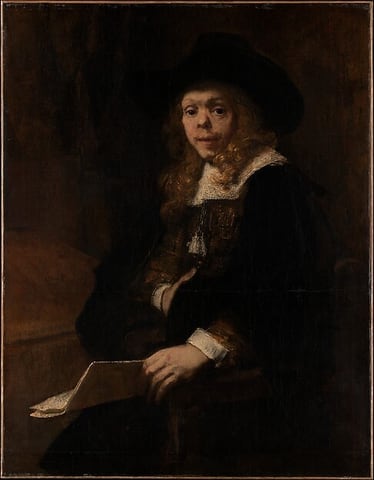
  1. Portrait of Gerard de Lairesse, by Rembrandt van Rijn, 1665–67
    Portrait of Gerard de LairesseRembrandt van Rijn, 1665–67Courtesy of The Metropolitan Museum of Art
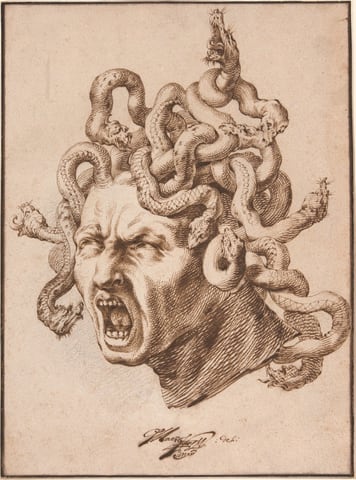
  2. A work made of pen and brown ink, with traces of black chalk, on cream laid paper.
    Head of MedusaGodfried Maes, 1680Courtesy of the Art Institute of Chicago
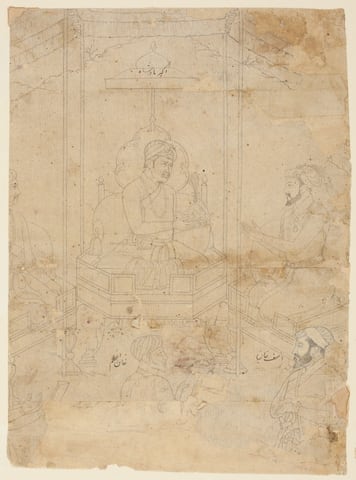
  3. A work made of ink on paper.
    Akbar Offering Timur's Crown to Shah JahanIslamic, Mughal period (1526–1857), ca. 1650–1700Courtesy of the Art Institute of Chicago
  4. The image depicts a woman seated with a child in her lap. The woman looks down at the child, who has curly hair. Both figures are intricately drawn in a detailed line drawing style. The woman wears a headdress and flowing garment, holding a cross-topped staff. The child clutches her arm. Surrounding them are cloud-like forms and cherubic figures with wings, some holding rosary beads. In the background, more clouds and angelic faces are sketched.
    The Madonna of the RosaryVicente Salvador Gómez, 1674Courtesy National Gallery of Art, Washington