Floor plan

Artist galleriesIslamic's contemporaries
Islamic's contemporaries
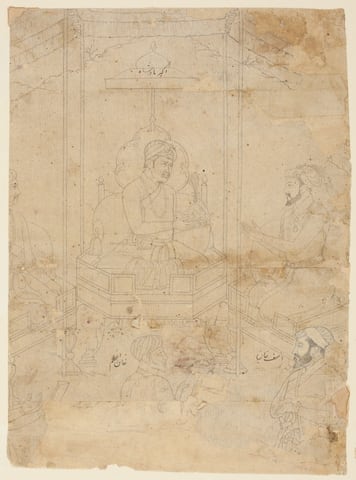
A work made of ink on paper.
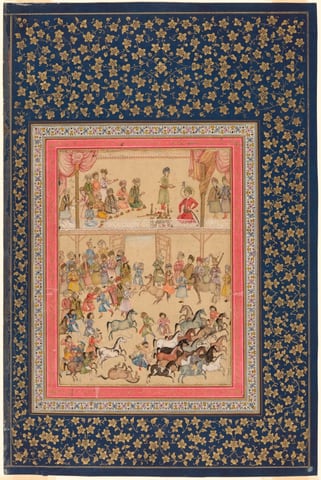
Watercolor of tiny people and horses, framed with gold flowers on navy background.
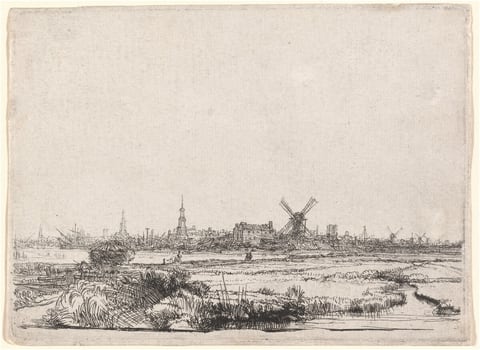
View of Amsterdam from the Northwest, by Rembrandt van Rijn, c. 1640
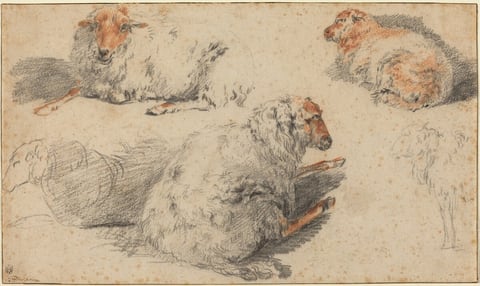
This is a drawing of multiple sheep in various poses. The full-page illustration depicts several sheep lying down. The fur of the sheep is textured with detailed pencil strokes, and there are subtle hints of shadow beneath each animal. There is a combination of different angles and poses, showing the sheep from different perspectives. The drawing also contains some rough sketches and outlines, suggesting movement and presence without complete detail. The background is plain.
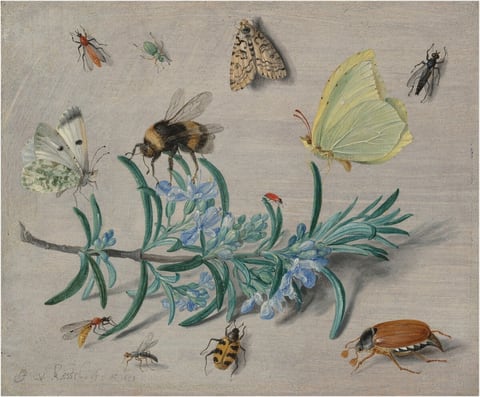
A sprig of flowering rosemary lying against an ivory-white background and the twelve insects that surround it fills this horizontal painting. Stretching nearly the length of the composition with the cut end to our left, the rosemary has blunted, needle-like, gently curling teal-green leaves and small periwinkle-blue flowers along the ash-brown stem. Several insects perch on the sprig while others are seen as if looking from overhead, resting on the white background. The three largest insects perch along the top of the sprig, with an ivory-white butterfly with moss-green and black markings to the left, a black and golden, fuzzy bumblebee near the center, and a lemon-yellow butterfly with red antennae to our right. A tiny red insect, perhaps a ladybug without spots, sits on a leaf between the bee and yellow butterfly, and a small wasp-like insect rests on a leaf in at the lower left. Another mosquito-like insect alights on the surface nearby, next to a beetle with a honey-orange body with black, almost tiger-like stripes. A large cockroach sitting near the lower right corner has six spindly legs, a mahogany-colored abdomen, a black thorax, and tiny, black head. Spaced somewhat evenly across the top of the panel are a brick-red, winged insect to the left, a mint-green, beetle-like bug near a moth patterned with bone white and black, and a black, fly-like insect to our right. Lit from the upper left, the rosemary and insects cast shadows on the surface. The artist signed and dated the work with gray in the lower left corner: “J v. kessel . . f. Ao 1653.”
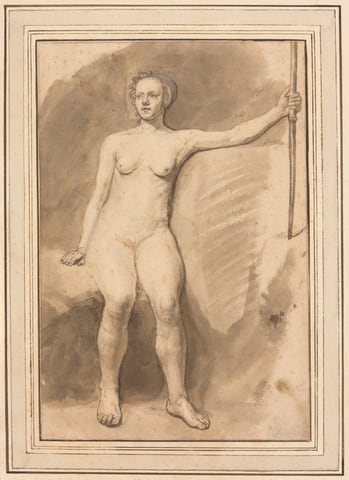
A work made of pen and brown ink and brush and brown wash, with traces of black chalk and opaque white watercolor, on cream laid paper, laid down on cream laid paper.
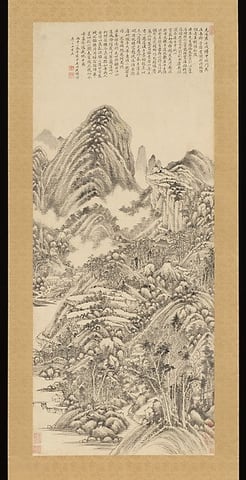
Landscape in the style of Huang Gongwang, by Wang Shimin, 1666
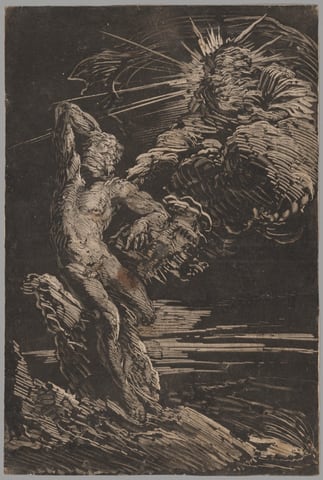
Drawing of god, radiating light, reaching down from clouds, touching male figure.

The works in this room are listed below.

Works in this room

A few works by Islamic, then their contemporaries: makers of the same nationality born within 25 years of them, then works from the same century and place.

With their contemporaries

  1. A work made of ink on paper.
    Akbar Offering Timur's Crown to Shah JahanIslamic, Mughal period (1526–1857), ca. 1650–1700Courtesy of the Art Institute of Chicago
  2. Watercolor of tiny people and horses, framed with gold flowers on navy background.
    Royal Horse Inspection'Aliquli Jabbadar, Safavid dynasty (1501–1722), late 17th centuryCourtesy of the Art Institute of Chicago
  3. View of Amsterdam from the Northwest, by Rembrandt van Rijn, c. 1640
    View of Amsterdam from the NorthwestRembrandt van Rijn, c. 1640Courtesy National Gallery of Art, Washington
  4. This is a drawing of multiple sheep in various poses. The full-page illustration depicts several sheep lying down. The fur of the sheep is textured with detailed pencil strokes, and there are subtle hints of shadow beneath each animal. There is a combination of different angles and poses, showing the sheep from different perspectives. The drawing also contains some rough sketches and outlines, suggesting movement and presence without complete detail. The background is plain.
    SheepNicolaes BerchemCourtesy National Gallery of Art, Washington

Their contemporaries

  1. A sprig of flowering rosemary lying against an ivory-white background and the twelve insects that surround it fills this horizontal painting. Stretching nearly the length of the composition with the cut end to our left, the rosemary has blunted, needle-like, gently curling teal-green leaves and small periwinkle-blue flowers along the ash-brown stem. Several insects perch on the sprig while others are seen as if looking from overhead, resting on the white background. The three largest insects perch along the top of the sprig, with an ivory-white butterfly with moss-green and black markings to the left, a black and golden, fuzzy bumblebee near the center, and a lemon-yellow butterfly with red antennae to our right. A tiny red insect, perhaps a ladybug without spots, sits on a leaf between the bee and yellow butterfly, and a small wasp-like insect rests on a leaf in at the lower left. Another mosquito-like insect alights on the surface nearby, next to a beetle with a honey-orange body with black, almost tiger-like stripes. A large cockroach sitting near the lower right corner has six spindly legs, a mahogany-colored abdomen, a black thorax, and tiny, black head. Spaced somewhat evenly across the top of the panel are a brick-red, winged insect to the left, a mint-green, beetle-like bug near a moth patterned with bone white and black, and a black, fly-like insect to our right. Lit from the upper left, the rosemary and insects cast shadows on the surface. The artist signed and dated the work with gray in the lower left corner: “J v. kessel . . f. Ao 1653.”
    Insects and a Sprig of RosemaryJan van Kessel the Elder, 1653Courtesy National Gallery of Art, Washington
  2. A work made of pen and brown ink and brush and brown wash, with traces of black chalk and opaque white watercolor, on cream laid paper, laid down on cream laid paper.
    Seated Female NudeSamuel van Hoogstraten, 1647/78Courtesy of the Art Institute of Chicago
  3. Landscape in the style of Huang Gongwang, by Wang Shimin, 1666
    Landscape in the style of Huang GongwangWang Shimin, 1666Courtesy of The Metropolitan Museum of Art
  4. Drawing of god, radiating light, reaching down from clouds, touching male figure.
    The Creation of AdamGiovanni Benedetto Castiglione, c. 1645/50Courtesy of the Art Institute of Chicago